Biomedical engineering PhD students win research fellowships to study spinal-cord injuries
Chen Lin ’24 and Zuer Wu ’24 both began projects while earning undergraduate biology degrees at Binghamton
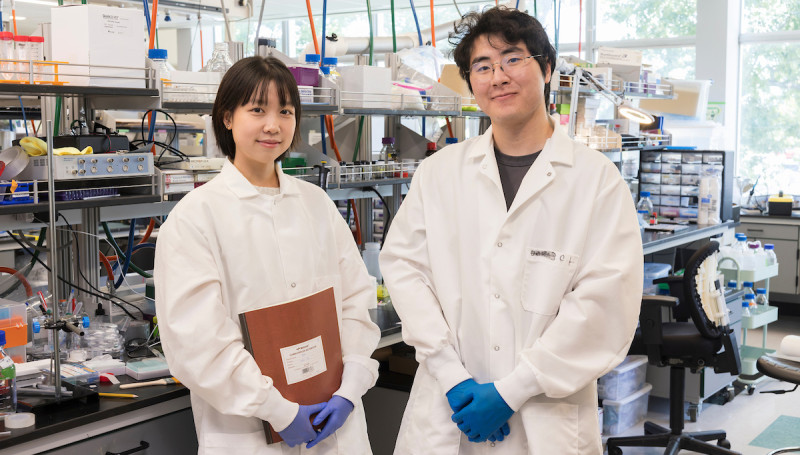
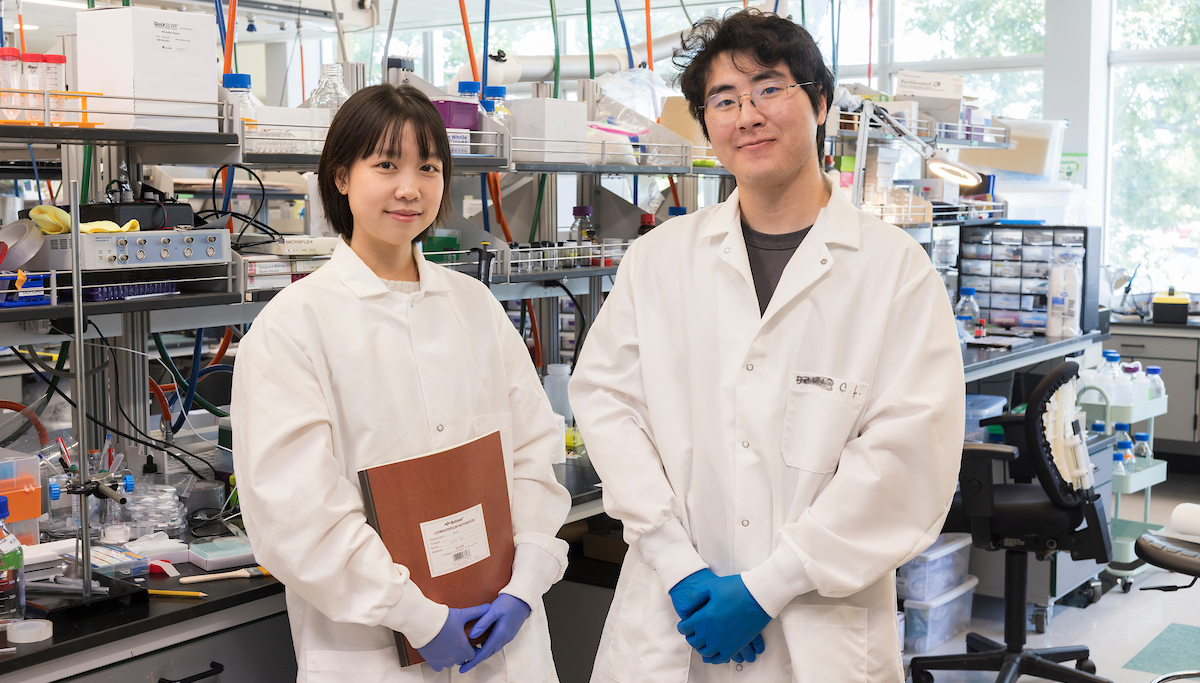
Two Binghamton University biomedical engineering doctoral students have received prestigious fellowships that will fund their research into spinal-cord injuries.
Chen Lin ’24 won the Ruth L. Kirschstein National Research Service Award Individual Predoctoral Fellowship from the National Institutes of Health, and Zuer Wu ’24 was awarded a predoctoral fellowship from the New York State Department of Health.
Both majored in biological sciences as undergraduates and are now third-year PhD students at Assistant Professor Siyuan Rao’s Neurobiological Interfaces Lab at the Thomas J. Watson College of Engineering and Applied Science’s Department of Biomedical Engineering.
“It’s very exciting when the work we do attracts this level of attention for our students,” Rao said. “These fellowships are designed to foster future leaders in the biomedical engineering field, and both Chen and Zuer work very hard and productively in our lab.”
Lin’s fellowship will focus on developing a better method to produce hydrogel-based bioelectronics for recording neural signals. Currently, the process to make the hair-thin, soft, and stretchable sensors requires a cleanroom, but microprinting could reduce the cost by eliminating that need.
Lin also is interested in the business side of new technology and is part of the University’s Excellence in Entrepreneurship and Discovery (EXCEED) program, which is supported by the National Science Foundation.
“I felt like many researchers nowadays are only focusing on the lab. They are inventing something really cool, but they are only using it within their own lab,” he said. “It should be open to the public, other people should know the technology exists, and you should be able to invest in it. Building a translational effort into the project would be great to making the product more visible.”
For her fellowship, Wu will continue to develop a soft, flexible hydrogel-based device to study single neurons deep within the spinal cords of freely moving mice. The device can stimulate neurons using light (optogenetics) and record their electrical activity over weeks. The goal is to provide a detailed, cell-type-specific view of spinal-cord function and recovery after injury, which is not possible with conventional techniques.
“Our multifunctional neural probe incorporates a lot of different functionalities — it can transmit lights, it can measure the electrical signals, and it can do long-term repeatable drug delivery,” she said. “It's a three-in-one tool, and most importantly, it’s soft, which allows it to stay in the mouse spinal cord for a long time.”
Earlier this year, Wu won special recognition for her work at the Watson GROWS (Graduate Research Outcomes Workshop Series) symposium and poster competition.