Binghamton team brought art, research, and a new path to Bethel Woods Center for the Arts
Students, faculty, and alumni transformed an architectural installation through trails, performance, projection, and sound at the historic Woodstock site
At the start, no one knew where the trail would go. It was decided one footstep at a time, by participants walking through the woods where the 1969 Woodstock festival took place.
From Sept. 9 through 13, Binghamton University students, faculty, and alumni joined artists, designers, and builders from across the country for the Bethel Woods Art & Architecture Festival, known as BuildFest. This year marked Binghamton’s first year at the event, which also drew teams from Cornell, UCLA, Pratt Institute, and Rensselaer Polytechnic Institute.
“The idea of camping, eating together, building with an engineering school [Rensselaer Polytechnic Institute], and doing our own work in the woods is fantastic,” said Christopher Robbins, founding director of the School of the Arts. “It’s an intense adventure that helps students connect across disciplines.”
At the heart of it all sits an experiment: the Purple Path, a trail where people with different political views can walk, talk, and maybe find common ground. The idea traces back to Shay Rabineau, associate professor of Israel studies, who has spent years studying the history and politics of hiking trails in Israel and Palestine. He has worked on trail development with Palestinian partners in the West Bank and knows firsthand that a path can do one of two things: deepen a divide or open a door.
After connecting with Bethel Woods about the Purple Path, Rabineau collaborated with colleague Sarah Nance, associate professor of integrated practice in the Department of Art and Design. Her fiber-based work already uses a language of lines, loops and landscapes, making trails a natural fit.
Going into BuildFest, the path had no planned route. Rabineau and Nance worked with participants, beginning with a loose starting point and a destination, letting the rest unfold. Decisions were marked by stakes topped with survey tape, which were then mapped into a digital point cloud.
This isn’t Nance’s first walking experiment. Last spring, she ran a version on Binghamton's campus with 12 students, six walking clockwise and six counterclockwise, alternating between passing on the inside and on the outside. GPS traces turned their movements into a woven three-dimensional form, time rising as the vertical axis.
At Bethel Woods, she let go of the outcome entirely.
“I hope people become more aware of how they’re moving through a landscape, how they’re making the choices that they’re making, and when those choices become individual — when it becomes collective,” Nance said.
Building and performing in the trees
Binghamton’s team also joined students and faculty from Rensselaer Polytechnic Institute to build Flying Buttruss, an illuminated, suspended structure pieced together from the bones of a previous BuildFest installation. The project responded to this year’s theme, “Staging,” which asks teams to build with future uses in mind.
Four Binghamton alumni returned to restage a piece first developed in Robbins’ Do It Wrong on Purpose course: Claire Goldstein ’24, a psychology major with a minor in painting; Kelly Fancher, MFA ’25, in cinema; Sydney Ferreira ’24, MBA ’25, who studied anthropology as an undergraduate; and Margo MacWilliams, BFA ’25, in art and design.
The performers stitched red thread through fabric near the places on their bodies where they carry memories of pain. As recorded personal stories overlap, they gradually became entangled, literally sewn together by thread and story. At BuildFest, they introduced a new element by weaving in stories gathered from other participants.
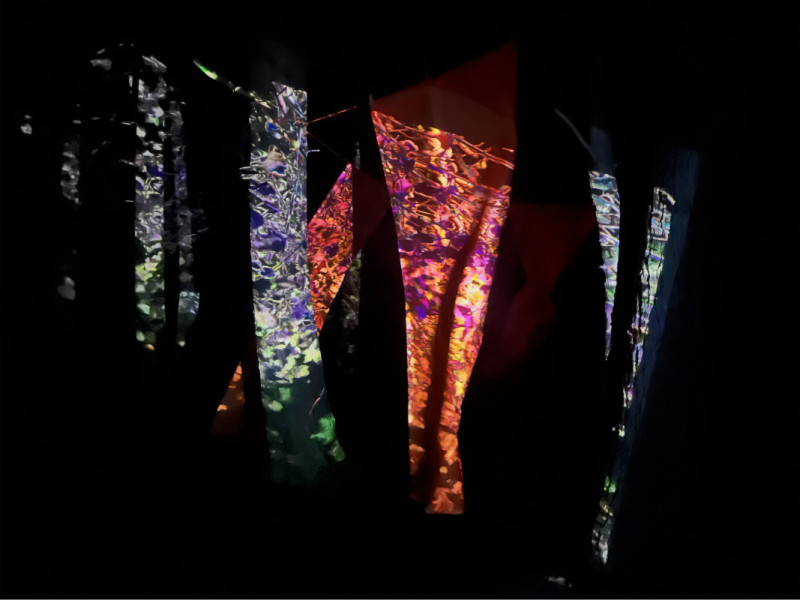
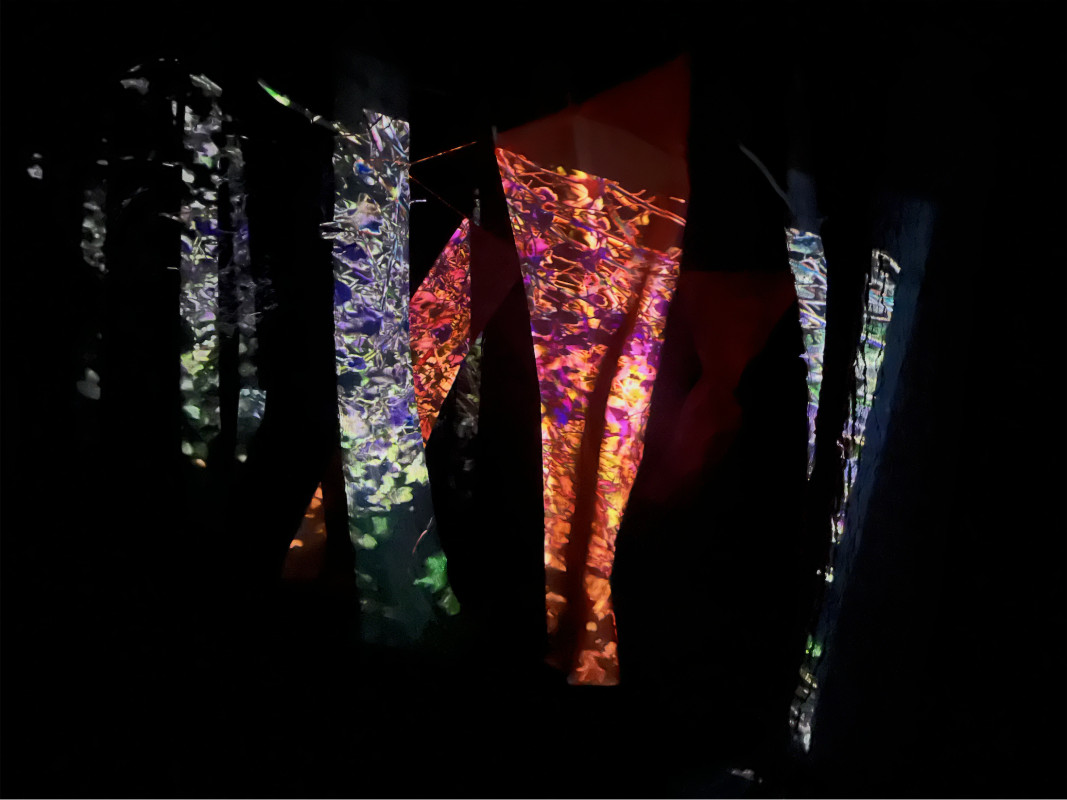
Binghamton University Cinema alumnus Andrew Frangella ‘24 also participated, scattering fragments of a projection screen through the woods, burying interactive elements along a path, and turning unfamiliar footage of trees into a moving-image trail of its own. Music composition graduate student Skylar Warren ’27 used the experience as inspiration for a piece to be performed at a future BuildFest.
For Rabineau, the project’s collaborative nature reflected the site's history, in which music and art offered new ways of thinking during a time of war and division.
“Creativity should be giving us new ways forward,” he said. “You have to keep on trying.”