Naming of Watson College’s Acoustics Core honors longtime professor and his groundbreaking research
Alumni support future research with financial gift in recognition of Distinguished Professor Ronald N. Miles' work
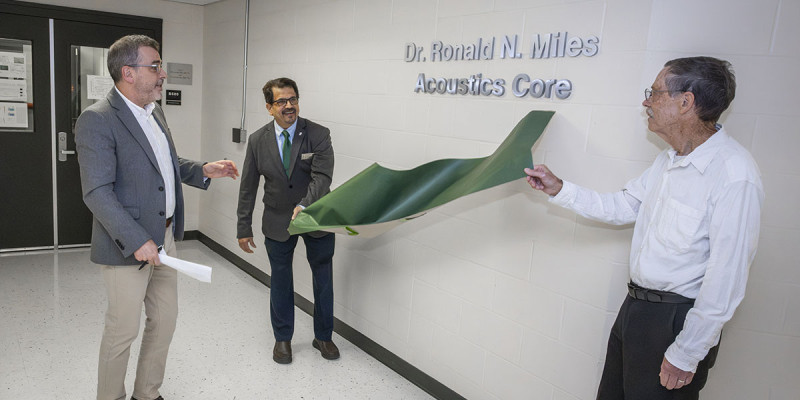
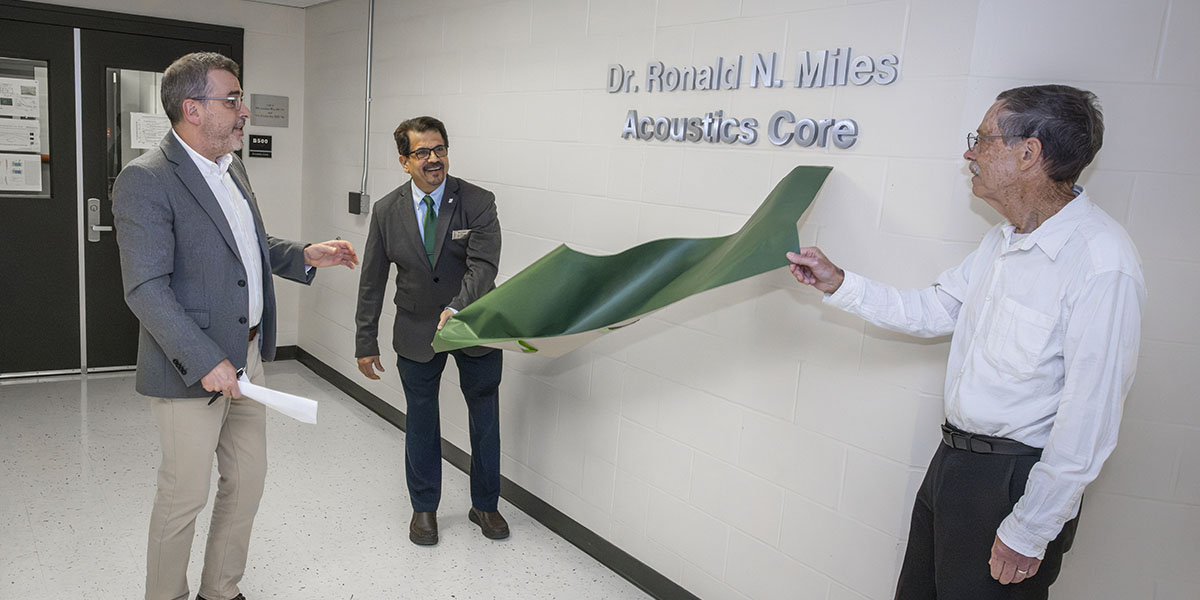
A gift from two Binghamton University alumni honors a longtime professor and his research into the mechanics of sound and vibration, with a lab dedicated in his name.
The Ronald N. Miles Acoustics Core honors the SUNY distinguished professor at the Thomas J. Watson College of Engineering and Applied Science’s Department of Mechanical Engineering whose work in mechanics, acoustics, vibrations, microelectromechanical systems, neurobiology, and control systems has led to breakthroughs in advanced microacoustic sensors.
The endowment from Yanchu Xu, PhD ’94, and Jianhua Wu, MS ’95, will support future research in the Acoustics Core, located in the Engineering and Science Building at the University’s Innovative Technologies Complex.
The lab includes an anechoic chamber, which was engineered and built to block out all external sound. To mitigate all vibrations, the room sits on springs so it’s not connected to the building. Having the chamber sets Binghamton apart from peer institutions and allows for a wider range of research.
Devices from Miles’ lab have been integrated into many applications, including consumer electronics, lab instrumentation, automotive, hearing aids, and other healthcare applications.
After earning his bachelor’s and master’s degrees in Nanjing, China, Xu came to Binghamton as one of Miles’ first doctoral students at a time when opportunities for Chinese students in the U.S. were rarer than they are today.
Xu recalled their early research into how insects hear, which has led to sensor technology based on the vibration-sensing abilities of flies and spiders.
“At the time, I certainly could not have imagined where that research might eventually lead. Today, it is remarkable to see how those ideas have developed into microacoustic sensing technologies with the potential to improve hearing technology and help people with hearing difficulties,” he said.
“That, to me, is also a wonderful example of why fundamental research matters. We do not always know at the beginning where an interesting scientific question may eventually take us.
Alongside Miles’ accomplishments in acoustics, Xu also appreciates the way he approached research and mentorship.
“He created an environment with high standards, intellectual curiosity, and real purpose,” he said. “He respected independent thinking while still expecting rigor. I valued that very much then, and I continue to value it today.”
Xu is a senior technologist for noise and vibration at Apple, where he has worked since 2012. He held previous positions at Hitachi GST, SAE Magnetics Ltd., and Maxtor, as well as an assistant professor at the Shanghai Institute of Mechanical Engineering. In addition to the Acoustics Core, he has supported the Mechanical Engineering Department and the Binghamton Fund for Watson College.
At a dedication ceremony on Monday, a humble Miles praised Xu and how he ran through all the doors that opened when he came to the U.S., education-wise and career-wise.
“Teachers like us learn a lot of important things from our students, even though we spend all our time harassing them with little details," he said. "Thirty years later, the stuff that really matters is the stuff that you remember, and it's more about how you live. …
"You don't have to be a genius. You just have to take advantage of good opportunities that come to you. That's the lesson that he taught me, and I hope it can be learned by lots of other people.”
Watson College Dean Atul Kelkar thanked Xu and Wu for their generosity and said that Miles' legacy will inspire generations of engineers in the years ahead.
“Every student who walks through these doors will not only have access to world-class equipment, but they will be reminded of the power of mentorship,” he said. “They will see that the relationships built in our classrooms and labs don't just last through graduation — they shape entire careers and leave a lasting mark on the world.”