Binghamton University’s Innovative Simulation and Practice Center named a SUNY Nursing Simulation Center of Excellence
$10M investment will focus on faculty training, professional development in simulation-based education across healthcare disciplines
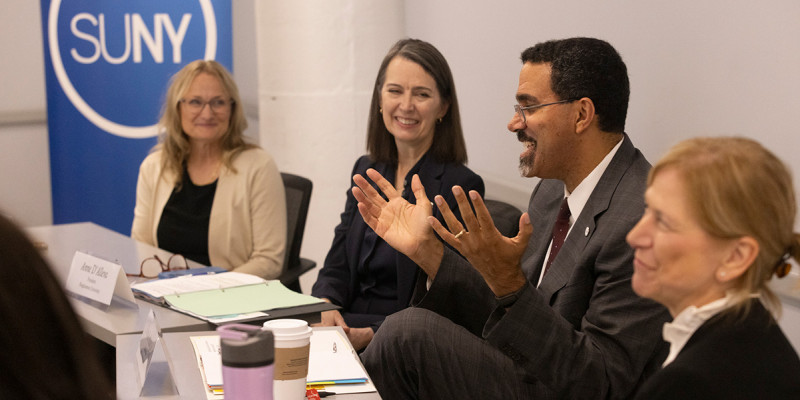
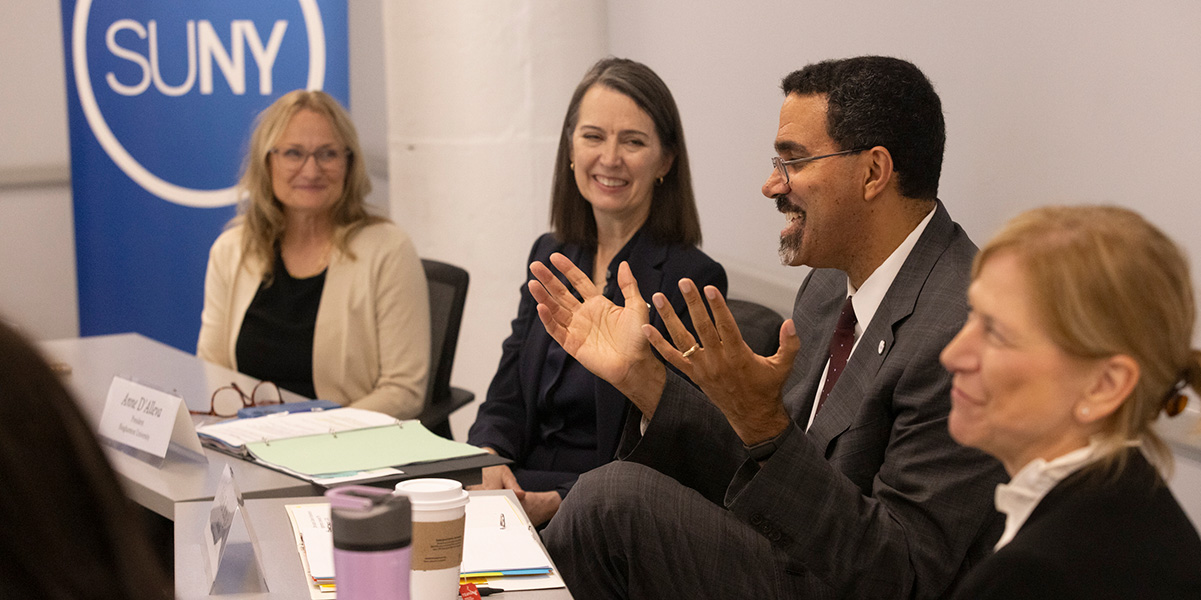
State University of New York Chancellor John B. King Jr. joined Binghamton University President Anne D’Alleva, faculty, staff, and students on Oct. 1 to announce a $10 million investment to establish a Nursing Simulation Center of Excellence at Binghamton’s Innovative Simulation and Practice Center (ISPC) at Decker College of Nursing and Health Sciences in Johnson City, New York.
“Today, the State University of New York at Binghamton joins Buffalo as a SUNY Nursing Simulation Center of Excellence. We're making these investments because we know simulation is a win-win for our students, for our communities," said King. “We're also going to create flexible pathways in simulation education, so that folks can learn more about operating a sim center, managing simulations, and how to use simulation in education.”
The $10 million investment includes $5 million in direct SUNY capital awards, with the remaining funds contributed by Binghamton University. The funding will be used to expand simulation space and experiences at the Health Sciences Building (home to Decker College) and the Binghamton University Clinical Center at Park (currently being renovated), add an artificial intelligence and virtual reality simulation room and experiences, and purchase new equipment and human-patient simulators.
“I am grateful to Governor Kathy Hochul, Chancellor King, and the SUNY Board of Trustees for choosing to invest in the Innovative Simulation and Practice Center at Decker College,” D’Alleva said. "The experiences students gain in the ISPC are an invaluable part of their education and prepare them for real-world scenarios. Decker College students graduate with confidence and skills that enable them to stand out among their peers and make a difference in their patients’ lives. I’m also appreciative of the efforts of Assemblywoman Donna Lupardo, whose legislation on expanding clinical simulation programs has greatly benefited the University in teaching the next generation of healthcare providers.”
While King and D’Alleva toured the 15,000-square-foot ISPC facility, they also observed students in simulation and practice experiences and met with nursing and physical therapy students, including Dana Kurthy, a third-year physical therapy student, and Dalila Hernandez, a senior nursing student and student worker at the ISPC.
“Decker College integrates simulation and practice experiences into the curricula for all our degree programs: nursing, occupational therapy, physical therapy, speech-language pathology, and public health,” explained Patti Reuther, Decker College assistant dean of simulation and practice and Binghamton’s director of interprofessional education, who led the tour. “This enables us to provide standardized experiences that all students should encounter before graduation, address gaps in clinical experiences, and offer opportunities to practice navigating difficult conversations and complex situations. Simulation also allows us to assess whether students are meeting educational benchmarks while building confidence and competence in essential skills and clinical judgment.”
Simulation has been an integral part of a Decker education for almost two decades, and Binghamton is the first and only SUNY institution to achieve accreditation from the Society for Simulation in Healthcare (SSH), which it earned in 2017.
“Decker College has highly-trained faculty and experts in healthcare simulation education and operations, and a demonstrated commitment to systemwide collaboration through our partnership in the SUNY Nursing Simulation Fellowship,” said Mario R. Ortiz, dean of Decker College. “Being designated a SUNY system Center of Excellence will build on and expand our role as a system leader in simulation education. By focusing on faculty training and professional development, our center will establish an exemplar model for developing a robust pipeline of healthcare educators with expertise in simulation-based education.”
Also attending the event were Valerie Grey, SUNY senior vice chancellor for academic health and hospital affairs; Kaitlyn Bertleff, SUNY associate vice chancellor for healthcare workforce and strategic initiatives; Rose Olsen, Southern Tier regional representative for Gov. Hochul; Senator Lea Webb ’04; Assemblywoman Lupardo, MA ‘83; and Sara Wozniak '06, MS '09, PhD '24, Decker College associate dean.
Designation as a simulation Center of Excellence and the investiture of funding advances Gov. Hochul’s signature legislation, enacted in May 2023, which permits nursing students to complete up to one-third of their clinical training through high-quality simulation experiences. The investment will also expand SUNY’s capacity to support the growth of healthcare education across Binghamton University and the SUNY system. Further, by leveraging Binghamton’s expertise and the center’s focus on faculty training and professional development in simulation-based education, the investment helps advance the governor’s goal of growing New York's healthcare workforce by 20%.