Lost for 100 years, Mexican composer’s music finds new life at Binghamton
Contralto Brenda Iglesias to revive the music of Gustavo Campa for Oct. 24 recital and future book
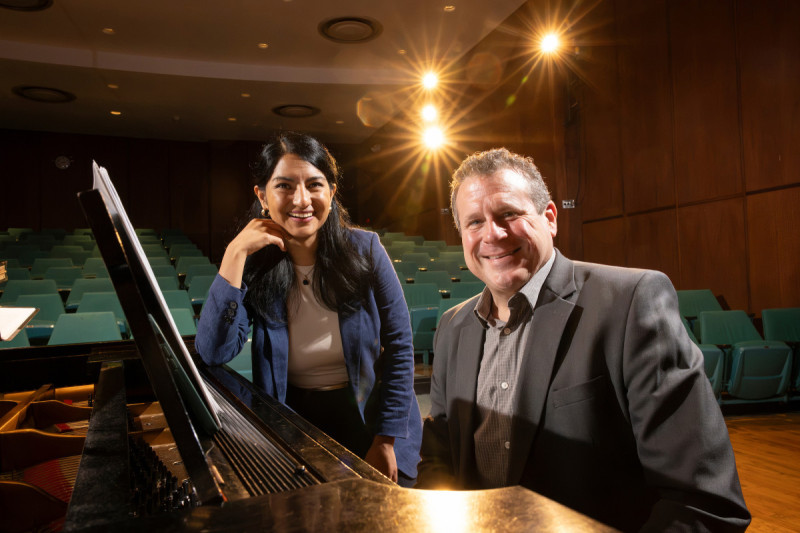
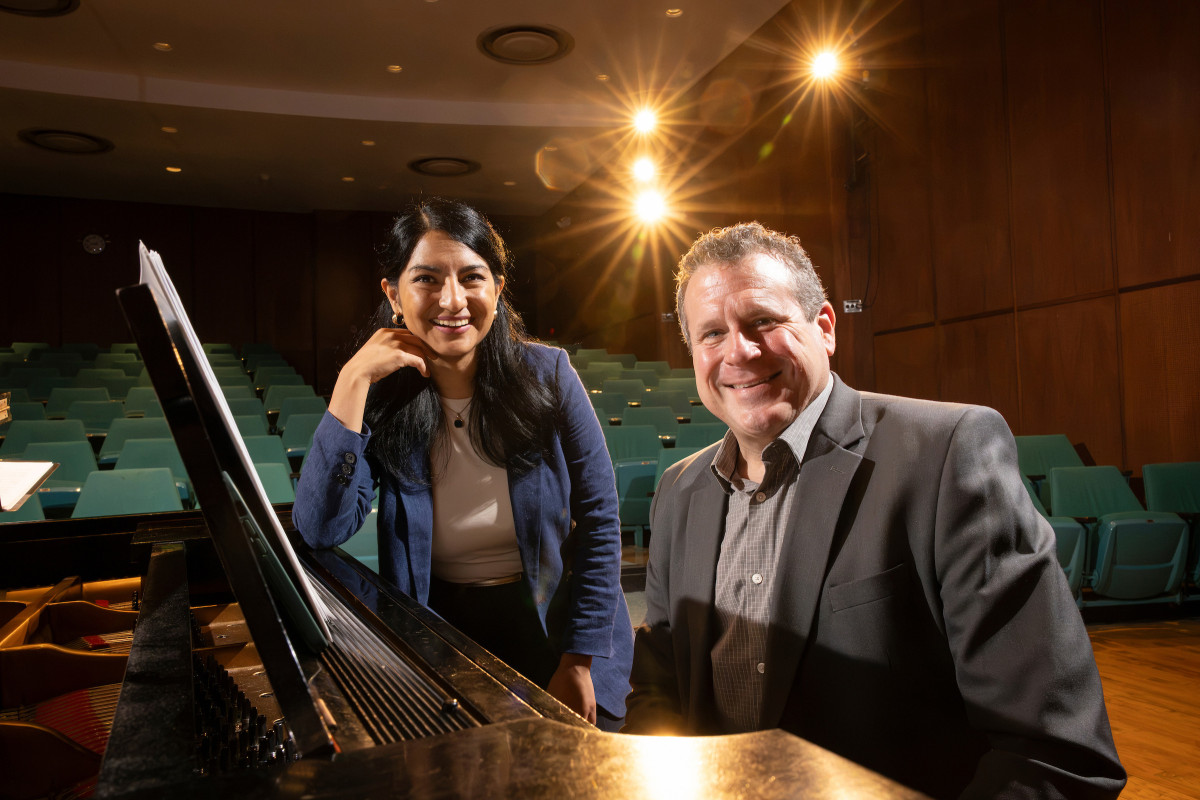
A lost repertoire lay hidden in archives in Mexico, Paris, and Berlin, silenced and almost entirely forgotten for more than a century.
Binghamton University Assistant Professor of Voice Brenda Iglesias is working to recover the work of 19th-century Mexican composer Gustavo E. Campa, who shared his work and received positive feedback from such greats as Massenet, Saint-Saëns, Verdi, and Pedrell. Supported by a Presidential Early Career Research Grant through the Division of Diversity, Equity and Inclusion, Iglesias is completing a critical edition of two song collections by Campa, which she expects to publish alongside a recording of selections within the next year.
As part of this project, Iglesias will give a faculty recital at 7:30 p.m. Saturday, Oct. 24, in the Chamber Hall. Titled Love, Loss, and Dreams, the concert will premiere seven of Campa’s French-language art songs, and also feature Schumann’s Frauenliebe und Leben and Manuel de Falla’s Siete canciones populares españolas. Iglesias, a contralto, will be accompanied by pianist and Assistant Professor of Music, Head Vocal Coach and Opera Conductor Curt Pajer.
“These songs haven’t been heard in over a hundred years — a real rediscovery moment for Mexican and French art song,” Iglesias said.
The project began with Iglesias’ doctoral work on 19th-century Mexican music, which led her to Campa. Along the way, she connected with the composer’s great-granddaughter, who generously shared information, and libraries in Mexico, UCLA, and Berlin, where his scores survive only as first editions, photocopies, and manuscripts.
“Piecing this music back together has been a real detective process,” Iglesias said.
A transitional composer
Campa is considered a transitional composer, and his music differs significantly from the folk-inspired currents of today’s Mexican music. During the 19th century, Mexican music was more European in style, influenced by Italian opera; Campa, in particular, drew inspiration from French composers and often wrote in that language, as well as German and some Spanish. During that era, French — not English — was the most common second language in Mexico, Iglesias said.
Campa was also a music critic and later directed Mexico’s Conservatorio Nacional.
“He’s not as well-regarded as other Mexican composers because he was a little bit of a rebel in his time, his music doesn’t sound nationalistic, and he had the ‘bad’ luck to be supported by Porfirio Díaz,” Iglesias explained.
A controversial figure, Díaz brought railways and economic progress to Mexico, but also ruled the nation as a dictator until he was overthrown in 1911. The Mexican Revolution was by then underway, and the artistic style favored by the former ruler fell out of fashion.
Iglesias is still actively searching for all of Campa’s music, which includes orchestral works, chamber music, piano pieces, and a single opera. While music of the period trended toward opera, Campa preferred to focus on individual songs, she said.
Many of his scores were published around 1890 to 1910; as first editions, they sometimes contain mistakes in the harmonies, rhythm, or text. Iglesias is transcribing them into clean versions and making them available to future performers.
“I’m on a mission to get this music published because it changes the perception of what you perceive as Latin American,” she reflected. “Part of the reason that it was buried in libraries and not easy to access is this misconception that only folk music in Spanish can be Mexican.”
Bringing this music to new life poses an interesting challenge: No audio recordings exist for six of the seven Campa songs Iglesias will perform. Iglesias and Pajer will instead draw on their background in French repertoire to inform their performance choices.
“In that sense, it’s like premiering new music,” Iglesias reflected. “You get to be the person that says, ‘I’m going to make the decisions’ — which is how music used to be before recording. You had no reference point, and it was passed on by tradition.”
If you go
Love, Loss, & Dreams: A Woman's Life in Song features Binghamton faculty artists Brenda Iglesias, contralto; Curt Pajer, piano; and Joey Grunkemeyer, cello. The event will be held at 7:30 p.m. Oct. 24 in the Anderson Center for Performing Arts’ Chamber Hall.
Tickets are $10 for the general public; $5 for Binghamton University faculty, staff, and alumni, as well as senior citizens and veterans; $3 for Music Department faculty and staff; and free for students and children. Click here to purchase.