Inside Binghamton University’s student-led Metabolic and Exercise Physiology Laboratory
Modern research and teaching facility helps advance human physiology through research, education, and objective assessment
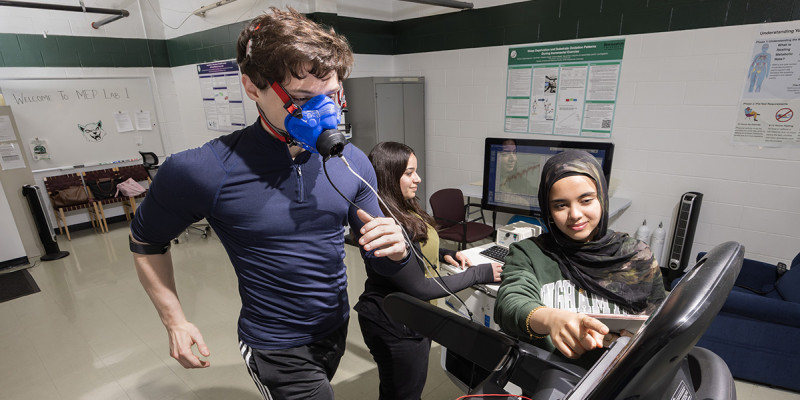
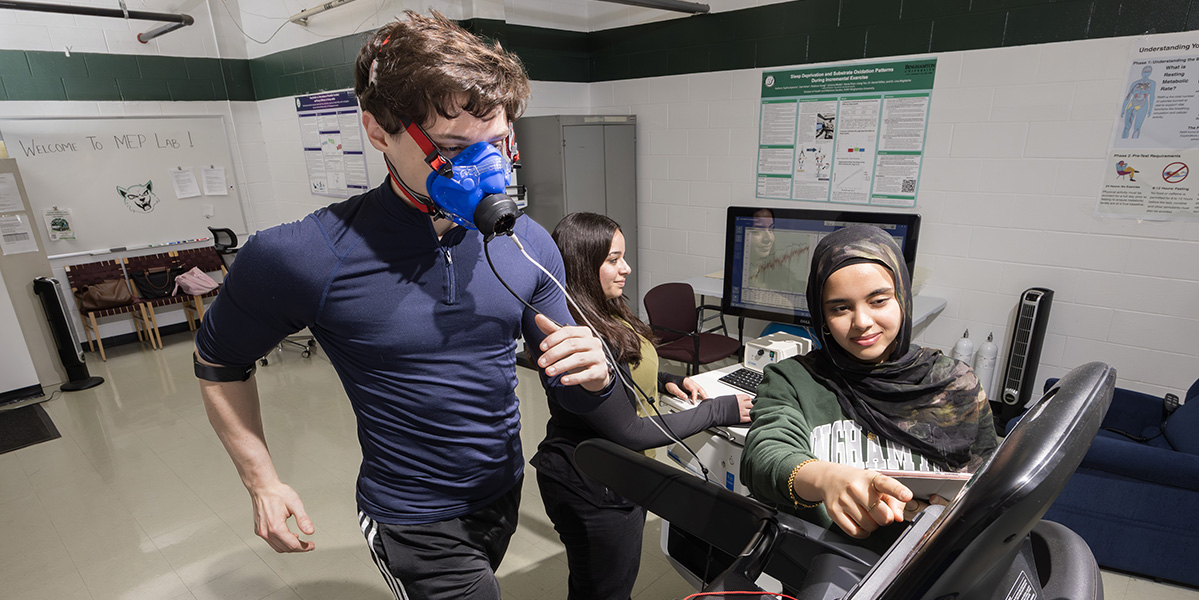
With a focus on interdisciplinary collaboration and community engagement, the Metabolic and Exercise Physiology Laboratory (MEPL) at Binghamton University is a research and teaching facility dedicated to advancing human physiology. Through preventive health research, experiential learning, community service, and rigorous assessment, the lab addresses complex challenges in metabolism, exercise performance, and human well-being.
The MEPL is the only Binghamton University lab that is fully student-led and operated; it is part of Decker College of Nursing and Health Sciences.
Researchers in the MEPL use the COSMED Quark RMR-CPET metabolic cart to measure how the body works at rest and during exercise. This device tracks oxygen use, carbon dioxide output, energy use, and heart and metabolic health. The data shows how the body produces and uses energy, helping researchers understand energy needs, fitness, and heart and metabolic function.
Used in advanced research, clinical, and elite-performance settings, the technology enables investigation of how metabolism, cardiovascular health, sleep, nutrition, physical activity, stress, behavioral health, disease risk, and social factors interconnect. Lab researchers integrate resting metabolic rate (RMR) and cardiopulmonary exercise testing (CPET) with validated psychometric and behavioral assessments to examine how lifestyle factors — sleep, physical activity, stress, diet, and emotional regulation — influence health. This comprehensive model allows them to explore how objective biological measures and daily behaviors interact, revealing the complex pathways linking lifestyle, environment, and physiology.
“We view health as an interconnected system shaped by biology, behavior, environment, and experience,” explains Daniel Miller, a lecturer in Decker’s Division of Health and Wellness Studies (HWS) and the principal investigator and faculty mentor for the MEPL. “By studying the body as a dynamic whole, the lab advances rigorous, relevant research that benefits student wellness, community health, and preventive medicine.”
Students lead the way
Since its founding in 2024, the MEPL has been a fully student-led laboratory built on collaboration, innovation, service, and shared responsibility. Undergraduate students take on all key roles within the lab, including daily operations, developing and maintaining the research portfolio, training, and outreach.
“What makes the MEPL different is that students are not just helping with research; they are helping to build the research culture,” says Rania Khan, a senior majoring in integrative neuroscience and minoring in biological anthropology, who has served as lab manager and lead director of research since the MEPL’s founding. “From protocol development and participant testing to data interpretation, outreach, and scholarly writing, students are learning how to turn scientific questions into real-world impact.”
Within weeks of the MEPL opening, over 100 students from diverse disciplines across campus applied to work there. Students were recruited for their academic interests, curiosity, work ethic, compassion, willingness to learn, and commitment to serving others. The lab brought together first-year undergraduates and upperclassmen, creating an interdisciplinary team where students contribute according to their strengths while growing as researchers, leaders, and collaborators.
What started as a small undergraduate team is now a campus-wide research hub, operating six days a week and supporting 66 hours of lab activity.
Each semester, over 200 students engage in applied physiological testing directly linked to their coursework through select HWS courses. A course fee covers MEPL expenses and enables participation. Students receive personalized physiological data that is integrated into instruction as required activities. This hands-on approach allows them to analyze their results while learning key concepts in metabolism, exercise physiology, nutrition, and health behavior, transforming the classroom into a research environment.
Impacting lives on campus and beyond
Despite young adulthood often being viewed as a period of low disease risk, many chronic disease patterns — disrupted sleep, stress, sedentary lifestyles, poor diet, anxiety, and early metabolic strain — can begin then. While exercise physiology typically relies on standardized measures such as aerobic capacity and energy expenditure, the MEPL broadens this approach by integrating biological, behavioral, social, and educational perspectives. The aim is not just measurement, but understanding how early health issues develop, and how they can be altered before disease emerges.
“We did not build the MEPL around a machine; we built it around a question,” Khan says. “If we can identify the biological and behavioral patterns that begin in young adulthood, we may be able to change health trajectories before chronic disease becomes inevitable. That is what makes this work so meaningful.”
Additionally, the lab prioritizes research on female physiology and partners with Decker’s Motion Analysis Research Lab to address a significant gap in female athletic research.
The MEPL also demonstrates its commitment to service through campus wellness programs, community education, and outreach. Two student-led groups drive this mission: the Community Health Outreach Group partners with local organizations and nursing homes, and participates in health events, while the Institutional Engagement Group leads campus outreach, collaborates with student organizations, and hosts educational programs to raise awareness of metabolism, exercise physiology, and preventive health.
“The MEPL was built on the principle of servant leadership, the belief that leadership begins with service to the people and the communities we are responsible to,” Miller says. “Our work is not only to generate data, but to use research, education, and mentorship to serve students, the University, and the broader community. When students learn to lead through service, they become more than researchers; they become advocates for health, equity, and meaningful change.”