The fraud triangle: Binghamton grad and podcaster breaks down white-collar crimes
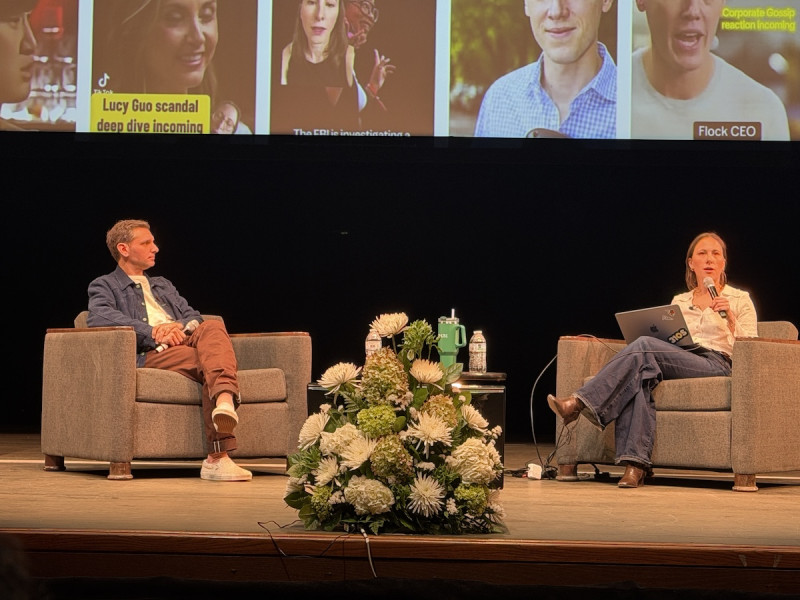
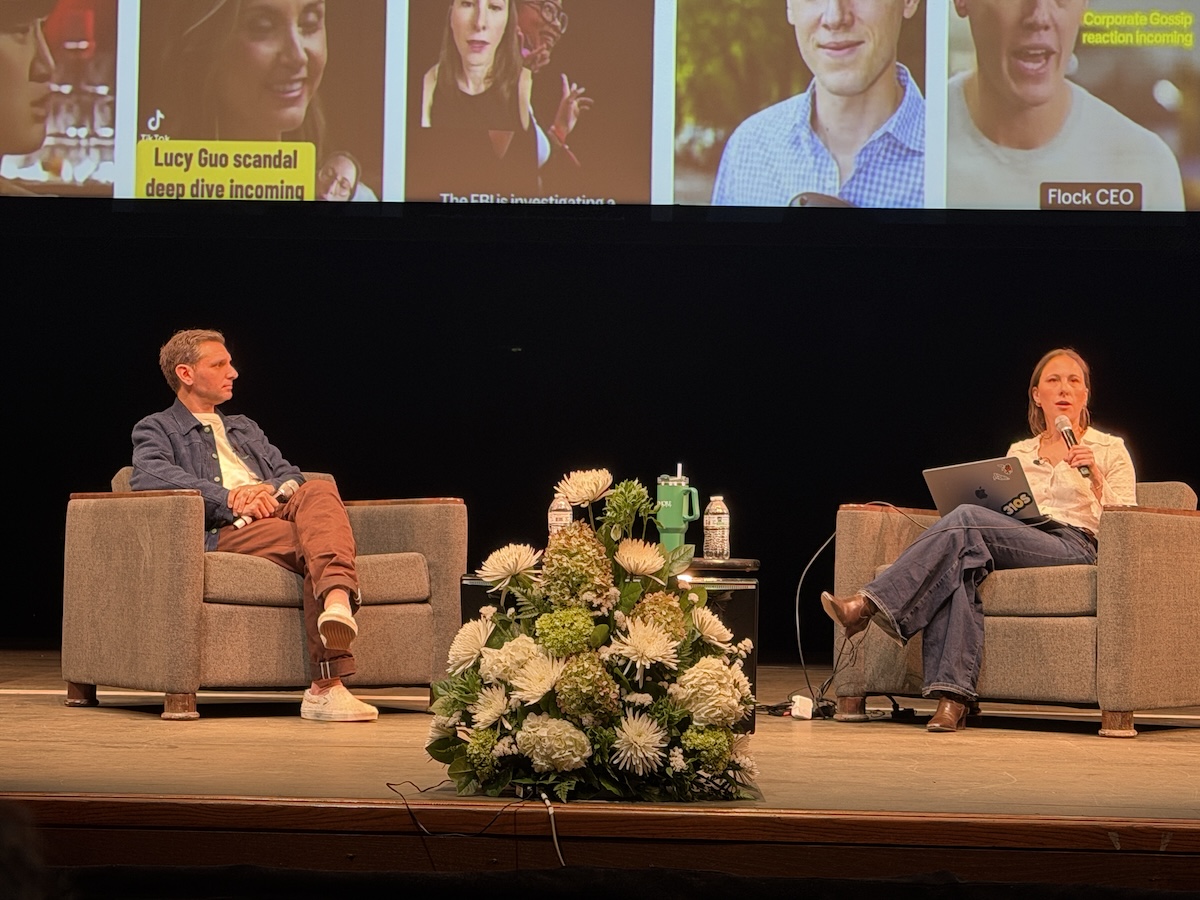
Rebecca Platsky ’12, MS ’13, creator and host of the 'Corporate Gossip' podcast, presents to students at 37th annual Briloff lecture
In today’s corporate world, fraud is everywhere.
For Rebecca Platsky ’12, MS ’13, creator and host of the “Corporate Gossip” podcast, which has over 200,000 total followers across social media, she found it at her job.
While working as a certified public accountant, Platsky discovered that one of the executives at her company had been named as a defendant in a high-profile trial investigating fraud. She sent a message on Slack — an internal communications platform — to her team at the time, calling this out with a link to an article with the executive’s name in the headline.
Platsky shared a screenshot of this message with a crowd of School of Management (SOM) students in the Anderson Center’s Osterhout Concert Theater on Oct. 7, to kick off the 37th annual Abraham J. Briloff Lecture Series on Accountability and Society. She was joined by her co-host, comedian Robby Slowik, turning the event into a live podcast atmosphere, covering some shocking content.
“One thing that fascinates me about fraud is that it’s accessible,” Platsky explained. “Anybody can do it, even if you think you’re a really good person.”
Her lecture covered famous instances of fraud, some of which led to hefty prison sentences, while others escaped culpability. Platsky noted that many experts have said we are in the “golden age of fraud” and delved into recent high-profile scams devised by Sam Bankman-Fried and Charlie Javice, among others.
According to Platsky, each case was derived from three elements, which she calls “the fraud triangle.” Pressure, opportunity, and rationalization contributed to each one of these schemes. By the end of the presentation, the audience was able to identify which of the factors were which when quizzed by Platsky on a specific case.
“What I hope we’ve done today is given you a tool that you can have in your back pocket,” Platsky said. “Use the fraud triangle to stay out of trouble.”
Kimberly Jaussi, an associate professor for SOM, taught Platsky as a student, and over a decade later, introduced her to the stage to give the Briloff lecture. The two have stayed in communication since Platsky graduated.
“At this point, she’s like family,” Jaussi said. “She’s a great example of exactly why we teach, and the kind of Bearcats we want to be putting out into the world.”
After the lecture, Assistant Dean of SOM Jerah Reeves moderated a Q&A between students and the co-hosts. They asked questions about fraud, experiencing failure, and carving out a career in the entertainment industry.
When answering a question about how to build an audience on social media, Slowik shared admiration for how Platsky has built her online brand.
“She got on TikTok, which is an available platform,” Slowik said, “and accessibly broke down some complicated things with passion behind it, and it resonated with people.”
To end the night, SOM Dean Shelley Dionne presented Platsky with a recognition award. She praised Platsky and Slowik for the unique, interactive nature of their talk.
“Ethics matters,” Dionne said, reflecting on the presentation. “It’s a personal choice that can’t be passive. It has to be more active going forward. You have to question yourself, and that’s okay.”