Music professor explores creative process behind Canadian composer’s songs
Through sketches, correspondence, and recordings, Hippocrates Cheng's Toronto fellowship traces how John Beckwith transformed poetry into music
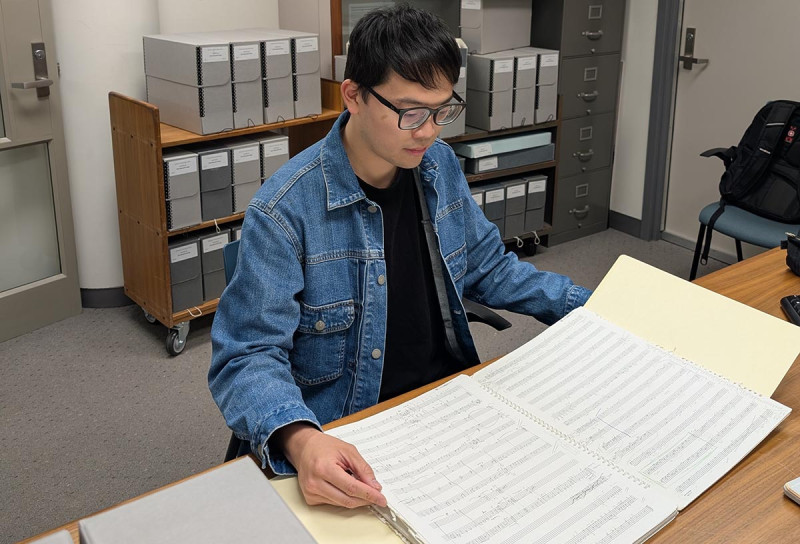
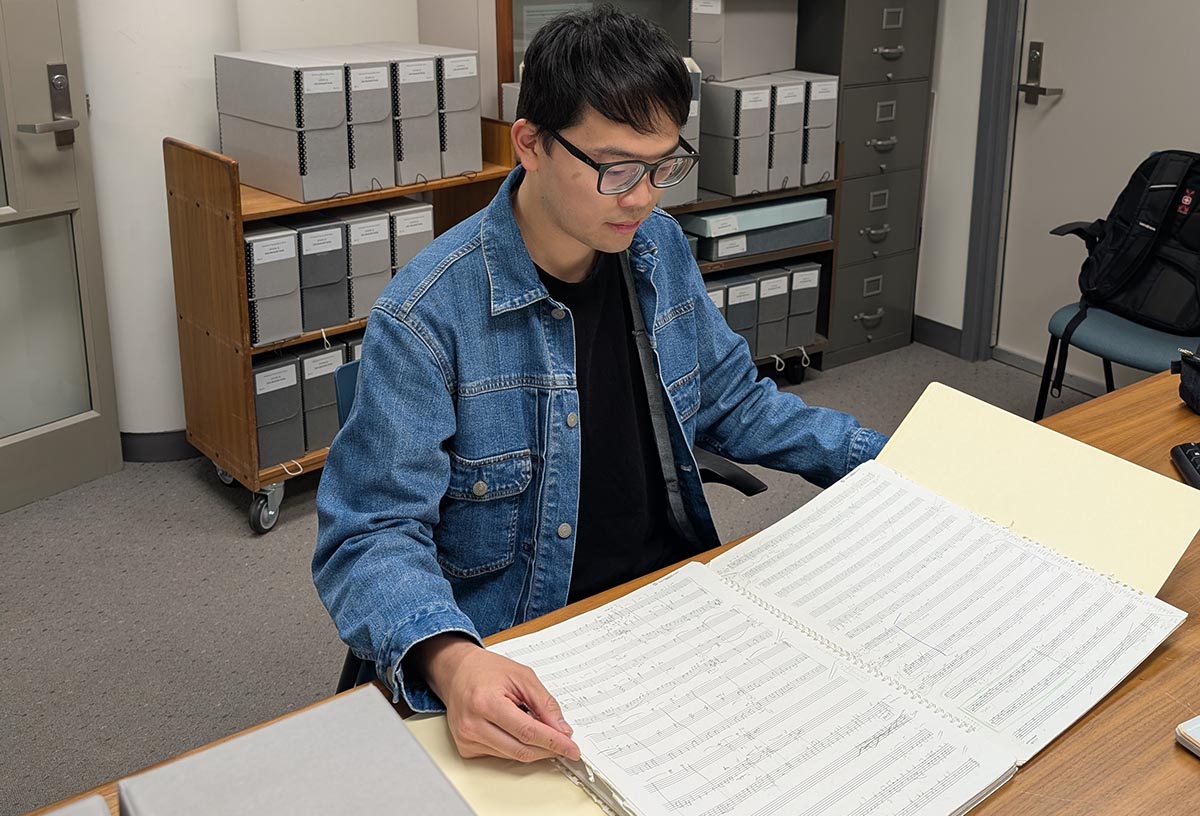
On a page of musical sketches, fragments of several songs might sit alongside crossed-out passages and handwritten notes. For Hippocrates Cheng, those unfinished ideas offer a unique insight into understanding a composer’s creative process.
The Binghamton University assistant professor of music theory and composition spent four weeks at the University of Toronto Music Library examining Canadian composer John Beckwith’s archive, tracing the decisions behind his songs for voice and piano.
“I’m not just looking at the final product, not just the published music score,” Cheng said. “I start from his sketches.”
Cheng was the inaugural recipient of the Ruth Pincoe Research Fellowship, hosted by the University of Toronto’s Music Library and music faculty. The residency gave him access to an archive containing more than 50 boxes of Beckwith’s manuscripts, sketches, correspondence, recordings, and other materials.
Cheng, who is a composer as well as a music theorist, approached the research from both sides. Through looking at how Beckwith chose his poems, developed his musical ideas, and revised his work, Cheng was able to piece together a deeper reading of the music itself.
His research covered works between 1945 and 2014, spanning nearly seven decades of Beckwith’s career. Cheng presented his findings on Aug. 28 in a fellowship lecture, “A Detailed Analysis of John Beckwith’s Songs for Voice and Piano: From Archival to Analytical Perspectives.”
Following the creative process
Piecing together how Beckwith worked meant doing more than reading the sketches in order.
Although Beckwith dated most of his works, Cheng’s job of tracing a song's development from beginning to finish was anything but simple. Like anyone scribbling on the nearest page, Beckwith often put fragments of different songs on the same sheet. Cheng had to work out which passage belonged to which song and how it fit with the other drafts.
Working closely with archivist Becky Shaw at the University of Toronto Music Library, he located relevant materials and was able to piece together the development of individual compositions.
Among the works he examined was “Six Songs to Poems by e.e. cummings,” composed between 1980 and 1982. Fragments of all six songs were in the sketches, from first ideas to nearly finished passages.
One case is a poem, “O Purple Finch.” Cheng studied how Beckwith used music and voice to suggest the bird's song, and how his choices conveyed that imagery in the poem. His presentation placed handwritten sketches alongside the poem and a birdsong example, showing how archival research could inform an interpretation of the finished work.
Other materials revealed the reading and research that preceded the composition.
Beckwith composed "Five Lyrics of the T'ang Dynasty" in 1947 and revised it in 1949, setting English translations of poems by Li Po, Wang Wei, and Li Shang-yin. Cheng examined Beckwith's notes, his poetry sources, and a lecture in which he compared translations by Witter Bynner and Arthur Waley.
The piece had caught Cheng's attention before the fellowship. The sources and sketches gave him a closer look at how Beckwith reacted to what the poems said and how they felt.
Connections in the archive
The archive also led Cheng back to a composer whose work and life he had researched for years, Hong Kong's Doming Lam.
Cheng knew that Lam had studied at the University of Toronto. He didn't know that Beckwith had been his teacher.
The evidence appeared in a letter from Lam inviting Beckwith to participate in a recording project of "Five Lyrics of the T'ang Dynasty." In the letter, Lam mentioned that he had studied with Beckwith 20 years earlier.
Cheng followed that clue into university records to corroborate the teaching connection.
“Sometimes I feel like I’m also like a detective,” he said.
The finding built upon research Cheng had done in 2023, when he visited Lam’s residence after the composer’s passing to look through what he had left behind. Finding a related letter in a different country showed how scattered the record can be for musicians who worked across borders. Their materials end up in institutions and private collections around the world.
For Cheng, bringing those materials together through his research helps reveal the relationships behind the music.
Understanding a composer he never met
That attention to both the music and its context resonated with the people who knew Beckwith.
Beckwith's son, Larry Beckwith, and his longtime partner, Kathleen McMorrow, were in the audience for Cheng's fellowship lecture. Larry has long been an advocate for his father's music. McMorrow once led the University of Toronto Music Library.
After the presentation, Cheng recalled McMorrow telling him, “You know John Beckwith well.”
The comment stuck with Cheng. He never met Beckwith, but after weeks with the sketches, notes, and letters, he had come to understand him in a way that someone close to the composer recognized.
“I was able to decode and digest what he was thinking,” Cheng said.
Back at Binghamton, Cheng will develop the research into scholarly publications and has shared his ideas with colleagues in the Department of Music.
He also plans to share the experience with students in his music theory and orchestration courses. Tracing a composer's revisions, following a paper trail, and finding connections between musicians can show students the people and decisions behind the music they study.
Cheng also sees opportunities to exchange ideas with University colleagues who work with archives, preservation, and special collections.
For his students, he hopes the experience will offer a broader picture of what it means to study music.
"It is not just learning from textbook knowledge," he said.