Blast off! Binghamton alumnus plays a pivotal role in Artemis moon missions
Victor Yu works as an advanced design engineer for NASA
During a nearly 10-day journey in April, an Orion spacecraft carrying four astronauts roared off the launchpad at Kennedy Space Center in Florida, looped around the moon, and splashed down in the Pacific Ocean as part of the Artemis II mission.
Those of us back on Earth watched in awe as those intrepid humans visited our lunar neighbor for the first time since the final Apollo mission in 1972, testing systems and conducting important research for a scheduled moon landing in 2028.
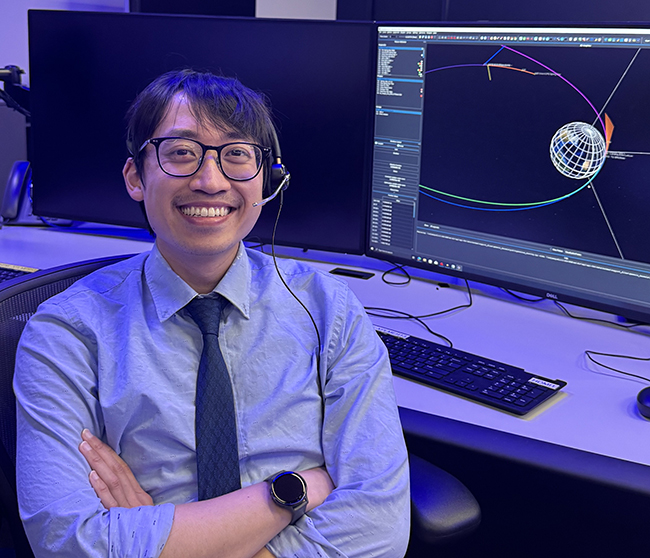
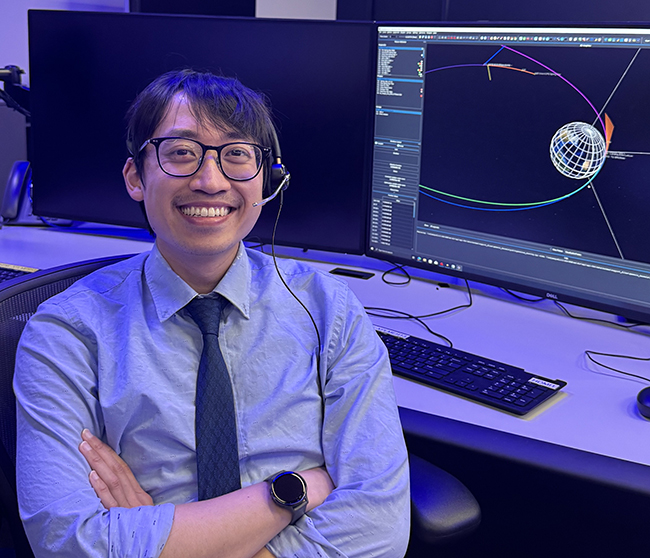
Victor Yu ’17, MS ’20, worked alongside hundreds of NASA personnel supporting Artemis II at NASA’s Johnson Space Center in Houston. He was the lead developer for abort trajectories that may have been needed during Orion’s trans-lunar injection, the burn that sends the spacecraft and crew to the moon. He helped to map out the best solutions for worst-case scenarios.
“We developed hundreds of thousands of cases. For example, if there was a fuel leak or if there was a malfunction in the life-support systems, how do we get the crew home as quickly as possible?” he says. “It’s very rewarding to be part of this project, and I’m very grateful for it, but it’s also a big responsibility. There are humans on board, and every little thing has to be 100% perfect. You have to be careful not to add any more additional risks to the mission.”
From intern to employee
Yu grew up in Brooklyn and went to high school on Staten Island, excelling in his STEM classes. He knew he wanted to be an engineer, but when he decided on Binghamton University, he wasn’t quite sure what kind. His experiences in the Thomas J. Watson College of Engineering and Applied Science’s first-year Engineering Design Division program, which introduces students to the options available at Binghamton, persuaded him to pick mechanical engineering.
He admits he was “kind of an introvert” as an undergraduate and wishes he’d been more active in extracurricular events and clubs, but he credits his time at Watson with helping him open up to other people. He’s especially grateful for the relationships he built with mechanical engineering faculty members, some of whom became mentors.
“It wasn’t until later in my college career when I understood how much of an impact that college has on you, because you grow academically and socially,” he says. “I learned how to talk to professionals, how to talk to professors — how to communicate better. The team projects that I worked on helped me to improve these skills, as well.”
As he pursued his master’s degree, Yu interned at NASA’s Goddard Space Flight Center in Maryland, where he worked on the Lunar IceCube project, a nanosatellite intended to collect data on the moon’s ice deposits. The device launched aboard the uncrewed Artemis I.
The experience gave him a taste for aerospace engineering, and he also interned for one summer at Collins Aerospace — but NASA became his passion. He next went to NASA’s Johnson Space Center for a series of internships and co-op roles in life-support systems, astrodynamics, and guidance and control systems. After earning his master’s, NASA hired him as an official full-time employee in Houston.
“What’s nice about NASA Johnson is that networking is pretty easy to do here,” Yu says. “You can easily find people who can point you in the right directions, which is how I got my foot in the door where I’m working today as a full-time employee.”
His time at Watson College proved to be key: “During my interviews with NASA, they didn’t ask any rigorous technical questions. They asked about my soft skills, with questions about the importance of working as a team. The answer I gave them came from my experiences at Binghamton.”
Next stop: The lunar surface
As shown in the film Hidden Figures, human mathematicians did the complex calculations for early NASA spaceflight with little more than paper, pencils, slide rules, and protractors. Apollo 11 landed on the moon with the computational power of a modern pocket calculator onboard.
Today, the Artemis program harnesses all the scientific advances from the past half-century, including supercomputers that can do millions of calculations per second. Yu sketches out trajectory ideas in a NASA software called Copernicus and programs them in Python, then connects his laptop to a mainframe that works out the solutions. For Artemis II, he supported in-flight operations by providing real-time abort trajectories if the astronauts needed them.
“It’s very exciting, but obviously very stressful, too,” he says. “Once they had a successful flyby around the moon, we knew we had an almost-successful mission. The mission wouldn’t truly be complete until the crew was safely back on Earth. Once they landed, we had a celebration.”
Yu’s current assignment is for Artemis IV, which is scheduled to return astronauts to the lunar surface in early 2028. Working with SpaceX, one of two American companies NASA is working with to develop human landing systems, he is developing potential trajectories across multiple launch periods that will be narrowed down later to one.
“It’s a lot more complicated than Artemis II, because now we actually have lunar surface operations, too,” he says. “There’s more than just NASA on the mission — there are different providers like Blue Origin and SpaceX, so we’re working with them on the lunar landing and other mission objectives.”
Even though Artemis IV is targeted for 2028, Yu admits the excitement is growing: “Having people step foot on the moon again will be an amazing moment when it happens.”