Serving those who served: Binghamton psychology graduates support veterans
Clinical psychology alumni bring their expertise to address mental health challenges
For military veterans suffering from post-traumatic stress disorder (PTSD), healing can take various shapes: A traditional psychologist’s office, where they work through their fears or learn to navigate complicated relationships. A virtual reality headset. In a training ring with a wild mustang.
Alumni of Binghamton University’s doctoral program in clinical psychology are at the forefront of research and treatment of conditions relevant to veterans.
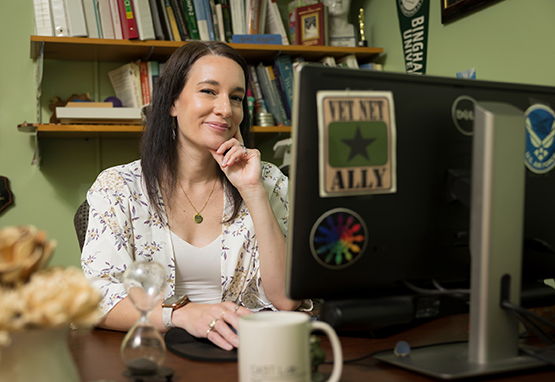
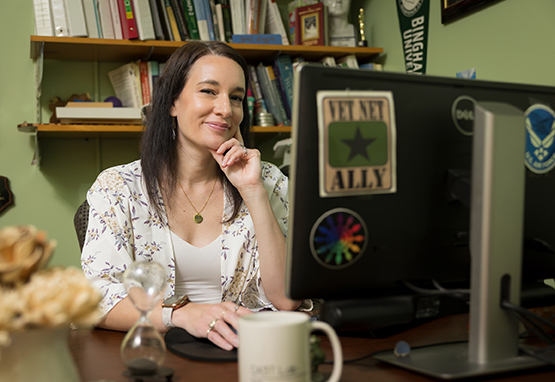
Today, more than half of Associate Professor of Psychology Christina Balderrama-Durbin’s students end up with careers at the Veterans Health Administration. In fact, her first student when she arrived on the Binghamton University campus in 2015 is now a staff psychologist at the nearby VA clinic in the City of Binghamton, and has recently begun supervising graduate students and interns in their clinical work.
“It feels like things have come full circle for me,” says Balderrama-Durbin, who also directs the Couple Adjustment to Stress and Trauma Lab at Binghamton. “I credit much of my own clinical training to the experiences I had as an intern at the Minneapolis VA Health Care System. It’s such an honor to serve those who have served this country.”
Doctoral candidates in clinical psychology are required to complete an internship year at an external site, and the VA offers one of the largest and most robust evidence-based treatment training experiences for program graduates, Balderrama-Durbin says. Given their positive experiences with alumni, these sites also seek out Binghamton graduates in turn.
Terence Keane, MA ’76, PhD ’79, SD ’11, was part of the clinical psychology program’s first class. During his 49-year career at the VA, he developed many of the most widely used PTSD assessment measures. Recognized today as a world leader in the field of traumatic stress, he is the director of behavioral science for the VA’s National Center for PTSD, as well as a professor and assistant dean for research at Boston University School of Medicine.
“Trying to help the next generation of researchers and clinicians is very important to me,” he reflects. “The training we received at Binghamton University prepared us to do good things here.”
The challenges faced by veterans
A friend gave Keane a framed page from an 1866 edition of Harper’s Weekly, depicting an etching by Thomas Nast titled “Why He Cannot Sleep.” It depicts former Confederate President Jefferson Davis, his stricken face turned toward a pillow; around him, ghostly figures dance amid a scene of slaughter and grief, with a gibbet on view through the window. Above him looms a phantasmal goddess-like figure, symbolizing America. Published in the immediate aftermath of the Civil War, the image depicts the haunting reality of PTSD.
“It suggests that somebody very sensitive to the problems of combat veterans was working at Harper’s Weekly,” Keane says. “It was a recognition that people who were involved in wars — who saw the devastation and were perhaps in part responsible — didn’t sleep well. Among the symptoms of PTSD, even today, is poor sleep.”
Depictions of PTSD can be traced back to Homer’s Iliad and Odyssey in ancient Greece, Shakespeare’s King Richard and Hamlet, and more. The condition went by various names through the centuries: soldier’s heart in the Civil War, shellshock in World War I, and battle fatigue or combat stress reaction in World War II.
Combat isn’t the only cause of PTSD; it’s experienced by survivors of a wide range of traumatic events, from domestic and sexual violence to car accidents. It’s also not the only mental-health challenge that veterans face; while they demonstrate amazing resilience, they are also at increased risk for suicidality and substance abuse, Balderrama-Durbin says.
Plus, the adjustment from military to civilian life can affect an entire family system, explains Tarah Midy, PhD ’18, a staff psychologist at the VA of Cleveland, Ohio. Midy, trained in integrative behavioral couple therapy and a national consultant, works as a local recovery coordinator, ensuring that treatment is grounded in recovery-oriented practices that put veterans’ needs first.
PTSD didn’t enter the diagnostic lexicon until 1980, although cases of what was called “post-Vietnam syndrome” began to emerge in the 1970s. Keane first encountered patients suffering from the condition in 1977 during an internship at the University of Mississippi Medical Center, which included a VA center in Jackson, Mississippi; his initial rotations were in the VA’s substance dependence treatment programs. While interviewing patients, he heard war stories — mainly from Vietnam, but also from Korea and World War II.
“Thematically, the stories were so similar. It was stunning to me,” he recalls.
At the end of his first year at the VA, he helped start the first outpatient program for Vietnam veterans dealing with combat stress. In the summer of 1980, he headed to Purdue University to meet Charles Figley, a Marine veteran and faculty member involved in the development of a new diagnosis: PTSD. Five years later, Keane moved to the VA Boston, helping establish what later became the National Center for Post-Traumatic Stress Disorder.
Contrary to popular belief, PTSD is not a life sentence. Today, there are a half-dozen psychological treatments for the condition that are successful in 50-60% of cases, as shown in clinical trials. Work remains to be done in addressing the remaining 40%, Keane acknowledges.
Overall, treatment involves setting conditions so that clients are willing to face their fears and learn the difference between what is truly dangerous in the present versus reminders of the past, notes Zachary Collins, PhD ’08, a psychologist based in Rochester, New York.
“We have a variety of evidence-based approaches,” says Albert “Skip” Rizzo, PhD ’91, the director of medical virtual reality at the University of Southern California’s Institute for Creative Technologies. “We’re not erasing memories; there are always going to be bad memories, but you can function. You can start having satisfying relationships.”
High-tech solutions
A research professor with the USC Department of Psychiatry and Behavioral Sciences and at the USC Leonard Davis School of Gerontology, Rizzo explores high-tech ways to treat trauma and brain injury, including virtual reality, gaming, and apps. When he started this work in 1995, the equipment was both expensive and primitive; that’s not the case now.
With a computer science colleague, Rizzo used 3D footage to build Virtual Iraq, a prototype for the treatment of PTSD in Iraq War veterans. It’s not “Call of Duty,” but a fully immersive experience with audio, a vibrating floor that simulates a vehicle’s rumble, and even machines that puff out battlefield smells.
For patients with comorbid depression, simulations outperform traditional, evidence-based therapy. The reason: Depression can make it difficult for individuals to engage in pure imagination, especially when coupled with the avoidance of troubling memories at the heart of PTSD.
“It’s a way to emotionally engage people at a pace they can handle, even if it’s not an exact replica of what they went through,” Rizzo explains. “What we try to do is help them safely confront and reprocess difficult emotional memories. It’s hard medicine for a hard problem.”
The program has since expanded from combat-related issues to sexual trauma, another significant problem in the military. Recently, his team has been developing VR systems for clients in Ukraine, Israel, and Gaza.
VR can also be used to determine whether a soldier is eligible to return to duty after experiencing a concussion. One day, such programs may help prevent PTSD from developing, by providing troops with pre-deployment resilience training introducing them to combat environments. In this type of training, the scenario doesn’t just end with death, an explosion, or an ambush. A virtual human mentor walks into the scene and guides soldiers through the normal physiological experiences of combat, such as increased heart rate, and introduces relevant coping strategies.
Another one of his projects: a conversational AI mobile phone app for at-risk veterans that can answer questions, guide users through healthcare resources, and help them establish a safety plan. The VA has recently released a general version of the app, called Sidekick.
The goal isn’t to replace clinicians, but to overcome stigma and barriers to care, he points out. Chatbots may also help patients practice cognitive reframing exercises, breathwork, or other strategies in times of stress.
Over the years, the VA has adopted virtual reality and digital technologies on a broad scale, using them for pain management, game-based physical and cognitive rehabilitation, social-skill role-playing, and more. The veterans like it, too. In fact, when given the option between VR or traditional therapy for PTSD, 76% of veterans in one study picked VR. Of the 1,000 people who tested the mobile app, 92% said they would recommend it to other veterans and use it themselves.
“My philosophy is that the thoughtful, scientifically informed, ethically sound use of technology for the delivery of healthcare is something we need to pursue,” Rizzo says. “But there’s a capital E on the ethical.”
Back to nature
On the other end of the treatment spectrum are wild horses. Collins first began treating veterans during an internship at the Syracuse VA Medical Center. Since then, he has worked in multiple clinical settings, including embedded behavioral health with the U.S. Army at Fort Drum, New York, and in VA residential and outpatient clinics for PTSD.
Today, his office is on the campus of a 200-acre horse farm, where he provides free, nature-based therapy through the Monroe County Veterans Service Agency. Most participate in group programs, which range from therapeutic horticulture on the site’s three-acre organic farm to nature photography, a farm-totable cooking class, and an ecotherapy program, in which participants hike, build trails, and gather around a campfire.
Collins’ favorite is Mission Mustang, which involves gentling wild horses provided by the Bureau of Land Management.
“Those are wild animals, very much in contrast to our therapeutic herd, who are extremely chill. They come to us untouched by human hands, and our expert mustang trainers coach veterans through the process of training them,” he explains. “The work is really rewarding for both the horse and the veteran participants.”
As herd animals, horses are sensitive to the energy around them, serving as emotional mirrors. They can hear a human’s heartbeat up to 4 feet away and will shy from an anxious trainer — in effect, a trauma response.
“But the horse doesn’t have PTSD because they’re not in their head, blaming themselves and telling themselves a story,” Collins reflects. “That’s really the core of PTSD: ‘I’m telling myself a story about my trauma. This is my fault; I should have prevented it; I should have done something different.’ The horses never do that; they respond to trauma in the moment, but when it stops, they adjust.”
During his training at Binghamton, Collins received a key lesson that has shaped his practice — the same one that veterans learn through Mission Mustang: To be effective, a therapist must manage their own emotions before sitting with someone working on trauma.
“I have to do my own preparation, which is a mirror of what we’re training veterans to do with the horses. The veteran shows the horse that, hey, this thing that’s scary, we’ll get through it together,” he explains. “Whatever the veterans went through, there’s nothing so bad that we can’t at least talk about it.”
Alumni credit Binghamton’s clinical psychology program with providing the grounding they needed for rewarding careers. In both Jackson and Boston, Keane has recruited other Binghamton graduates; many have chosen to remain at the VA for decades.
“If you told me 20 years ago that I would be working with veterans, I would find that very surprising,” says Midy, who initially came to Binghamton to study with Professor Matthew D. Johnson and his science-based approach to marriage and family relationships. “I really enjoy the work. Veterans are such a special population. They appreciate the help, and they deserve the best.”