Cliff Joslyn has lifelong love for systems science
Alum leads research efforts at Pacific Northwest National Laboratory
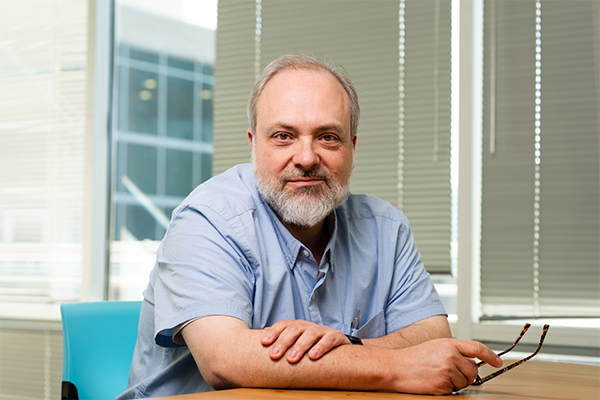
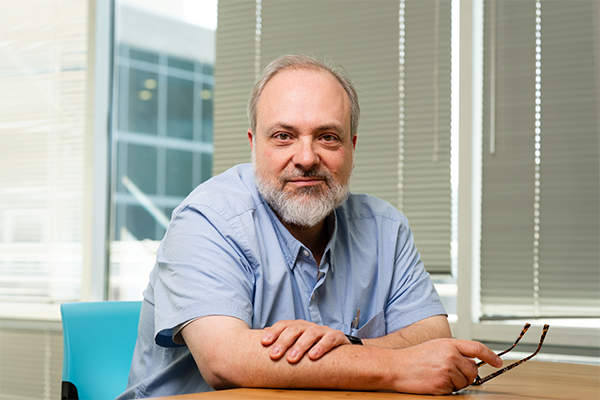
Cliff Joslyn, MS ’89, PhD ’94, is chief knowledge scientist for Pacific Northwest National Laboratory (PNNL) in Seattle, and is a visiting professor of systems science at Binghamton University.
Q: What’s involved in your PNNL role?
A: I lead research efforts in applied mathematics and data science for the Pacific Northwest National Laboratory, sister lab to a number of others, including the Los Alamos National Laboratory (where I also served for 11 years). I’m in the National Security Directorate, responsible for working with federal agencies involved in national security to understand their needs for new, cutting-edge research in mathematics, data science, and artificial intelligence; articulate how that research can be applied and demonstrated against real-world problems; then lead teams including data and software engineers and subject matter experts to build technologies that demonstrate that capability and value.
Q: What are some of your more noteworthy research projects?
A: I’ve been blessed in my 30 years in the National Laboratory system to have been able to work across a wide range of application areas, with concentrations in computational biology, cybersecurity, and open-source analytics to analyze and integrate documents and databases. Systems science is deeply concerned with the nature of information in models of complex systems, and my work has concentrated on the mathematics of information, especially semantic information which focuses on the meaning, use, or interpretation of signs and symbols.
Systems science at Binghamton fueled my passion for methods in modeling complex systems and set me up for a range of successful work in the coming decades. One of the things I am most proud of is to have built — together with some great colleagues — a robust set of capabilities and staff at PNNL working in what are called “high order networks” (hypergraphs) and “computational topology.” The point of these programs is to formally represent the inherent complexity in systems like cybersystems or biological organisms, where multiple collections of entities interact in complex ways across a range of scales.
Q: As a visiting faculty member, what do you teach?
A: I’ve engaged with faculty and students in a few ways, including serving as advisor to MS and PhD students, and offering a number of independent studies for graduate students in a range of mathematical methods for modeling complex systems. All of my work with the department is from my home in Seattle — I do wish I could be on campus more. Binghamton has hosted a number of complex systems conferences, and I’ve been able to visit campus then, and some other times.
As I move toward retirement from the National Lab system, being able to return to my roots has been a very engaging and gratifying way to put a foot down in scholarly work, in a manner which complements my fulltime career as a “labby.” I’m more than happy to talk more with any interested parties at cajoslyn@binghamton.edu.