AI conference gathers experts to sharpen focus for new research center
New co-director for New York Center for AI Responsibility and Research says Binghamton University is primed to lead innovation
The New York Center for AI Responsibility and Research at Binghamton University is quickly gaining momentum for its research mission.
The first-of-its-kind statewide effort to advance artificial intelligence science and safety was announced in January with a historic $30 million philanthropic gift from a group of donors led by Bloomberg LP co-founder Tom Secunda ’76, MA ’79, paired with an initial $25 million research investment from SUNY and operating capital from New York state.
Gov. Kathy Hochul gave the center a further boost on Nov. 10, when she named two internationally recognized leaders in computer science and cybersecurity as interim co-directors. Greg Morrisett of Cornell Tech and Jeannette Wing of Columbia University will bring together more than 80 scientists from colleges and research institutions across New York with expertise in AI safety, security, and computer science.
“The Center for AI Responsibility and Research will help New York state lead the nation in AI transparency and security,” Binghamton University President Anne D’Alleva said. “Thanks to the leadership of Gov. Hochul and with gratitude to our alumnus Tom Secunda, Binghamton University is proud to host this transformative center and welcome the world-class researchers who will help us continue to serve as global leaders in advancing the public good.”
The center is supported by the advanced computing power of Empire AI, Hochul’s $500 million public-private initiative to drive AI research.
“New York is uniquely positioned to answer one of the defining challenges of our time: ensuring the world’s most powerful AI systems are safe, reliable, and grounded in rigorous science,” said Secunda, who serves as Empire AI board chair. “We are harnessing the power of Empire AI and the collaborative strength of our academic institutions to advance AI research and open new paths to scientific discovery. Independent testing will help researchers understand what increasingly powerful systems can do and how to use them safely.”
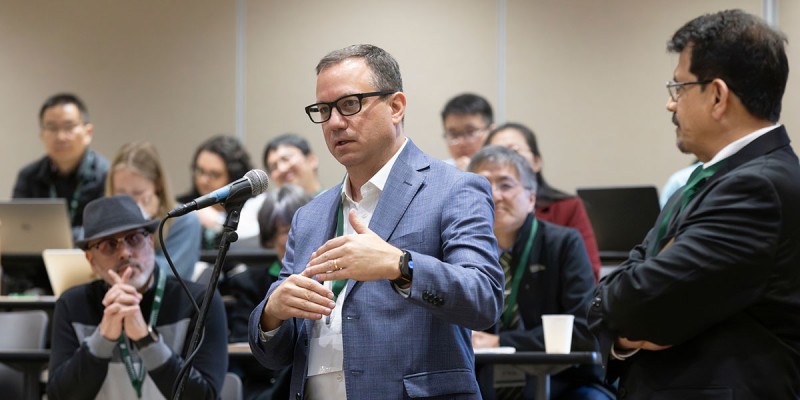
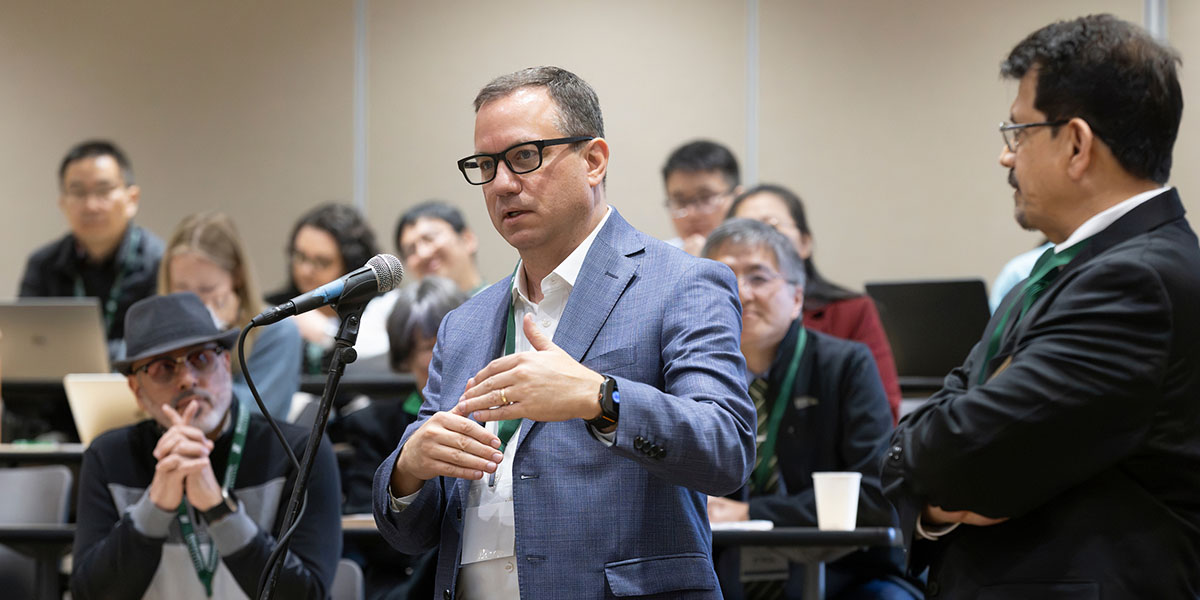
Then on Nov. 12-13, a forum on the Binghamton campus brought together leaders from academia, industry, and government to discuss the priorities, opportunities, and challenges ahead for AI research.
Attendees at the Research Frontiers for AI Safety and Responsibility conference shared perspectives on AI safety and verification as well as transparency and hardware verifiability. They also had opportunities for networking and collaboration with peers, research partners, and industry leaders.
Organizers hope the discussions inform a forward-looking roadmap for transformative research as the AI center moves ahead.
“The next step is to synthesize the conference discussions and work with the new co-directors to plan the initial rollout of the center’s efforts,” said Professor of Empire Innovation for Trustworthy AI Kuang-Ching “KC” Wang, director of the Thomas J. Watson College of Engineering and Applied Science’s School of Computing, and one of the forum organizers.
‘Binghamton is ideal’
At the Research Frontiers forum, Morrisett spoke about the broad range of AI issues that face computer scientists, ethicists, and society at large.
As examples, he’s heard from a mother who is concerned about what AI means for her children’s education and whether it’s safe for kids to interact with it, as well as a bank official deploying an AI agent who wants to ensure account security.
“We need a big network of researchers to tackle those issues,” he said. “Starting here in Binghamton is ideal. You have so many great people who've already thought hard and deeply about this challenge, and Jeanette and I are eager to bring in other people and other voices that can complement the strengths here.”
He pointed to a 2025 law that puts New York at the forefront of trustworthy AI. The Responsible AI Safety and Education Act (RAISE) Act requires large AI developers to create and publish information about their safety protocols, and to report incidents to the state within 72 hours of determining that an incident occurred.
The new Office of Digital Innovation, Governance, Integrity, and Trust (DIGIT) recently launched its online portal for frontier AI developers to register with the state by Jan. 1.
Morrisett and Wing believe that many AI issues are security issues, such as when AI agents break out of the contained “sandboxes” meant to keep them from the wider internet.
“We need to secure the harnesses and sandboxes that contain agents, and make sure that they don't do bad actions,” Morrisett said. “We can use many of the same systems techniques to contain it that we would for any bad piece of software. That's a step that we think is important.”
‘We have a responsibility’
Keynote speakers at the Research Frontiers conference were Ruchir Puri, IBM Watson chief technology officer and chief architect; Renzi Arpaci-Dusseau, professor and founding dean of the College of Computing and Artificial Intelligence at the University of Wisconsin – Madison; Katie Antypas, senior science advisor for the National Science Foundation’s Office of Advanced Cyberinfrastructure; and William Caban, AI safety and governance senior principal manager at RedHat.
During his talk, Arpaci-Dusseau discussed how fast computer science has changed in the few short years since generative AI like ChatGPT and Claude became mainstream.
“Code is no longer as static as it used to be — only done by professionals, rarely changing,” he said. “Instead, people build software for themselves and are empowered by it, and that's actually very exciting. I started calling this liquid infrastructure."
He also told attendees that he sees academia as a counterweight to tech companies and their profit motives.
“The world is changing, and universities should be part of that. We have a responsibility,” he said. “It's not good just to wait and see what industry does and hope it turns out well for all of us. I don't think that's a good way to go. It's not a responsible way to go.”