How Binghamton University students shocked Google
Your mission, should you choose to accept it: Google Games
A favorite trope in Hollywood is the problem-solving computer whiz who can hack into any government database, solve the big mysteries or hide earth-shattering secrets with just a few keystrokes. How to Get Away with Murder has Oliver, there’s Huck from Scandal and Penelope on Criminal Minds, just to name a few.
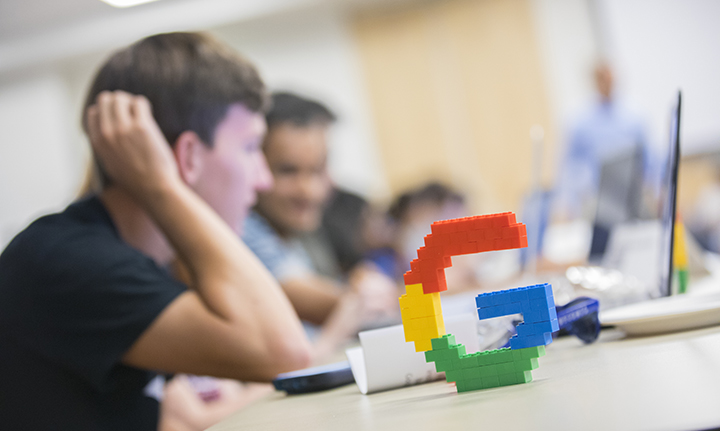
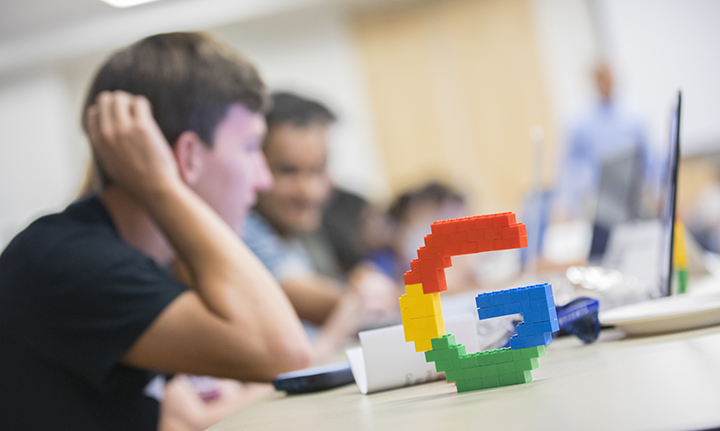
Nearly 220 students took on that role when Google came to Binghamton University for the Google Games series — a puzzle-solving competition that Google puts together. While it can sometimes be at Google’s headquarters, it’s also done on college campuses. This was the first time Binghamton University hosted the event, and registration soared to the highest Google has ever seen. The Google team expected around 100 students, so was shocked when more than double their estimates showed up. The students represented a variety of programs and majors, but more than half of them were graduate students from the Thomas J. Watson School of Engineering and Applied Science.
The hosts for the events were two Binghamton University alumni and Google employees. Jim Bankoski ’91 is an engineering director at Google who – because of a company acquisition – technically has more seniority than Google’s founders Larry Page and Sergey Brin. Candace Schenk has been working at Google for the past three years as a site reliability engineer after receiving her PhD in mathematics from Binghamton University in 2013. She describes her job as, “keeping Google running so you don’t lose your data or get interrupted.” No pressure there.
To participate in the games, students formed teams of five with names like 404 brain not found, Bearhamton Bingcats, Master Minds and the decoders. As the games began, students opened their laptops and went to a site that Google provided. The site listed a total of nine problems for the students to solve in 75 minutes. Bankoski warned that very few of the teams would get through all nine. Each problem required some level of coding expertise to be solved in the time allotted and was based on the theme of a top-secret mission, just like the Hollywood trope. The final answers could be words, phrases or numbers, and teams could continue to submit answers until they got the questions right.
During the competition, Bankoski and Schenk would answer what questions they could while students rapidly typed in between bites of free pizza. During the competition, students had no idea how they compared to the more than 40 other teams, so they had to make sure they answered enough questions correctly to end up on top.
When the dust settled and the laptops cooled, three teams emerged as victors. The third-place team — with an unpronounceable name — was :(){:|:&};:. A few of the members from :(){:|:&};: had experience with a similar competition, the annual Binghamton University Hackathon. Second place went to the Slippery Lizards. Both teams received extra Google swag on top of what was handed out at the door. The Legend of the Gamer team took home the grand prize of a Google Home device for each team member, a particularly impressive feat from a team that only had four members — Google recommends five.
While prizes and bragging rights were at stake, many students were just excited to participate. “I really just appreciate getting this type of practice and with Google especially,” one master’s student from the team BolDiverse said. “It’s not about winning for me.” Given the excitement surrounding this event, it’s likely to become a staple for Google’s annual visits. Now students just have to wait for their next chance to solve top-secret missions like Hollywood-style hackers.