Celebrating the women of computer science
Students and alumni attend an international celebration of female computer scientists
Not enough women are studying computer science. That may not be news; after all, the historical lack of female representation in the STEM industries is well-documented. The problem is that many believe this male-dominated field will eventually even out on its own, as have the legal and medical fields.
For computer science, however, the picture is much bleaker. Things are moving backward. The National Science Foundation reports that in 1985, more than 35 percent of computer science majors were women. By 2014, the number of women had been cut in half, to about 18 percent.
A number of organizations are trying to change that.
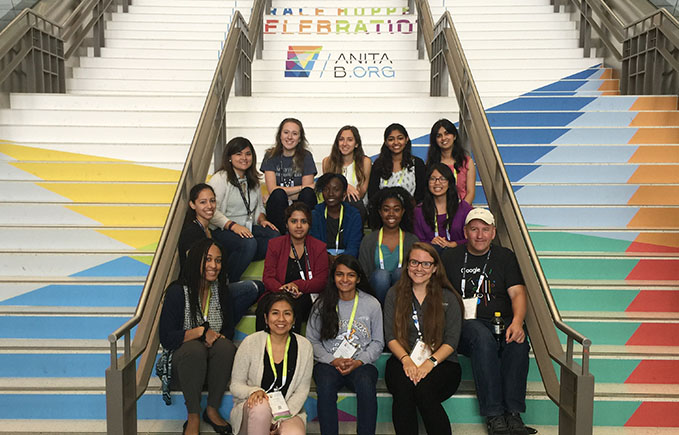
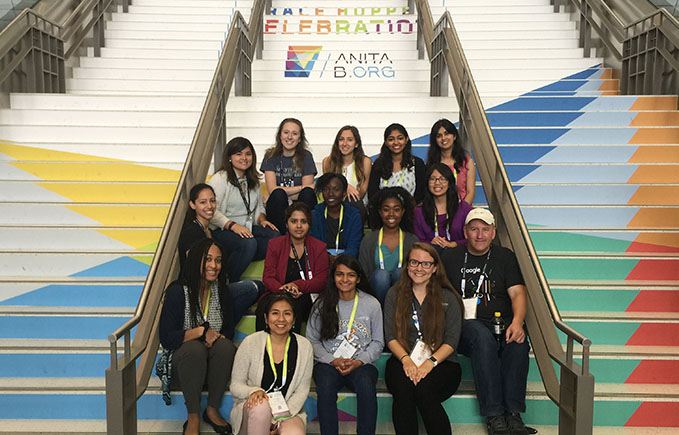
In early October, a group of eight female computer science students from the Thomas J. Watson School of Engineering and Applied Science attended a conference designed to encourage young women to stay in the field. It also highlighted women who are success stories in computer science.
The students attended the annual Grace Hopper Celebration (GHC) in Orlando, Fla. The GHC is the world’s largest gathering of women working or studying in technology fields. Speakers at this year’s event included Melinda Gates, from the Bill & Melinda Gates Foundation; bioengineering professor Ayanna Howard, from the Georgia Institute of Technology; computer science professor Fei-Fei Li, from Stanford University; and Mary Spio, CEO and president of CEEK VR.
For six of the attendees, the trip was sponsored by Binghamton alumnus and Google engineering director Jim Bankoski ‘90, and the Watson School.
Four computer science alumnae also attended the conference. They are Joanna Westcott ’15, Emily Goetz ‘15, Stacey Troy ’15 and Roseanne Levasseur ’15, MBA ‘16.
After the conference, Levasseur, who works at Microsoft, expressed just how excited she was to see so much support from her alma mater at the GHC. “This conference is a great platform for future women computer scientists to not only become inspired but continue to build the Binghamton reputation of successful graduates,” she said.
Diversity advances technology
While there is a clear underrepresentation of women in computer science, some people still wonder why that matters so much. Howard gave the keynote speech on Friday and addressed how her work needs diversity to be effective.
Howard works with robotics, a field that she says is unique in its ability to elicit an opinion and an emotional reaction from even the youngest child. Howard said that children are naturally trusting of robots. That’s why she is building robots that can work as therapists for children with disabilities and whose families often can’t afford to take them to a therapist regularly.
“We take human values [like empathy and compassion] and put them into a robotic system. If my robots are supposed to work with the world, that means my robots are supposed to work with the entire world,” she explained. “A robot that’s designed by 10 percent of the population, that’s a problem.” For robotic pediatric therapy, the technology is integrally bound with human experience and, as such, creators with a limited range of experiences might make robots that can’t reach a wide variety of people.
Many of the speakers mentioned that mentoring can help keep diverse students from dropping out or becoming too discouraged. Bankoski was one of many mentors the students worked with at the GHC. He offered to conduct mock interviews with a few of them to give them an idea of the typical hiring process and what he described as the “odd experience of having to write code in front of someone with little time to think.”
Bankoski didn’t go easy on the Binghamton students in those mock interviews. He asked the same questions he asks senior engineers with 20 or more years of experience. The students rose to the challenge, and Bankoski later had nothing but words of encouragement. “When I say you did fine on the interview I meant it! I was really impressed with you all — to me, you seemed confident, capable and fearless,” he said in an email. “I am convinced you will all do fantastically well in this industry and will have great impact on the world.”
Gates, another keynote speaker, explained the type of impact Bankoski believes the computer science students will have.
“When I worked at Microsoft, I managed teams, and I knew that when teams were diverse, they were more productive and more creative,” she said. “That’s why everyone suffers when a woman or a minority — or a woman who is a minority — can’t get a seat at the table. Without them, we’re failing to leverage the full force of our collective brain power.”
With community support, societal representation and direct mentorship, the decision to study and stay in computer science can become easier for young women and minorities. The Watson School will stay committed to that mission and encourages alumni and students to take part in increasing diversity within STEM fields.
As Gates said during her keynote address, “If we want tech to live up to its full potential, the industry needs a whole lot more of what I’m seeing here today.”