An autistic child’s best friend
Alumni veterinarian connects service dogs with families
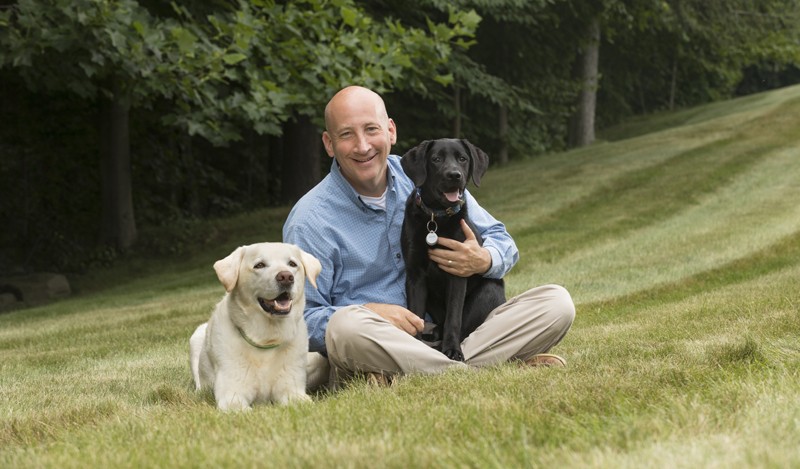
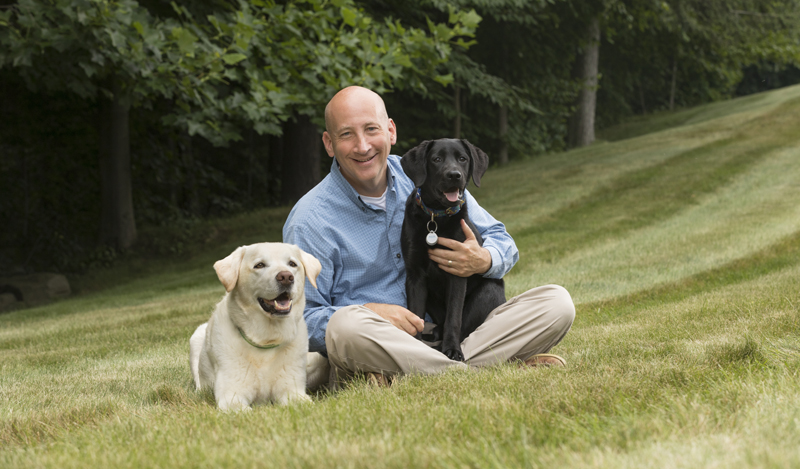
After 27 years working in the nonprofit veterinary world, Dr. Jody Sandler ’83 has no desire to stop. “Being a veterinarian, you feel like you have an impact on families just by keeping pets healthy and treating disease,” he says. “But when you add in the extra component of the service dog, and you see how much these families depend on a service dog, it is very rewarding.”
Sandler, who received his bachelor’s degree in biology from Binghamton University and his Doctor of Veterinary Medicine (DVM) from Cornell University in 1988, is CEO of BluePath Service Dogs in Hopewell Junction, N.Y., which provides autism service dogs.
He previously worked for Guiding Eyes for the Blind, which provided service dogs for the visually impaired.
“I worked there for 26 years, directing their veterinary department and running the kennels,” he says. “They wanted to find a use for the dogs that couldn’t be trained as service dogs for the blind. My wife, who also worked there, researched what else they could do and, as a result, she founded a service-dog program for children with autism.”
In the eight years that the autism service-dog program operated, the organization placed 90 dogs with 90 families, with a 99 percent success rate. When the program was suddenly ended, Sandler launched his new nonprofit. Now, BluePath Service Dogs trains primarily Golden and Labrador retrievers and places them with families that have children with autism.
The primary role of these dogs is to help protect children who have bolting behaviors, in which the child suddenly runs.
“Parents can turn around for a moment, and in the blink of an eye their child is gone,” Sandler says. “Sometimes they see it happen, sometimes they don’t. That puts the child in a very dangerous situation, especially if they run into a busy street, or a pool or pond. These children are gone in a moment, and you can only imagine the panic that sets in with the parents.”
The dogs are trained to be an anchor for the child. A dog wears a nylon vest with a tether that attaches to a belt worn by the child. The vest also has a handle that the child holds onto while they walk together, and the parent maintains control of the service dog with a leash. Should the child bolt, he or she will reach the end of the tether while the dog immediately lies down and acts as an anchor or brace to keep the child from going farther, giving the parents a chance to react.
“The service-dog component is to keep the child safe, but there are other benefits that impact the whole family,” Sandler says. “Many children who have autism may not be verbal, and in some cases the dog may stimulate language for the child. “Because autism is a communication disorder, a lot of children on the spectrum don’t have friends. Some children not on the spectrum may shy away from these children, and those uneducated about it may make fun of the child. With a dog by their side, however, other children are drawn to them.
Children are drawn to animals. It stimulates social interaction between typical children and those on the spectrum. That benefits them with their education.”
By working with children with autism through both BluePath and the discontinued program at Guiding Eyes, Sandler has seen how family structures suffer.
“The parents don’t have any time alone together; someone always has to be with a child on the spectrum,” he says. “Also, other siblings are affected because they don’t get to have the memories that most of us have of going out on family vacations and family outings. Many families are unable to travel or in some cases are afraid to leave the home because of the bolting behavior. Children with autism may very often have meltdowns, and for many families it becomes difficult to go out in public. Everything revolves around accommodating and keeping the child safe.”
Sandler was honored by the American Veterinary Medical Association (AVMA) as the recipient of its 2016 Bustad Companion Animal Veterinarian of the Year Award. In January 2017, Sandler accepted the award at the AVMA Veterinary Leadership Conference in Chicago.
“That was probably the highlight of my career,” he says. “It was very heartwarming. I’m incredibly honored that they chose me.”
Sandler says he treasures the moment in which he realized he was pursuing a career that makes a real difference in the lives of many.
“There was a family that received a service dog for their child on the spectrum,” Sandler says. “They had five children and one was on the spectrum — a little boy. The family was having a very difficult time trying to live an everyday life while worrying and caring for ````````their son. Within a month or two of receiving their service dog, their life had already changed dramatically. They started to go out all the time as a family unit: They’d go to restaurants, went on family trips, even went on an airplane. They were out one day, in a restaurant, and one of the children turned to the parents and said: ‘You know, Mom and Dad, it’s amazing how one life changed seven other lives,’ pointing at the service dog.”
Sandler attributes his career success in part to his time at Binghamton University.
“I (recently) went on my first college tour with my middle son. I tried to think back to what my tours were like, and I don’t remember many of the other college campuses other than Binghamton,” he says. “Something about Binghamton stuck with me; the community of both the students and the professors there, the size of the campus and the quality of the education. Something drew me there.”
While he received his education in biology, he also founded one of Binghamton’s continuously flourishing extracurricular groups.
“My closest friend and colleague now, Patrick Misciagna ’83, along with my roommate, Jeff Moore ’83, started the Hinman Production Company in 1979,” Sandler says. “I didn’t work on the very first show. I came on for the second show, and we worked as directors and producers for our four years there. We were kind of the founders of Hinman Production Company. I follow the group on Facebook and it is so much fun to see that it’s still in existence all these years later.”
Looking back at his time at Binghamton University, Sandler is appreciative of the opportunities that Harpur College provided him to pursue this career.
“My time at Binghamton was wonderful, and I try to go back to visit whenever I can,” he says. “I’m more than grateful for the impactful experiences I had while attending Binghamton, and I know many others feel the same way.”