Inside the (student) actors’ studio
Theatre Department standouts look back on stage roles, lessons
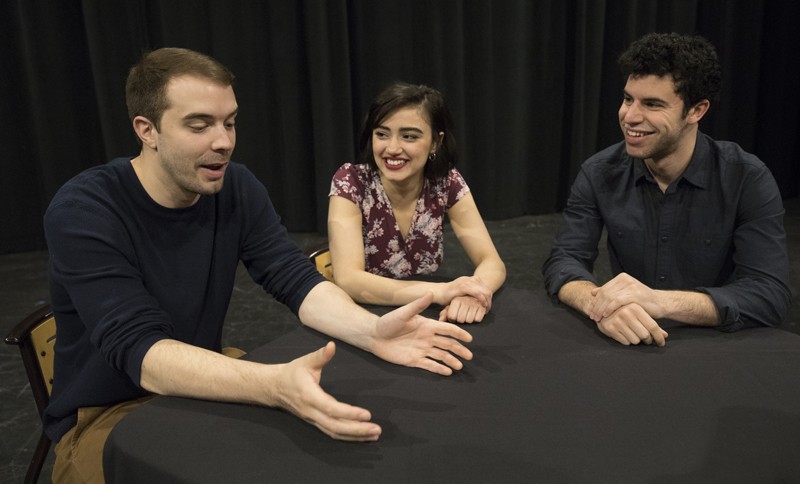
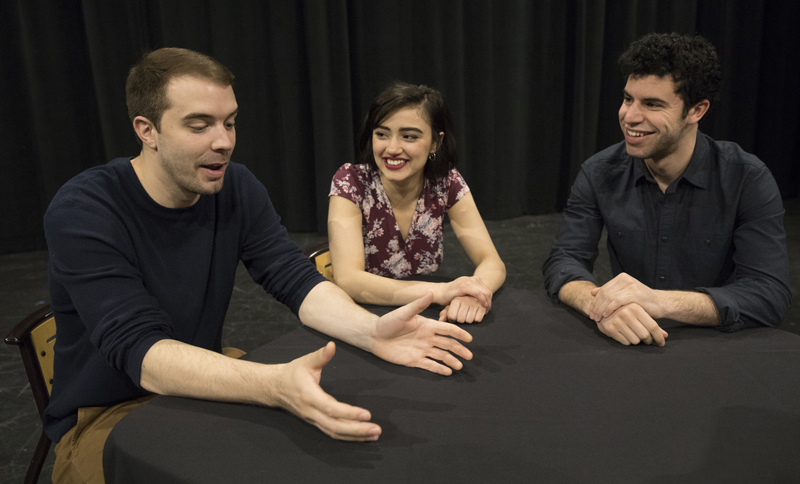
For the past four years, Danielle Nigro, Eric Berger and Jeff Tagliaferro were mainstays of the Mainstage productions from the Theatre Department at Binghamton University. The three 2017 graduates were featured in more than two dozen roles that varied from Nigro and Berger’s portrayals of Hamlet and Claudius, respectively, in Hamlet to Nigro and Tagliaferro singing 1950s tunes as Ella and Jeff in Bells are Ringing.
The trio sat down with Harpur Perspective days before Commencement to reflect on their time in the Theatre Department and discuss the joys and challenges of acting, along with how it helps in other liberal arts classes.
HARPUR PERSPECTIVE: WHAT WAS YOUR FIRST ROLE AT BINGHAMTON? WHAT ARE YOUR MEMORIES OF IT?
Eric Berger: My first role here was George in Don’t Dress for Dinner. It was a small part where I got to come in near the end of the show, beat up the guys and get piled on by the women. My memories were mixed, because it was my very first semester and I didn’t know anyone. But afterward I started to feel completely at home here.
Danielle Nigro: On my first day of college, there were auditions for Rent. New place, new people, I’ll go audition. Why not? I said: ‘Here’s my schedule. I have night classes. Will that interfere?’ Yeah. I almost didn’t audition because of that. I auditioned, I was cast and I changed my schedule — and major — all in a week! So Maureen in Rent was my first role here.
Jeff Tagliaferro: My first role was the officer in Tartuffe. When I came here, I was directing a show called Dog Sees God at the Endicott Performing Arts Center, so I didn’t audition for the fall shows. I auditioned for the spring shows, was called back for Tartuffe and got a small role. I remember the rehearsal schedule was much different than in community or high school. It had a more professional feel.
DN: I got whipped into shape so fast. I was still running on community-theater rules. I got here and learned really fast. It was great to dive headfirst into it.
HP: HOW EXACTLY IS IT DIFFERENT?
DN: Rehearsal etiquette . . .
JT: Being on time. The dialogue between the actors and stage manager. Communication and organization. Someone contacted you every night and let you know what you needed to prepare.
DN: It’s extremely professional here. The way things are run here is more or less how things are in the professional business.
JT: I can’t even think about going back to a loose rehearsal structure.
DN: No, no, no.
HP: WHAT WAS THE ROLE THAT MADE YOU SAY: I CAN DO THIS. LET’S SEE WHERE THIS GOES?
DN: At the end of my first semester, I auditioned for the spring shows, Twilight Zone and Anne Boleyn. I was cast as Anne Boleyn and thought ‘what?’ I was not expecting it at all. When Anne Brady cast me, I thought that someone in the department had extreme faith that I was going to be able to do something. I decided to take it and run with it because even if I wasn’t seeing it, someone else was.
JT: I played the adult male in Spring Awakening. During that semester, I was also taking three classes with Anne Brady.
DN: Three? Whoa!
JT: Yeah, three at once! After the semester, I looked back at myself in the beginning and thought: ‘I’m doing things differently. I’ve broken habits and learned better ones.’ But in every show, there is always a moment when you say ...
DN: Can I do this?
JT: But once you’re performing, it’s like: ‘Even if I can’t do this, I love doing this.’
HP: WHICH IS HARDEST FOR YOU: SINGING, DANCING OR ACTING?
EB: Definitely singing. I can get up and act or dance in front of a crowd — no problem — but I get very nervous singing for people.
DN: They each have their challenges, and I’m always training in all three aspects. The one that I always hit walls with is acting. I guess that’s where I push myself the most. I’ve been singing and dancing my entire life, and they’re both still hard. Acting is still new for me. I didn’t start until I got to college.
JT: For me, it’s singing. I can move, but I wouldn’t call myself a dancer per se. Singing is what I struggle with the most, and I think it’s more of a mental thing. There are very few times I stress out about acting. But if I have to sing in front of people, it makes me uncomfortable sometimes.
HP: SO HOW DID YOU HANDLE STARRING IN [THE MUSICAL] BELLS ARE RINGING?
JT: We had a wonderful team. I was taking voice lessons with Peter Sicilian, and our musical director was James McQuillien. Both of them bolstered my confidence. Of course, working with [director] Tommy Iafrate and Danielle made it an open space. I felt comfortable messing up or sounding off. I knew there were people there who would pick me up.
HP: IS THERE A ROLE YOU DIDN’T GET THAT NAGS AT YOU A LITTLE?
DN: I feel like such a jerk!
JT: Why? Because you get all of the roles?
DN (laughing): Not for long! The real world could be like, ‘See you later!’
JT: You never know. For me, I really wanted Melchior when we auditioned for Spring Awakening. I was bummed that I didn’t get it, but Colin Roth could sing that part to death. I got the adult male [role] and fell in love with it within the first few rehearsals. ... You have to love every role that you get. Take every role and have fun with it.
EB: Every role that I’ve gotten has challenged me in some way or another. Jake in A Lie of the Mind was a role that I really wanted because I knew it would be a huge challenge, but Mike — the part I did get — ended up being a great undertaking in its own way.
HP: WHAT ARE SOME OF THINGS ABOUT A THEATRE PRODUCTION THAT THE AVERAGE AUDIENCE MEMBER DOESN’T REALIZE?
EB: There’s a lot that goes into a production behind the scenes: research about the way of life for these people and everything that affects their actions and words, really investigating the text for what it means and why it’s said, accents, improvisations. It differs by production, but there’s always a lot of work just to understand exactly what’s going on.
DN: Sometimes the biggest misconception — and I hope not everyone thinks this — is that we just learn our lines and go onstage and say them. I didn’t know what acting was until I started studying it. It’s much deeper than saying lines and repeating them.
JT: If I had a nickel for every time after a show someone said: ‘I can’t believe you learned and memorized all of those lines!’ That’s like getting dressed in the morning — and then you have to live your day.
DN: We work moment to moment to moment. If [Jeff’s] face is different than it was last night, our scene is going to go differently. That’s our job: to bring new, fresh life to each scene and moment each time we do it. We are fully emotionally, physically and mentally invested in the roles we’re playing. It’s fun, but it’s exhausting.
JT: If people are saying: ‘Wow! That looks easy,’ it must mean that we’re living and moving onstage and not just doing what we’ve rehearsed.
HP: HOW MUCH DOES THE AUDIENCE AFFECT YOU?
DN: We’re aware of a lot more than the audience thinks! I can see every person on their phone. I can see every person falling asleep. In Lady Windermere’s Fan, the house lights were at half and I was onstage but not doing anything for 20 minutes. I’m listening to the scene, but I can see you on your phone, you sleeping. The energy of the audience affects us, as well. If the audience is with you and laughing and clapping, we can tell they’re along for the story ride. That helps us. But if they’re not, it’s our job to still be amped up even if they are snoozing out there. I remember going out to sing “Over the Moon” in Rent. I was facing the audience and could see how packed the house was. It was so exciting. But tiny houses can be great because they’re all listening.
JT: They’re engaged because there are so few of them, and they’re afraid to detach. They’ll stick out!
DN: We can hear you, too. Remember when someone started Facetime-ing during Dancing with Lughnasa? All of that affects us onstage.
EB: At this point, I really only get nervous on opening nights, but a crowd can greatly affect how a performance goes, giving us more energy or sucking it out of us. You just have to try to stay in the circumstances of the play and not let the responses — or lack thereof — hurt you.
JT: There was a night with Lady Windermere’s Fan in which there were a lot of alumni here. Chilean students had just come and done a project with us, and they were in the audience, too. Before the curtain even opened, we could feel the energy from them. They were clapping and hootin’ and hollering. They literally were hootin’ and hollering! When the audience is giving you laughter or gasps or whatever, that also affects you and makes it new..
DN: When we first get before an audience, something you’re not expecting will get a huge laugh. You have to stay in the moment and wait until —
JT: The peak of the laughter.
DN: And then start saying the line because the laugh is going to die out. We can’t just plow through with our lines if the audience is ‘hootin’ and hollering.’
HP: HOW HAS THEATER AND ACTING HELPED YOU IN YOUR LIBERAL ARTS CLASSES AT HARPUR COLLEGE?
EB: I can BS things better! But really, I’ve gotten better at giving presentations, and I’m more inclined to give my input in discussions, even if it’s controversial.
DN: I’ve noticed an increase in my ability to focus: being in the room, listening and receiving the information that my teachers are giving me. The [professor] is up there doing a kind of performance. There’s nothing worse to me than seeing kids sitting back, on their phones, doing nothing when the teacher makes a joke. I’ve found myself to be a far more active student in terms of listening, responding and wanting to be part of the learning.
JT: We do a lot of exercises in our [theatre] classes that allow us to be open and to listen. I find myself doing those exercises — breathing deeply — in classes when I’m absorbing things. Sometimes teachers see me looking blank, but that’s when things are hitting me. In our scene-work class, we learned that there are no consequences in the scene, so do what you want. Sometimes I take this too far in the [non-theatre] classroom. I’ll do or say anything like there’s no consequence.
DN (laughing): I think that makes us stick out. Jeff and I were in a history class and you could feel the [lack of] energy from the rest of the room. And then there was the two of us.
JT: We get some strange looks. Livening up the classroom is something that sometimes happens.
HP: FAVORITE NON-THEATRE CLASS?
JT: Anthropology of Corporations. Whenever I say that to anybody, they go “ohhh!” It’s the world we live in. We discuss how capitalism controls how corporations run and do their business, and we look at the effects on everyday people in the community around them. Growing up in Binghamton, I know a lot about Endicott Johnson Shoe Company. I have friends and family who live in houses built by this corporation. It’s very interesting to me.
DN: I took an Apocalyptic Literature class in the English Department my freshman year. It was so cool. I read a lot of great books, and the professor was cool. I thought: ‘Non-theatre classes are cool, too.’
HP: IF YOU COULD TAKE A TIME MACHINE AND GO BACK TO SEE ANY SHOW IN ITS ORIGINAL FORMAT, WHAT WOULD YOU SEE?
JT: I would go back to 1972 and see the original Pippin with Ben Vereen.
EB: That’s a good choice!
JT: I’ve seen clips of it on YouTube. It was one of the first shows I worked on as a director, and I just fell in love with the style. There’s something about the show that really grabs me. Ben Vereen is one of my all-time favorite performers.
EB: I might actually agree with you.
DN: I’ll see you guys later!
EB: The musicals of the 1970s were so different from today. Now it’s much more naturalistic — we do musicals about life. Back then, with Bob Fosse doing choreography, it was insane. I would like to see [Pippin] as well, so I’m going to hop in the time machine with you.
DN: This is the impossible question. Thoroughly Modern Millie is the reason [I said]: ‘I want to play that part one day! I want to do musicals! I want to do theater!’ I would go back to 2002 when they did it on Broadway with Sutton Foster. That would fulfill some part of me that’s missing — just to be able to say that I’ve seen it.
HP: WHAT ARE YOUR POST-GRADUATION PLANS AND CAREER GOALS?
DN: Auditioning. Auditioning. Auditioning.
JT: For the next year, I’ll be working locally in theater. I plan to travel and visit some theaters that I found in my studies with Anne Brady that intrigue me. Chicago is a place I’d like to end up, but I have friends and family all over the place. I’d like to find a city to hang out in for a couple of years before moving on.
EB: I’d like to move back to [New York City]. My parents live in the Bronx. I would actually like to do some voice acting. I have a friend who is breaking into voice acting, so I’m going to ask advice from her. Maybe I’ll end up on the next Simpsons.
HP: WHAT SHOW AND PERFORMANCE WOULD YOU PUT FIRST WHEN SOMEONE ASKS: ‘WHAT WERE YOU IN AT BINGHAMTON UNIVERSITY’?
DN: Hamlet. I got to play Hamlet, and it was a very important point in my acting career and my time here. It was with Anne Brady, who is also my mentor.
JT: Playing Jake in A Lie of the Mind was the biggest challenge I had. It was also the meatiest role I had. But I would also bring up playing the ghost and gravedigger in Hamlet. It was similar to my role in Spring Awakening. Afterward, I thought: ‘I’m a better actor than I was earlier in the semester because of the role and show.’
EB: There are three shows I would put up there — all vastly different. Hamlet as King Claudius. Lying Kind was the most fun I had working on a show. In Stupid F-ing Bird, I was working with people older than me whom I looked up to. I learned so much from that production, and felt that I had grown so much.