School of Management students fly high on the world stage
Binghamton takes on opponents from across the globe in supply chain case competition
There’s a reason why training might be reduced to a three-minute montage within a two-hour sports film. Preparing for the big event is not as exciting as the big event itself — especially if preparation involves running computer simulations that combine numbers and business concepts.
But a team of School of Management students facing opponents on the world stage have made it clear that running computer simulations is just as helpful as the training that propels Rocky Balboa through the “Gonna Fly Now” theme song toward the main event.
“If you have the ambition, and if you want to do well, the best thing you can do is prepare,” said Barbara Perez, a senior business administration major.
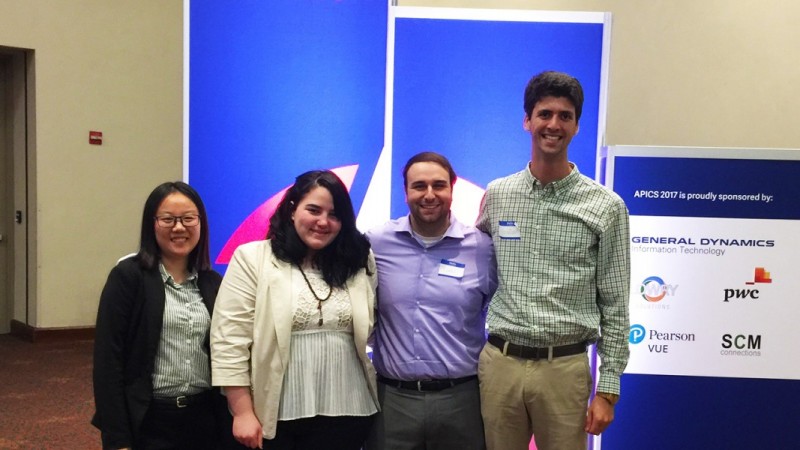
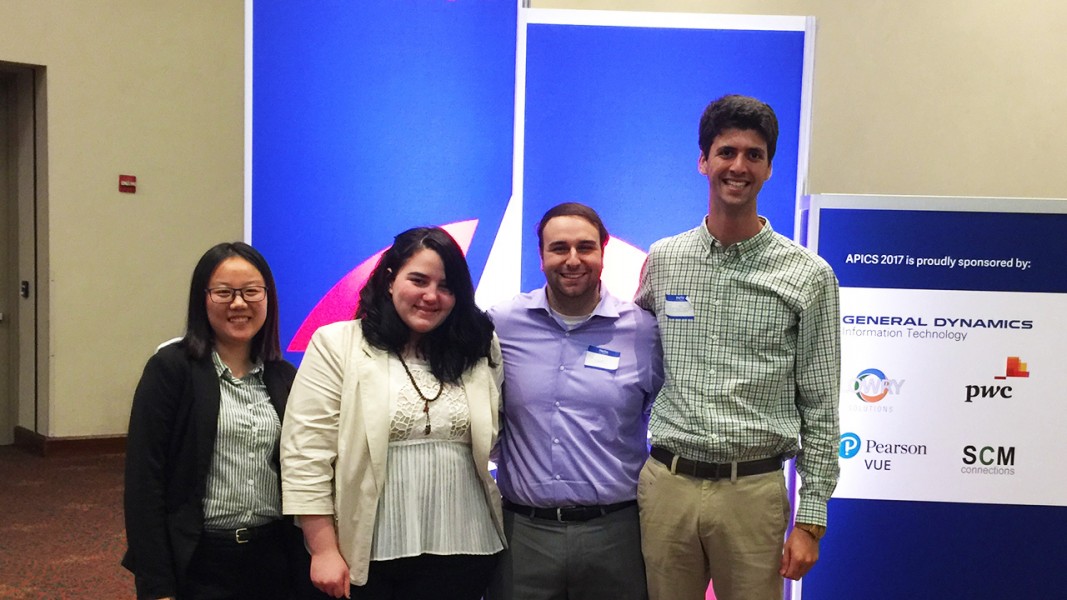
The team of Perez, Liyang Tao, Sam Clarke and Jonathan Aranov placed sixth in the annual APICS International Student Team Competition in San Antonio. They went up against teams from around the world in a supply chain case challenge that was the culmination of over a year of preparation.
To get to the final stage, the team had to first win a number of preliminary rounds, including a regional round in Albany that pitted them against undergraduate- and graduate-level teams from schools all over the Northeast. They rose to the top and immediately began to prepare for the final challenge, even though it was still months away.
In the case competition, teams face off by strategically adjusting a number of variables in a computer simulation to drive the best return on investment (ROI) for a mock company. The company, a manufacturer of fruit juices, is facing a decline, and effective supply chain management is needed to save it from financial ruin.
“These kinds of competitions involve some predetermined elements. Luck favors the prepared, and we made sure we were prepared,” said Perez, the team’s leader.
While the team didn’t know the specific variables that would be set on game day, they made sure they knew the computer program inside and out.
Don Sheldon, an adjunct lecturer for SOM and the team’s advisor, said the team ran various scenarios in the program to get familiar with it, even over summer break.
The team also developed a strategy that would serve as their “north” — something that would guide them while they navigated the chaos of game day. Perez said the team decided its strategy would be to focus on customer service, even if it came at a high cost. The idea was that if their customers were happy, they’d be able to increase overall margins by creating loyalty and having the ability to charge customers more for their product.
After months of team meetings and computer simulations, the time arrived for them to put it all on the line in San Antonio.
Competing against “heavyweights” from all over the world can be intimidating, but Perez said the team felt confident and excited to get the challenge started.
“I told myself, ‘We’re as good as any of these teams. We’re here, so we’re at their level. All that matters are the decisions that we’re going to make,’” she said.
Each of the four team members were assigned a role as a VP of a specific division (purchasing, sales, supply chain and operation) within the failing juice company, and together they worked to turn it around over the course of two days. They had to take into consideration numerous supply chain elements (inventory levels, contracts with suppliers, warehouse capacity, production intervals, etc.) while working through the problem.
“There is a lot to consider when making these decisions. If you move one knob, it affects three others. There are a lot of moving parts,” Sheldon said.
The team also had to deal with virtual curveballs thrown at them over the course of the competition. These challenges provided opportunities for the team to possibly save money by changing course, but the members were determined to stick to their “customer service above all else” strategy.
“We stuck to the basics, and we stuck to our strategy, and we had consistent ROIs all through the competition. I am proud of how the team performed,” Perez said.
The team placed sixth, an improvement over last year’s placement of eighth, and was also the second-highest ranked team from the United States.
Perez credited the team’s success to how much they prepared, but said the School of Management sets students up for these kinds of achievements.
“There are a lot of presentations you need to do in SOM, as well as group work,” she said. “You get presentation and team dynamics down pretty quickly. The school sets us up with these best practices.”
“I think the School of Management is very serious about success,” Sheldon said. “The professors are invested and interested in the success of the students, and the students keep it fun. And the success shows.”