Mobile apps: fun and functional
Binghamton University students created mobile apps that are ready to download.
A computer science class at Binghamton University gave students a chance to create their own mobile apps based on a partnership with a local doctor or their own unique ideas.
The class, led by associate professor Patrick Madden, gives students some hands-on experience with app creation and quite a bit of creative freedom.
“The students can make anything,” said Madden. “Some run with it and figure out their own path and others follow along with something Dr. Steinberg suggests.”
Dr. Joshua Steinberg, a medical doctor at UHS in Johnson City, does a lot of work with medical training and continuing education for physicians and found that he needed a way for staff to stay up to date on information.
“Dr. Steinberg came to me with questions about how to translate complex charts into mobile applications,” explained Madden.
At the beginning of the spring 2017 semester, Steinberg visited Madden’s class to pitch his ideas to students. A handful of students took on the challenge of translating Steinberg’s ideas into functioning mobile apps.
“It’s actually similar to what students would do on the job. They are given the information that needs to be automated and then have free rein to decide how to do it,” said Madden.
The apps are designed for physicians who need to quickly look up things like procedural diagnoses or calculations that can help interpret test results. A few of the apps have even made it into the app store.
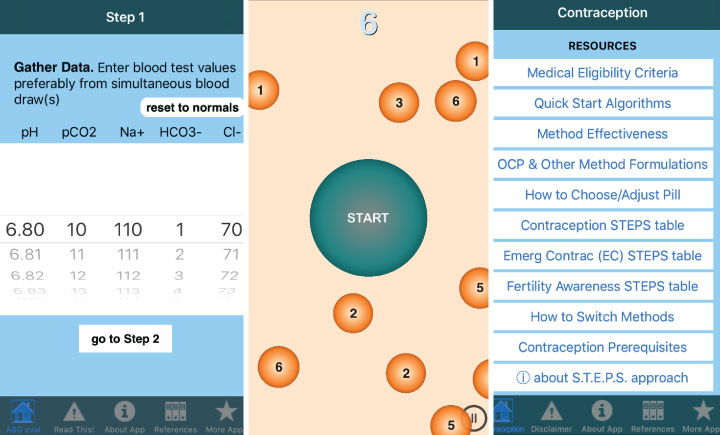
Student Eric Scagnelli created an app called Contraception Point-of-Care that allows physicians to quickly look up things like the cost of contraceptive options, which birth control methods are unsafe for patients with migraines or various methods of emergency contraception.
Scagnelli’s app is currently available for free download in the iTunes app store.
Pravin Biradar developed an Android app called ABG Acid-Base Eval. It guides clinicians through a step-by-step analysis of acid-base disorders and teaches the users as it diagnoses.
The app has already been downloaded by more than 1,000 people.
While the partnership with Steinberg gave students ideas for useful apps that will benefit medical professionals, other students went with their own ideas.
For instance, Aris Agdere created a game called Blooper that is bound to be everyone’s favorite way to kill some time.
The highly addictive game has users tap a central ball until it disappears. Part of the trick is to keep the ball from gaining strength through the other balls bouncing around the screen. Each level gets more difficult.
Madden plans to continue his partnership with Steinberg. “He has plenty of other app ideas and I am looking forward to seeing which options students take up next,” said Madden.