Binghamton University student builds model that predicts S&P 500
A PhD student from the systems science program recently published his research model that improves S&P 500 prediction accuracy by 20 percent.
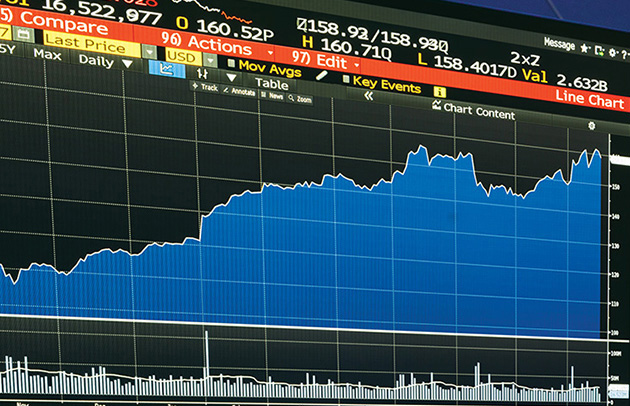
A Binghamton University systems science PhD student has built a system that is capable of predicting the movements of the S&P 500 one hour into the future.
Minjun Kim’s study “Predicting stock market movements using network science: an information theoretic approach” was done with guidance from systems science and industrial engineering professor Hiroki Sayama.
Kim originally came to Binghamton to study economics. “He was getting his
He used the price records of nearly 500 different stocks in the S&P 500 to build his model. “I looked at the changes that occurred in the companies over the course of an hour with one-minute intervals. I had data over 89 total hours spread over 15 days,” he explained.
Kim then used that raw data to create 89 different networks “similar to networks of neurons in your brain. Each neuron is connected and we can figure out certain things based on those connections,” said Kim.
Kim had already developed a model that could follow the S&P 500, but this research intended to make that more accurate.
The tedious and detail-oriented project required Kim to calculate the differences between every possible pair of the nearly 500 different S&P stocks. With that information, he then built matrices of various factors that could be predictors of the S&P 500’s movements.
“The two most statistically sound predictors were relative strength and Kullback-Leibler divergence of the connectivity distribution among stocks,” Kim said. The Kullback-Leibler divergence, also known as relative entropy, is a way to compare two probability distributions.
With the relative strengths and the Kullback-Leibler divergence metrics included in Kim’s prediction models, the predictive accuracy went up 20 percent.
Kim used what is called the mean squared error (MSE) to understand the accuracy of his model. It tells statisticians how closely a model follows the data. A lower MSE means that the predicted model more accurately follows the data. Kim’s model originally had a mean squared error of 26, but after including the matrices the MSE is 20.
Kim is all but dissertation in the systems science program at Binghamton University and recently published his findings in the Applied Network Science journal.
This research study was a chance for Kim to explore economics in exactly that way and is what Kim plans to continue working on in the future.