Inventors versus imitators: Who really has the advantage?
"Marketing Strategies for Global Success" the theme of fourth Global Trade and Investment Forum
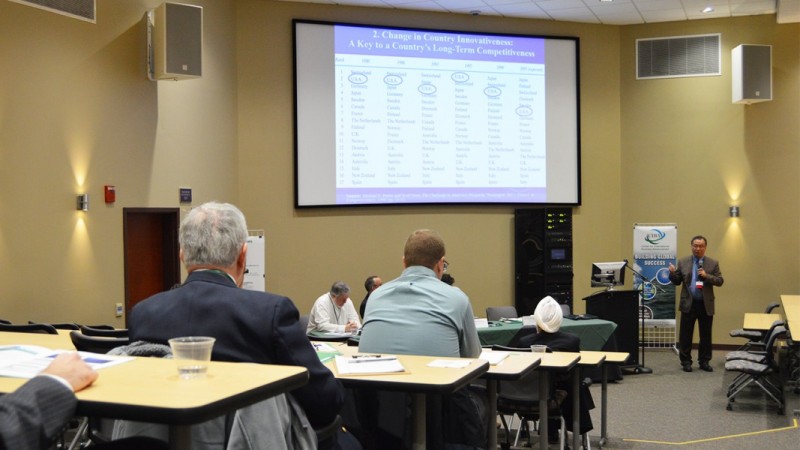
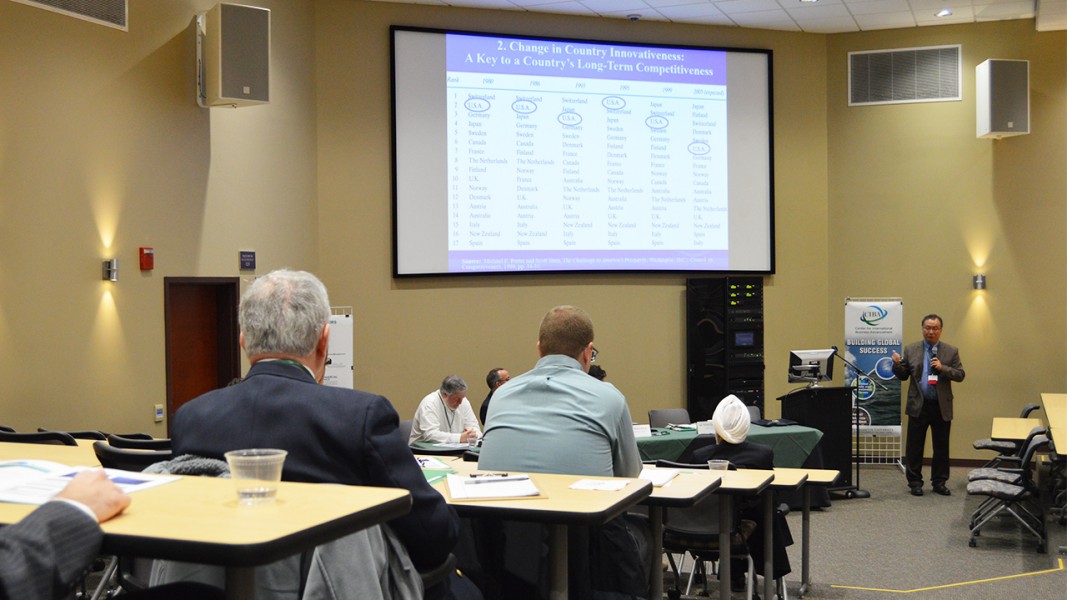
The business world is becoming increasingly global, as ever-changing technology helps eliminate some of the barriers to doing business across borders. To help companies in New York’s Southern Tier, where Binghamton University is located, learn what it takes to become players on the world stage, a forum of experts highlighted things to consider in today’s business climate.
The fourth Global Trade and Investment Forum took place on Nov. 17. The biannual event, organized by the Center for International Business Advancement at Binghamton University (CIBA), brings together leaders from local business and academic communities, and features a panel of experts from international business fields.
“This allows the community to understand the world around us and the importance of globalization. We need to understand how these processes are impacting us and how they are going to impact our businesses and future careers,” said Elena Iankova, founding director of CIBA and an adjunct assistant professor in the School of Management.
“Marketing Strategies for Global Success” was the forum’s theme and featured keynote speaker Masaaki Kotabe, distinguished professor in international business and marketing at the Fox School of Business at Temple University. His talk focused on the changing nature and sources of competitive advantage.
Kotabe compared the overwhelming success of Apple and the underwhelming success of Sony to illustrate how the nature of competitive advantage — when a company has a temporary “monopoly” in a specific market due to its superior technology or product or service — has changed in recent years.
Looking strictly at the number of patents each of the companies has held since the turn of the century, Sony has consistently been what Kotabe considers a high-tech company (one that holds a large number of patents), while Apple has been more of a low-tech company. While Sony has consistently been ranked as one of the top patent holders in the United States, Apple had been ranked far lower, but has climbed the list significantly in the past 15 years.
Kotabe noticed that Apple’s biggest jumps in the ranking matched the release of products like the iPod, iPhone and iPad. “When Apple was introducing some of the most successful products ever in the history of mankind, they weren’t that high-tech if you look at the quantity, not the quality, of their patents,” he said.
But by the time Apple released the less-successful Apple Watch in 2015, it was ranked 12th on the patent list and, by then, considered a high-tech company by Kotabe’s measure.
“When Apple became so high-tech, it started failing. How do you explain this? Was it by chance?” he asked.
Kotabe began to dig deeper. He referred to a collection of Wall Street Journal announcements of new products and technologies that he had been holding onto over the years. He broke these products down into two categories — inventors and imitators — and found that the imitators were the products that were often successful.
Kotabe demonstrated this by referring to cola drinks. Most of the variations in cola (diet, caffeine-free) that we see today were actually invented by RC Cola, but it’s been Coca-Cola (the imitator) that has achieved the most success with its lineup of cola variations.
“Coincidentally, looking at these articles, I found that inventors are more likely to fail and imitators are more likely to succeed,” he said. “This is the opposite of what we learn in textbooks — including my own. What is going on in real life? How do we make sense of this?”
This is where the changing nature of competitive advantage comes in. With today’s technology changing at a faster rate than ever, the window of time in which companies have a competitive advantage when new products are developed is becoming smaller and smaller. This gives an edge to the imitators to either catch up or surpass the inventors.
“Thirty or more years ago, if you had a temporary monopoly in your market, that would mean you probably had a five-year competitive advantage. Today, that life cycle is six months for new products and new ideas,” Kotabe said.
And with patent applications being made public online before the patent is even awarded, people can see what future products are in development all around the world with the click of a mouse. It’s no longer about who invented a product first, Kotabe argues, it’s now about who can use the inventor’s knowledge to bring it effectively to market first.
So while Apple’s launches of the iPhone and iPod were some of the most successful ever, Kotabe says they weren’t the first smartphone and MP3 player, respectively, to have been released. Apple, an imitator, was able to take existing technologies and mass produce and mass market them faster than the competition, transferring the competitive advantage in those markets from the inventor to Apple.
“Anyone can steal your knowledge and do it quickly. And two years down the road, your knowledge is obsolete because of how fast technology is changing, so a judge won’t take it up anyway if you want to take action,” he said.
Kotabe suggests that a change in intellectual property laws to better suit the modern era may lead to a shift that may be more advantageous to inventors.
The forum also featured:
- Robert Manogue, director of the Office of Bilateral Trade Affairs at the U.S. Department of State’s Bureau of Economic and Business Affairs, who discussed U.S. trade policy and navigating markets across barriers.
- Eric Niermeyer, president of American Craft Furniture Inc., who shared insights as an exporter on marketing innovation for global success.
- Alan Michaels, owner of Industry Building Blocks, who discussed resources available for information on global marketing.