New Harpur students get academic planning and success tips
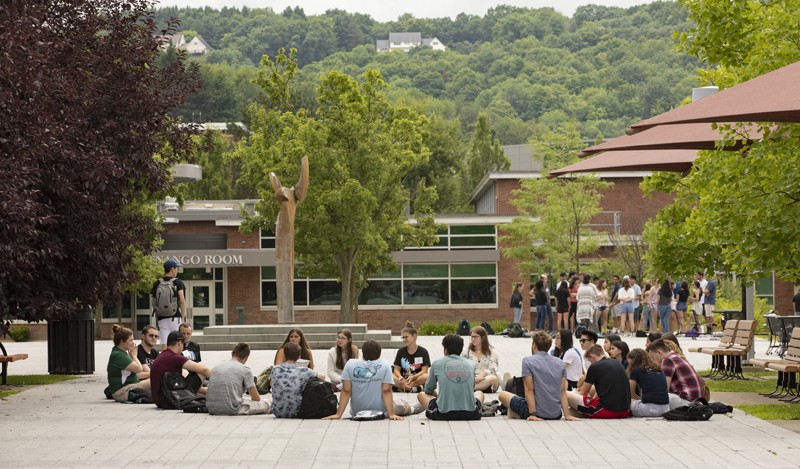
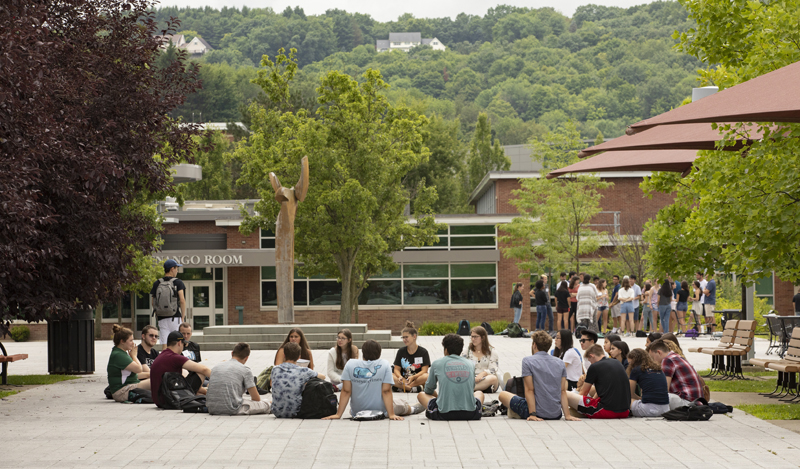
Incoming Harpur College freshmen received a one-word piece of advice as they embarked on their Binghamton University journey: Explore.
“This is probably the only opportunity in your academic lives or careers in which you get to explore,” geography Associate Professor Mark Reisinger told the recent high school graduates at a July orientation session. “When you go to graduate school, you focus on one area. There is no exploration. … Take classes all over Harpur College and find out what you really like. You may be surprised.”
“This is what college is for: Trying a different major, trying a different class, trying a different job field,” added Laura O’Neill, a career consultant at the Fleishman Center for Career and Professional Development. “Do different things to experience what your classes are about.”
Reisinger and O’Neill led the hour-long talk on the value of a liberal arts education. The session was just one element of a two-day summer orientation for incoming Harpur freshmen and transfer students.
Harpur College will provide students with a broad range of knowledge, Reisinger told the group of 70 gathered in the University Union. The college features more than two dozen majors in three divisions.
“One of the things you need to stop thinking about is college being a job-training opportunity,” he said. “In Harpur College, we’re not here to train you for a job. We provide you with knowledge that you can use in lots of different areas.”
A little more than half of the students indicated that they already knew what their major will be at Harpur College. Reisinger countered that it is OK for students to change their minds about majors and careers while at Binghamton University.
Reisinger then asked how many students plan to major in geography. Not one hand was raised.
“If nobody comes to major in geography, why do we even have a Geography Department at the University?” he asked.
Minds can change, the students said.
“We have 150 majors in geography, even though nobody comes here to major in geography,” he said. “How does that happen?”
The answer: Exploration.
“Students take our (geography) courses and find out that it’s not their stereotype of the discipline. Geography is more than finding places on a map,” he said, adding that the major features critical and analytical thinking, along with technology such as satellite imagery and drones.
Reisinger, who also serves as collegiate professor of the Newing College residential community, shared other academic-success tips with the students. He stressed the importance of making connections with faculty members and urged students to attend office hours and sit at the front of large classes.
“If you are sitting in the rear of the Lecture Hall, how engaged in what’s going on (at the front) will you be?” he asked.
A course syllabus, Reisinger said, will not only provide necessary information about the class but also show the workload expectations. At Binghamton University, students should study nine-and-a-half hours per week for each course, he said.
“When you come to Binghamton University, your academic life is going to change,” he added.
Reisinger then gave students a time-management lesson. They start with 168 hours in a week, with 12 hours spent in class, 56 hours for sleeping and 14 hours for meals. That leaves 86 hours — and 40 should be spent studying for classes in what Reisinger called “productive time.”
“Set aside a block of time each week, each day, that you are going to focus on your academic work,” he advised. “Don’t study in your room — too many distractions. … Find a space that’s quiet. When you walk into that space, you can say: ‘I’m here for one purpose: I am here to focus on my academics.’”
The remaining 46 hours of the week are a second level of “productive time” devoted to extracurriculars, such as campus clubs and community clubs.
Reisinger said he believes that students learn as much out of class as they do in it.
“The classroom provides you with knowledge,” he said. “But outside the classroom, you learn about yourself. You build character.”
Whether it’s on or off campus, students can gain transferrable skills that will help them in life as they go down their career paths, O’Neill said. Some examples include problem solving, working with a team, written and verbal communication, work ethic, leadership and initiative. The skills can be acquired through education abroad, internships, working with the Center for Civic Engagement or conducting scholarly research with a faculty member.
“Experience is important, but the skills you gain are going to take you a long way,” O’Neill said.
Most of the students in the room raised their hand when Reisinger asked how many were a little scared or anxious about starting college. He assured them that this is normal, expected and part of the journey.
“I go to graduation and sit on stage,” he said. “I will see you walk across the stage. I may not remember your name, but I’ll remember your face. I will see you walk across the stage as a young, confident adult.”