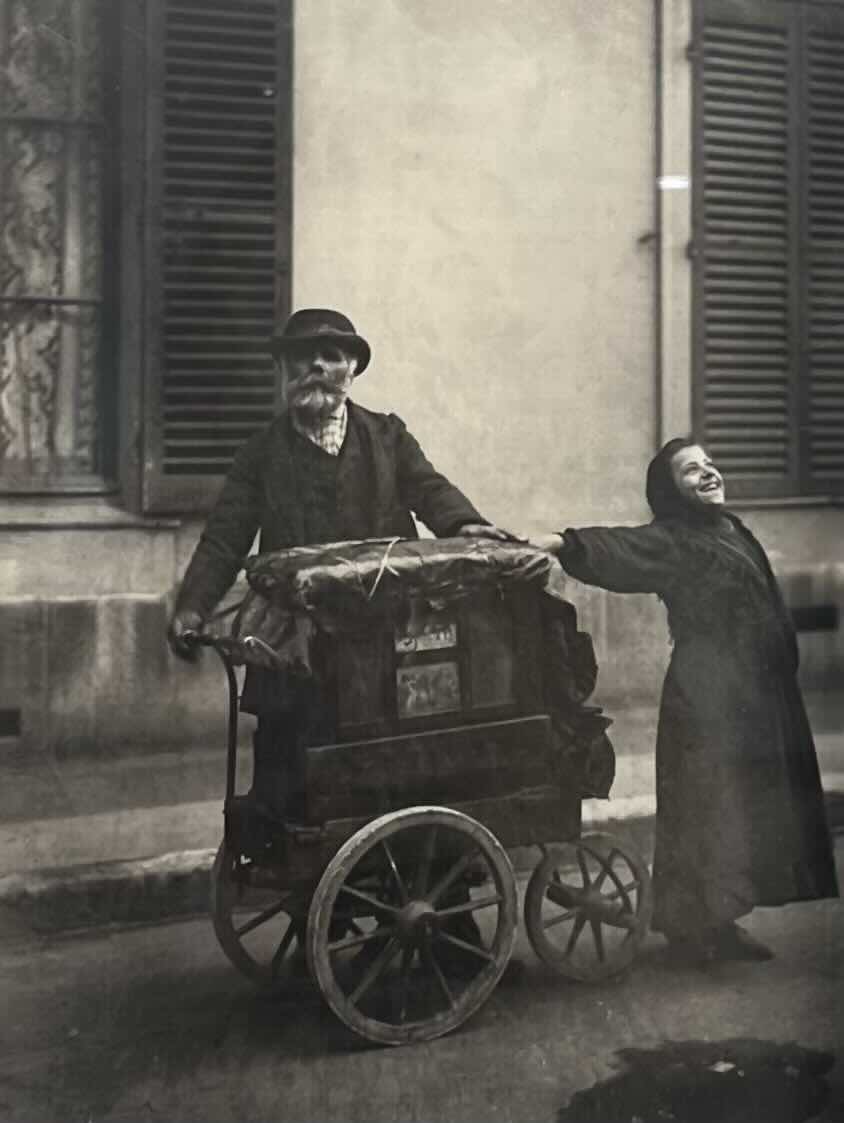
In 1929, Abbott returned to New York, taking with her more than fourteen hundred glass negatives and nearly 8,000 vintage prints. Determined to promote Atget’s work to an American audience, Abbott made modern prints from Atget’s plates, exhibiting them where she could and, in 1930, publishing Atget, Photographe de Paris (New York: E. Weyhe), the first survey of his photographic work and the beginning of his posthumous fame. The print we have therefore marks the intersection of two photographic careers: that of Abbott who, in 1935, would begin her own documentary project on “Changing New York;” and that of Atget who, by the time of his death, had methodically assembled and catalogued thirteen separate series of photographs documenting “Old Paris,” its environs, streets, architecture, parks, interiors, religious arts, and rapidly vanishing street trades, or petits métiers. It is to this latter series that the “Organ-grinder” belongs, alongside the knife-sharpener, the bread-boy, the fishwife, the pot seller, and the lampshade peddler, all posed with the attributes of their trade as models and types. But here, while the squarely framed organ-grinder stares grimly into the camera, the sheer ebullient joy of the child breaches the frame and breaks the mold, filling the street with raucous music and making this one of Atget’s most evocative images of street life in turn-of-the-century Montparnasse.
John Tagg, SUNY Distinguished Professor Emeritus of Art History
*Select photographs from Atget, Photographe de Paris can be viewed on the screen nearby.