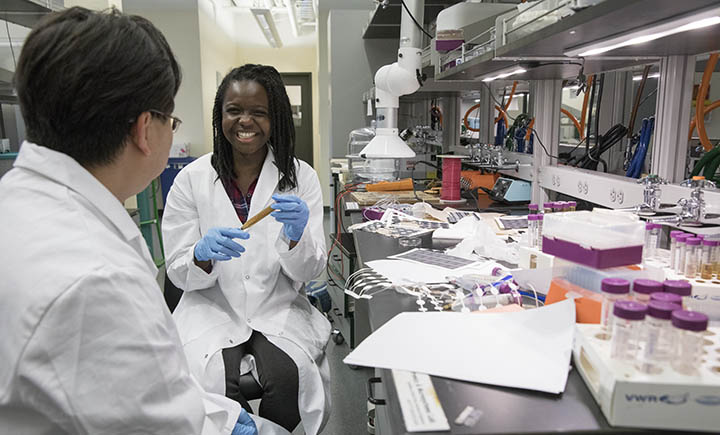
The world is experiencing a transformation where biology, electronics and data science converge to tackle critical challenges in healthcare, food safety and environmental sustainability. Bioelectronics enables direct interaction between living systems and devices, powering innovations like wearable sensors, bioenergy systems and living materials. Bioinformatics turns biological and environmental data into actionable insight, guiding intelligent system design with computational modeling and machine learning.
The Bioelectronics and Bioinformatics Cluster in the Department of Electrical and Computer Engineering integrates these fields to create adaptive systems that monitor health, track pathogens, detect pollutants and advance sustainability. Through interdisciplinary research, hands- on education and industry partnerships, we train the next generation of engineers to lead in this rapidly evolving frontier.
Specialties
- Bioelectronics and green electronics
- Biological microelectromechanical systems (BioMEMS)
- Lab-on-chips and organ-on-chips
- Biosensors
- Bioinformatics and AI-driven analytics
- Predictive physiological modeling
- Energy harvesting techniques
Related courses
Potential career pathways
- Biomedical and Healthcare Engineering: Design and integrate electronic circuits, sensors, and embedded systems for medical devices as a biomedical engineer, medical device designer or R&D scientist
- Biotech and Pharmaceuticals: Apply signal processing, machine learning, and systems modeling to biological data as a bioinformatics Scientist, computational biologist or drug discovery engineer
- Environmental and Sustainability Technology: Develop electronic platforms for pollutant detection, microbial power generation, and resource monitoring as an environmental biosensor engineer or bioenergy specialist
- Microelectronics and Smart Systems: Engineer flexible, low-power and biointegrated circuits for next- generation wearables and IoT systems as a bioMEMS engineer, flexible electronics designer or device architect
- AI and Data Science in Life Sciences: Combine embedded sensing with AI algorithms to extract actionable biological insights as a machine learning engineer, biomedical data analyst or health informatics specialist
- Academic and Government Research: Advance bioelectronic science and technology as a professor, research scientist or program manager at universities, national laboratories or federal agencies (NIH, NSF, DOE, ONR)
Research accomplishments and achievements
- Researchers boosted bacteria-powered biobattery performance using a 3D-printed stainless-steel micro-anode.
- Developed at Watson College, biodegradable “papertronics” use paper-based circuits with built-in components as a sustainable alternative to traditional electronics.
Faculty
 View Full Profile
 Anwar Elhadad
Assistant Professor
Electrical and Computer Engineering
 View Full Profile
 Jungwook (Jay) Paek
Assistant Professor
Electrical and Computer Engineering
 View Full Profile
 Ramesh Pokharel
Associate Professor
Electrical and Computer Engineering