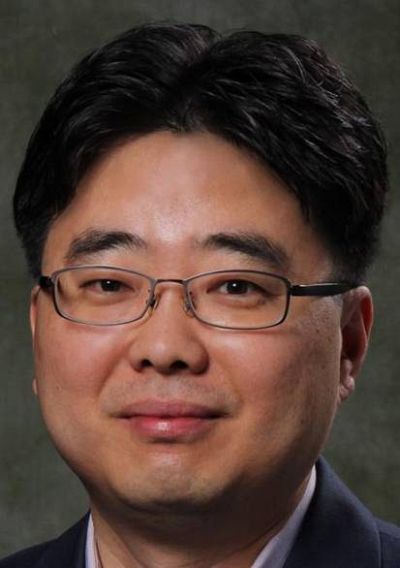
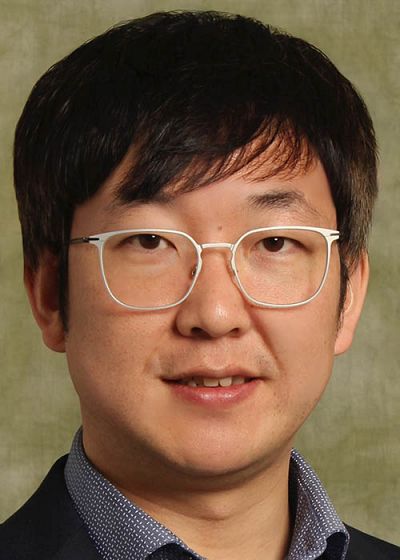
We are power systems engineers in the Department of Electrical and Computer Engineering, committed to powering people’s lives, driving innovation and combating climate change. Our mission is to enable a clean, intelligent, and resilient electric grid that supports society’s rapid electrification — from renewable energy and data centers to electric vehicles. Our research spans the full energy ecosystem:
- Power generation, where we study renewable and inverter-based resources and collaborate with material scientists developing next- generation photovoltaic technologies
- Transmission and distribution systems, where we enhance grid stability, protection, and planning to accommodate high levels of renewable and distributed energy resources
- Energy storage, where we integrate both electrochemical systems and emerging bio-batteries for flexible and sustainable storage solutions
- Demand-side systems, where we model dynamic and aggregated loads—including data centers, EVs and microgrids—to improve reliability, efficiency and demand flexibility
Students in our group engage in both theoretical modeling and hands-on research with utilities, national laboratories and industry. After graduation, they pursue impactful careers as grid engineers, renewable integration specialists, data scientists, and researchers — advancing the transition toward a carbon-free energy future.
Specialties
- Power systems dynamics
- State estimation
- Microgrid
- Renewable resources integration Photovoltaics and thin-film semiconductors
- Energy harvesting techniques Bioenergy
- Energy storage systems
- Lithium- and sodium-ion batteries and battery management systems
- Electric vehicles and dynamic wireless charging
Related courses
- Loading Course Info...
- Loading Course Info...
- Loading Course Info...
- Loading Course Info...
- Loading Course Info...
- Loading Course Info...
- Loading Course Info...
- Loading Course Info...
- Loading Course Info...
- Loading Course Info...
Potential career pathways
- Power and Energy Systems Engineering: Design and analyze modern electric grids integrating renewables as a power system engineer, transmission planner or grid integration specialist
- Control and Stability Analytics: Develop control and stability solutions for complex power networks as a control engineer, stability analyst or real-time simulation engineer
- Renewable and Inverter-Based Resource Technology: Model and control solar, wind, and battery systems as a renewable integration engineer, IBR specialist or energy conversion engineer
- Automotive and Battery Electric Vehicle: Developers and designers of battery modules and packs, onboard charging systems, battery safety and management engineers, battery researchers at leading automotive manufacturers, CCS and ChAdeMO adapters and EV charging system designers
- Simulation and Digital Twins: Build phasor- and EMT-based digital twins for grid studies as a power systems model developer or simulation engineer
- Transmission Planning and Reliability: Conduct interconnection and stability studies to ensure reliable grid operation as a transmission planning or reliability engineer
- Energy Storage and Microgrids: Integrate distributed storage and microgrid systems for resilience as a microgrid engineer or energy storage specialist
- AI and Data-Driven Energy Analytics: Apply AI and signal processing to grid data for forecasting and state estimation as a power data scientist or PMU analytics engineer
- Academic and National Lab Research: Advance grid dynamics, renewable integration, and EV battery as a research scientist, professor or program manager
Research accomplishments and activities
- Researchers win $1.2 million NSF award to test stability of power grids as more renewables are added.
- Binghamton team to lead $2.6 million research into solar energy and power grids
- A tiny bacteria-powered biobattery developed at Binghamton University can stay viable for up to 100 years before use.
- A breakthrough technique at Binghamton University enables low-energy production of ultrathin tin sulfide films, potentially cutting costs for solar cells and electronic devices.
- Student researchers studied next-generation solar cells to reduce lead use and improve environmental safety.
- Binghamton University hosted a Battery Safety Symposium bringing experts together to address battery storage risks and safety solutions.
Faculty
 View Full Profile
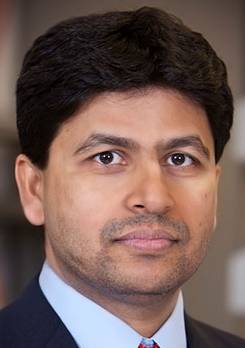
 Indranil Bhattacharya
Professor and Department Chair
Electrical and Computer Engineering
 View Full Profile
 Tara Dhakal
Professor; Director
Electrical and Computer Engineering; Center for Autonomous Solar Power (CASP)
 View Full Profile
 Vladimir V. Nikulin
Associate Professor; Director of Graduate Programs
Electrical and Computer Engineering
 View Full Profile
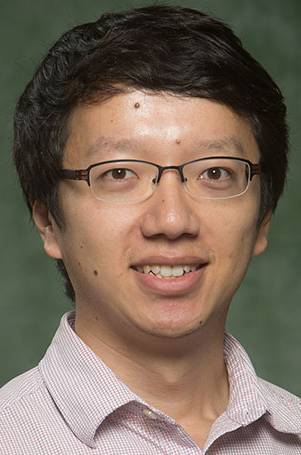
 Ziang "John" Zhang
Associate Professor
Electrical and Computer Engineering
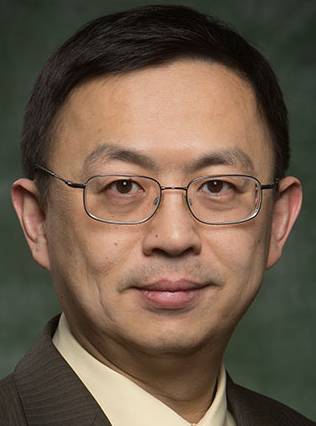 View Full Profile
 Ning Zhou
Associate Professor; Director of Graduate Admissions
Electrical and Computer Engineering