Everything you need to know about snow season at Binghamton University
Winter parking rules now in effect
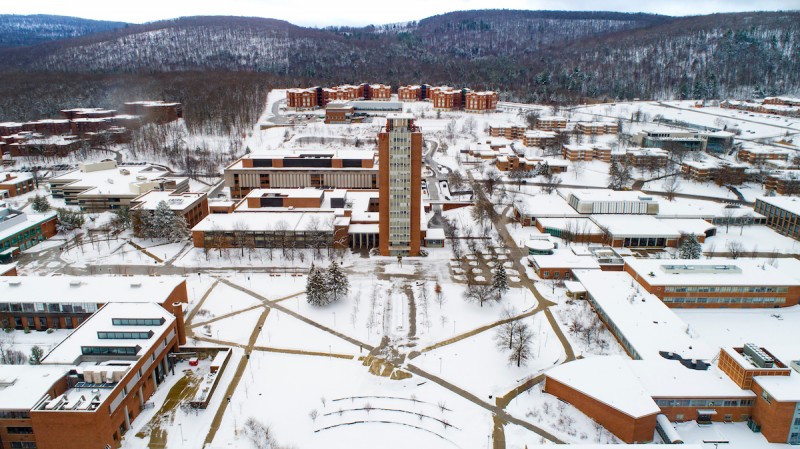
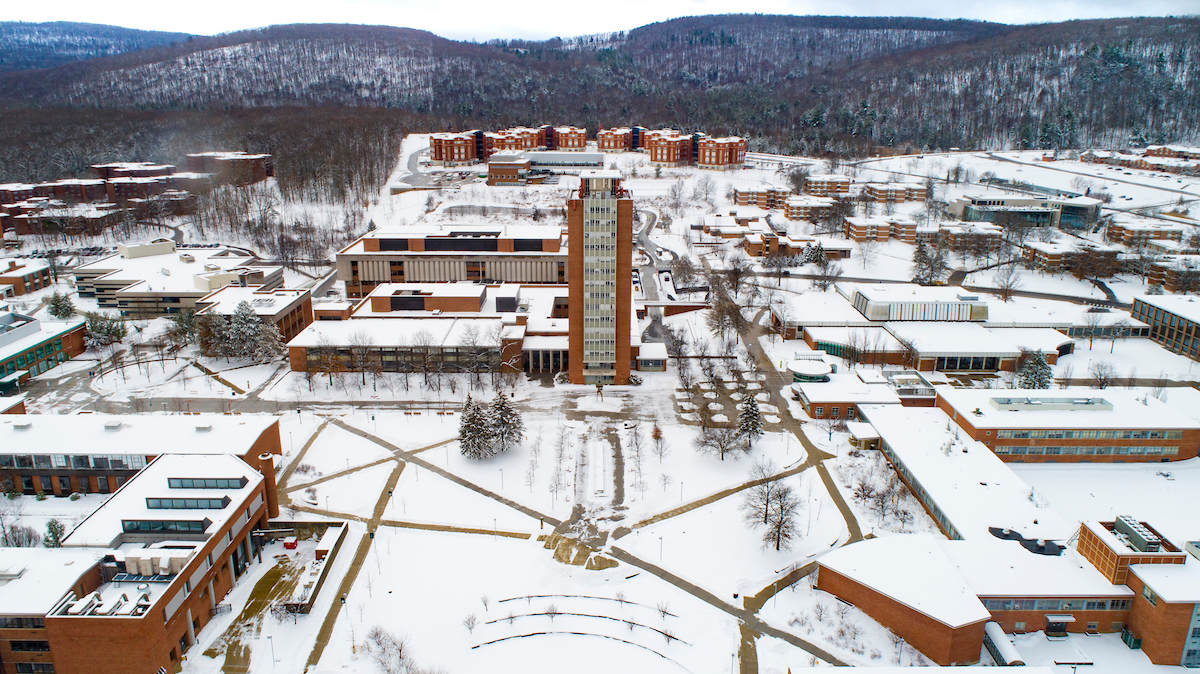
It’s snow season in Binghamton!
On average, Binghamton receives approximately 64 inches of snowfall each year. And while the snow may be pretty to look at, it’s essential to know how to stay safe when roads get slick. Although classes might be canceled or delayed, during inclement weather, Binghamton University works to maintain full operating status. The University still maintains functions and services that meet the needs of students, provide campus safety operations, maintain buildings and support critical research programs.
For the welfare of the campus community, campus parking, public transportation and class schedules may be modified depending on the severity of the weather.
Class delays and cancellations
Under what circumstances are classes delayed or canceled? Who makes that call?
It’s a team process, as representatives from about a dozen departments, including Provost Donald E. Hall, NYS University Police and Facilities Management, gather to advise on the approach to take for any given weather event, also considering detailed National Weather Service forecast information.
Executive Director of Emergency Management David Hubeny and the chief of police are among those who decide whether to delay or cancel classes. The final decision is made by 6 a.m. on the day of the weather event, allowing time to notify the campus community.
“The top priority will always be safety,” Hubeny said. “If we feel there is a significant danger posed to our students, staff and faculty, then we will advise the group of that concern.”
If the group decides to delay or cancel classes, the Office of Communications and Marketing gets the word out to the Binghamton community first through B-ALERT text and email messaging. Should classes be canceled or delayed, a possible message would be: In-person classes are canceled for today (day/date). Faculty may choose to hold classes virtually.
Updates will be made via social media, the web, recorded messages and local media, but the primary method of notification for any schedule changes is B-ALERT. Register to receive B-ALERT messages online. If the emergency weather begins after classes began, the group can opt to cancel classes at a particular time of the day, again after consultation with many departments. For info on closings and days, visit binghamton.edu/alert.
“Although the group has the authority to cancel classes, only the governor of New York can shut down the University,” Hubeny said. “We do not have the authority to tell staff and faculty to remain home — only the governor does.”
Similarly, the group decides when to re-start classes.
Driving and parking — on campus and off
As the seasons change, so do parking regulations.
On campus, overnight parking is allowed only in R lots (24-hour lots/resident parking). If snow is expected overnight, all vehicles in these lots must be removed from 5 a.m. to 7 a.m. to allow for snow removal. A green light in these lots will turn on the night prior if vehicles need to be removed the following morning. Vehicles remaining in these lots during these times will be ticketed and towed. For more information about on-campus parking, visit Transportation and Parking Services.
In Binghamton during the winter months, the city enforces alternate street parking to allow for easy plowing and shoveling.
“Student drivers need to comply with local, on-street parking regulations,” said David Husch, Binghamton University’s director of transportation.
- On even calendar days, cars must be parked on the even side of the street until 5 p.m.
- On odd calendar days, parking is on the odd side of the street until 5 p.m. After 5 p.m., cars must be moved to the opposite side of the road to park for the next day!
Husch also advises students not to feel pressured to drive in winter weather.
“Drive within your training and experience,” Husch said. “Just because you have a car, doesn’t mean you must always drive it. Use buses or rideshare any time you are not comfortable driving in wintry conditions.”
To find parking when lots are inaccessible due to snow or closed, view the campus parking map.
Public transportation
Bus schedules can also change as a result of wintry weather.
“In bad weather, bus passengers should be prepared for buses running late due to the road conditions,” Husch said. “It’s advisable that students take earlier buses to ensure that they get to campus in plenty of time. Passengers can get real-time bus tracking from the ETA Spot app for OCCT.”
If Binghamton University ends classes early due to weather, OCCT generally runs for two hours past the time that classes were canceled. Should the University delay classes, OCCT will begin service two hours prior to the start of classes.
Additionally, Broome County (BC) Transit buses generally continue to run unless a state of emergency has been declared. However, some routes may be canceled or altered. You can use this site to track BC Transit buses in real time.
Off-campus safety
While the University maintains the safety and accessibility of campus buildings, walkways and roadways, those who live off campus should be mindful of the following and should have a plan for snowstorms and extreme cold.
- Test your smoke detectors and carbon monoxide detectors. December, January and February are the peak months for house fires.
- Learn how to shut off water valves in your home in case a pipe bursts.
- Prepare your vehicle with an emergency kit and keep your exhaust clear to prevent carbon monoxide buildup in the vehicle cabin.
- Avoid overexertion when shoveling. This can lead to a heart attack.
- Know the signs and symptoms of cold-related illnesses such as hypothermia and frostbite.
- Use salt to melt ice and do not drive if conditions are dangerous — use buses or rideshares, or contact your supervisors/professors if you cannot safely travel to campus.
For more snowstorm and cold weather safety tips, visit https://www.ready.gov/winter-weather, or contact Environmental Health and Safety at 607-777–2211. The Office of Emergency Management also hosts tips on its Cold Weather Safety page.