School of SSIE celebrates fall 2025 achievements
The fall semester at Binghamton University is about a month away from wrapping up, and the School of Systems Science and Industrial Engineering (SSIE) at the Thomas J. Watson College of Engineering and Applied Science is excited to share its achievements in education and research in the second half of 2025.
For the 2024-25 fiscal year, SSIE’s research expenditures were nearly $12.7 million, which represented nearly 49% of Watson College and 14.5% of Binghamton University. Driving much of this research was the Watson Institute for Systems Excellence (WISE), which embeds graduate students into industrial and healthcare settings to solve real-world problems while students gain critical experience.
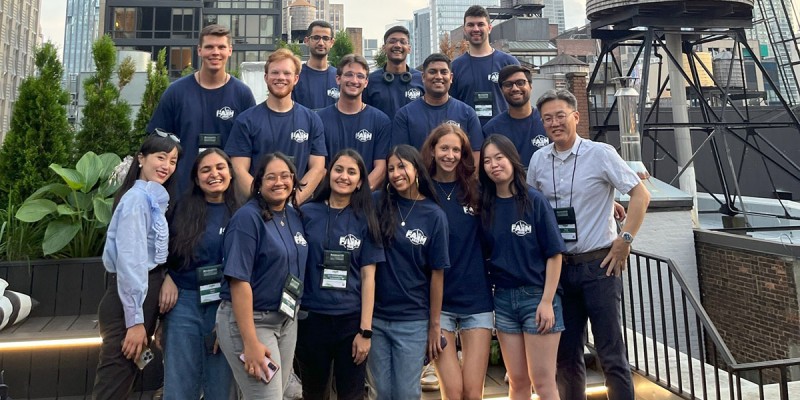
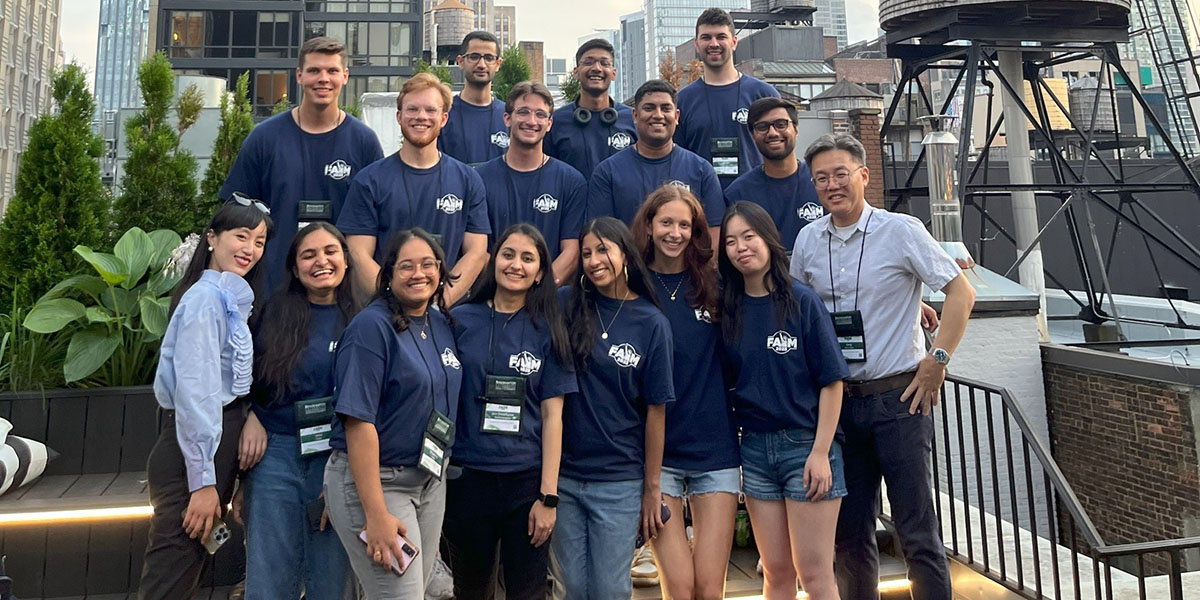
SSIE also hosted the Flexible Automation and Intelligent Manufacturing (FAIM) international conference in New York City in June. The theme was “The Future of Automation and Manufacturing Intelligence, Agility and Sustainability.” The conference had 228 attendees from 29 countries, with 180 presentations on a variety of manufacturing topics.
Faculty news
Welcome to the new faculty this fall: Assistant Professor Safa ElKefi, Professor Saad Hamasha and Assistant Professor Mina Ostovari.
A Stanford University study that looks at the impact of scientists worldwide identified 29 Binghamton University faculty who were among the top 2% of all researchers in the world in their fields in 2024. Among them from SSIE were Professor of Empire Innovation Carlos Gershenson-Garcia, Associate Professor Fuda Ning and Distinguished Professor Hiroki Sayama.
Research news
Associate Professor Jia Deng received a $580,623 National Science Foundation CAREER Award to pursue research into manufacturing electronics on a nano scale. He will investigate a manufacturing process that uses a tiny tool to interact through mechanical vibration and electric fields as hybrid energy forms to “mark” the target material.
Associate Professor Fuda Ning also won a prestigious NSF CAREER grant, receiving almost $600,000 for research to create better tungsten alloys using additive manufacturing. The new metals could be used for rocket nozzles, radiation shields or MRI components, among other high-tech applications.
With artificial intelligence increasingly part of our everyday lives, SSIE faculty members weighed in on what’s next and what the potential issues could be. Professor of Empire Innovation Carlos Gershenson-Garcia talks about what AI can and can’t do; Assistant Professor Stephanie Tulk Jesso thinks AI should not be a replacement for humans; Associate Professor Christopher Greene discussed how AI and robotics help with manufacturing; Associate Professor Daehan Won worries about AI biases; Professor Sangwon Yoon looks at AI in healthcare decision-making; and Distinguished Professor Hiroki Sayama connects AI with his research on artificial life.
Assistant Professor Yingge Zhou teamed up with Assistant Professor Ying Wang from Binghamton’s Department of Biomedical Engineering for research into how to improve the vascular systems of engineered tissues. By integrating nanotubes into a composite hydrogel that formed part of the tissue-growing medium, they increased blood flow throughout the cells.
Assistant Professor Neha Patankar collaborated with colleagues from around the world on research about accommodating our increasing need for power generation. They concluded that choosing the least expensive option isn’t always the best solution, and even a little wiggle room on cost can provide a much more socially, environmentally and politically coherent outcome.
Assistant Professor Melissa Zeynep Ertem worked with Associate Professor Lina Begdache from Binghamton’s Decker College of Nursing and Health Sciences to explore how lack of nutrition changes our resilience, stress mindset and level of mental distress, particularly across age and gender.
Research fellow Ahmed Abdeen Hamed led research that put ChatGPT and its large language models to the test when diagnosing medical conditions. The AI showed high accuracy in identifying disease terms, drug names and genetic information but struggled with symptom identification.
Master’s students Jhanille Hurde and Amaya McCollough ’25 published research analyzing the use of personas and how it can help patients as well as the healthcare system as a whole. Personas have been credited with revolutionizing the delivery of patient-centered care, which allows people more input into their own health management.
Student news
Bryan Cabrera ’26 has been working with Distinguished Professor Mark Poliks as part of a long-term research co-op studying flexible microelectronics. Cabrera’s project looks to break the bounds of rigid technology by designing biodegradable and bendable electronic devices with the plasticity of a sheet of paper.
As part of her dissertation, PhD student Xin “Vision” Wang is developing VizTrust, an analytics tool to make user trust dynamics in human-AI communication visible and understandable. She presented her current work and findings in April at the Association for Computing Machinery (ACM) CHI 2025 conference in Yokohama, Japan.
For a feature in this year’s Watson Review magazine, undergraduates Justin Mintz, Benjamin Deibler, Gerardo Dutan, Lilly Guizatoullina and Nicholas Ingraselino talked about their work with Professor Sangwon Yoon on a new algorithm to reschedule flights based on weather conditions.
Alumni news
Hadassah Mativetsky ’07, MS ’12, served as chair of the Binghamton City Council in 2024, bringing her principles as a systems science graduate into the real world. She compares it to her career in quality management, where companies are supposed to document processes.
Balki Iyer, MS ’00, SD ’19, brought his latest business venture back to the Binghamton area. Bridge Green Upcycle specializes in “Cleaning Up Clean Energy” by extracting critical minerals from batteries and reducing the need for additional mining or carbon emissions.
Michael Hindin ’18, MS ’19, works for Steinway & Sons, which has built high-quality, world-class pianos since 1853. He puts in hard work behind the scenes to ensure that operators can assemble their pianos with ease.