Two Binghamton students earned spots in a prestigious national civil dialogue program
Hosted by the University of Delaware’s Biden School, the SNF-funded initiative brought together student leaders from 53 campuses across the United States.
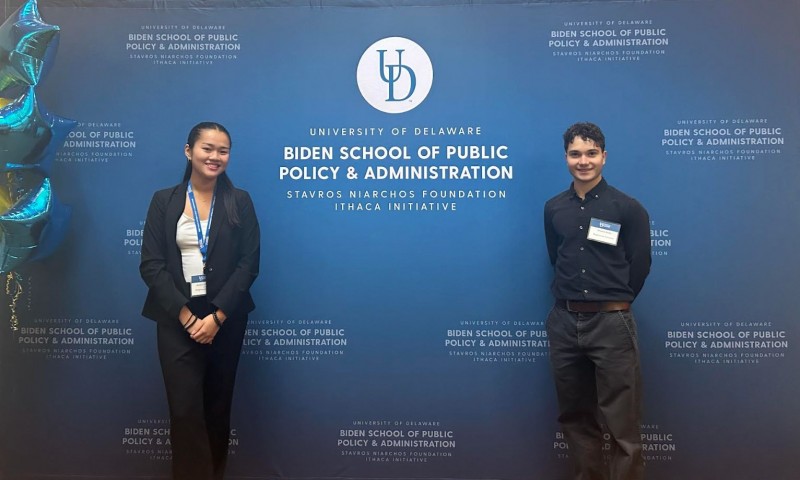
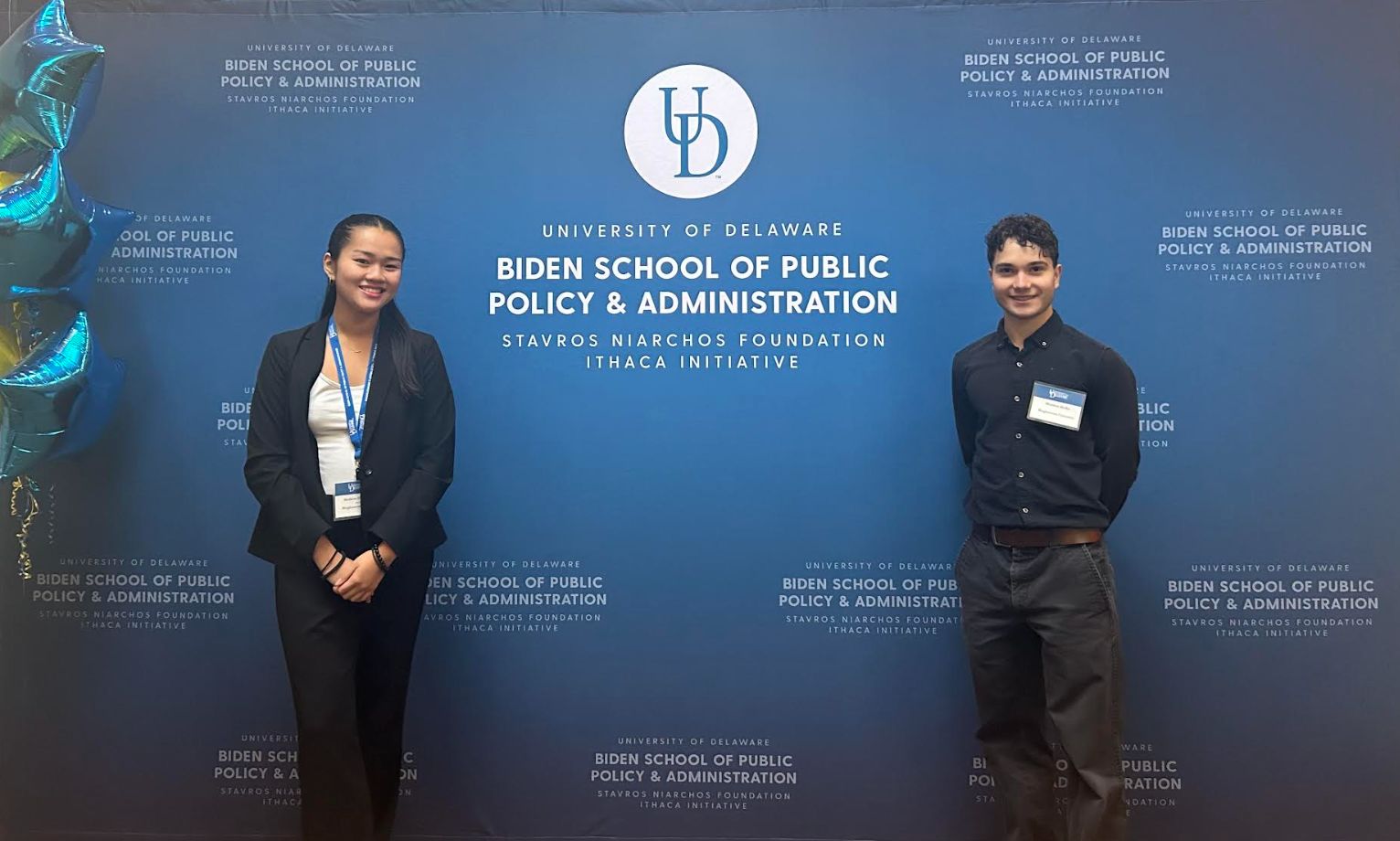
Two Binghamton students recently found themselves in rooms where national policymakers, scholars and student leaders gathered to tackle one of the country’s most pressing challenges: how to communicate effectively with one another.
At a program hosted by the University of Delaware’s Biden School and funded through the Stavros Niarchos Foundation (SNF) Ithaca Initiative, sophomores Madison Hernandez and Matthew Heffer joined more than 100 undergraduates from across the United States for a deep dive into the future of respectful debate. The program is a highly selective civil dialogue conference designed to push students to think differently about community, conflict and the ways conversations shape democracy.
The fully funded, two-day experience brought together students from 53 campuses to explore how “third spaces” – informal social environments outside of one’s home and the classroom – can spark genuine conversation and strengthen campus communities.
Hernandez, a sophomore from Queens, first learned about the program from Public Administration and Policy Professor David Campbell, whose UNIV seminar and philanthropy course sparked her interest in civil engagement. “He did an excellent job at engaging the class and engaging my interests in Binghamton,” Hernandez said. “When he recommended the program and said it aligned with the work I had done, I looked into it and it really appealed to me.”
Heffer, a sophomore mechanical engineering major from Long Island, also heard about the opportunity through Campbell. “I felt like I could contribute a unique perspective because most of the people attending weren’t engineering students,” he said. “I kind of brought a different view on things.”
During the conference, Hernandez joined a working group focused on student apathy versus engagement. Conversations compared how large research universities, small religious colleges and mid-sized regional schools approach building community.
“Across all our campuses, we found that engaging students who are on the fence is more effective than trying to reach those who are completely apathetic,” Hernandez said.
Listening to peers from across the country gave her a new perspective. “It was so interesting to hear what college life is like for someone at the University of Missouri or a tiny school in the South,” she said.
Heffer joined his group examining viewpoint diversity. For him, the emphasis on third spaces reshaped how he thinks about political conversations. “A political conversation is more likely to be peaceful and successful if it comes up naturally,” he said. “That’s where you get the friendliest dialogue, when it’s among friends.”
Both students returned to Binghamton eager to apply what they learned. Hernandez, who works for Residential Life and Harpur Edge as well as participating in several student organizations, said the conference helped her think more intentionally about engaging others across differences. “Learning how to be respectful of people’s backgrounds while also engaging them is something I hope to implement,” she said.
She also emphasized the value of slowing down and listening. “It’s easy to be passive, especially with social media,” Hernandez said. “But if students take the time to learn about the community around them, it will make our nation better, both on a micro and a grand scale.”
Heffer left Delaware with a renewed appreciation for the third spaces already built into Binghamton’s campus life, such as dining halls, gyms, the Spine, club meetings and pop-up events. “People put in a lot of effort to make these spaces happen,” he said. “It made me realize how important it is to actually go to these events and meet people, and maybe have a healthy political conversation as a result.”
He encourages students to ease into civil discourse rather than starting with tense or polarizing topics. “The stakes don’t have to be high,” Heffer said. “You can start with something nonpolitical, like your favourite movie, and challenge someone in a friendly way.”
For Hernandez, the most lasting impact of the weekend was the relationships she built. “I made really great friends who will forever stay in my network,” she said. “Connecting over differences impacted me more than I anticipated.”
Both students described the experience as a rare chance to pause, reflect and practice the kind of engaged listening they hope to see more often on college campuses. As Heffer noted, third spaces make it possible to “meet new people and have important conversations,” while Hernandez emphasized the mindset required to sustain that culture: “Don’t be passive. Put in the work. Listen.”