Student-led project focuses on women’s voices in exiled communities
Campus initiatives are providing women in exile the opportunity to use their voices and share their experiences.
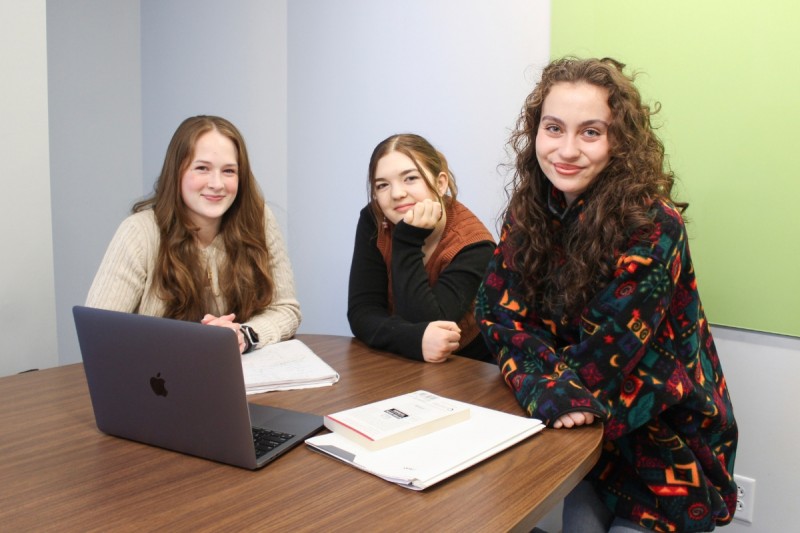
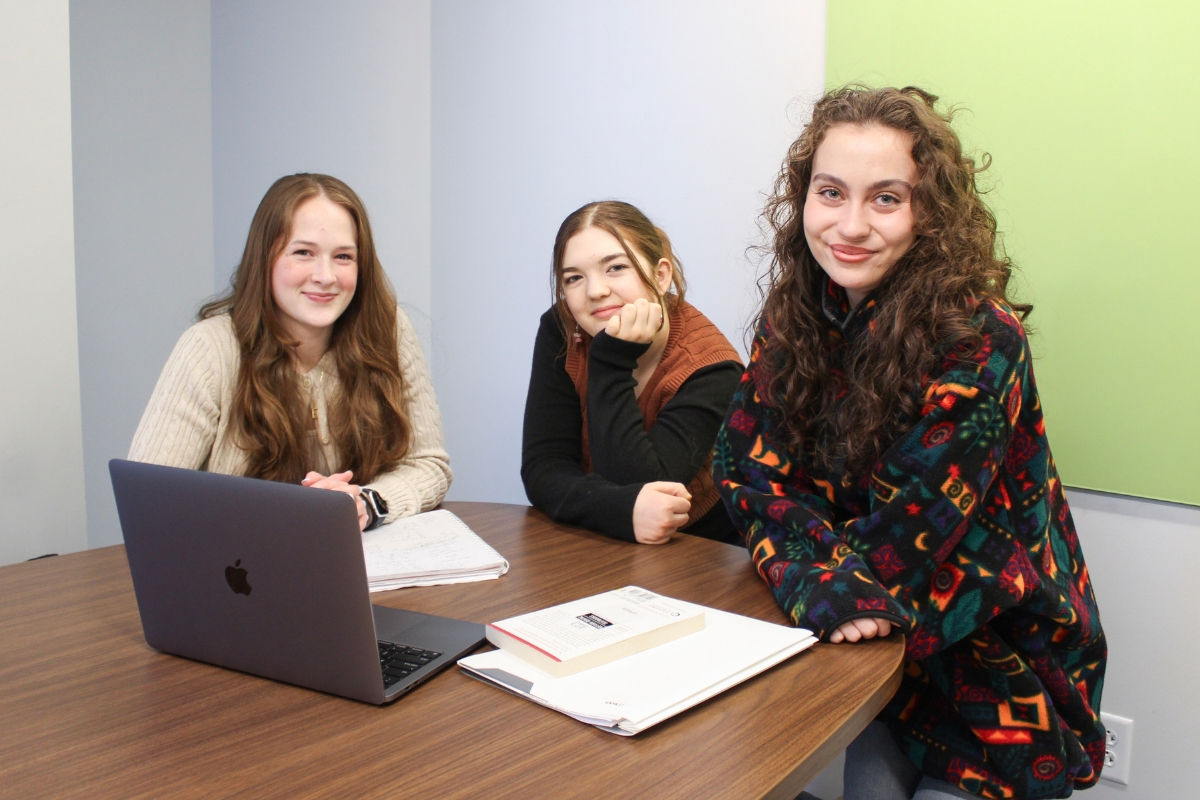
Binghamton students are leading a project that provides women who have been exiled a voice that they can share with others in the same position.
The Women in Exile project is an ongoing initiative sponsored by Binghamton’s Human Rights Institute (HRI) that examines how women peacebuilders who have been exiled from their home countries maintain agency and continue peacebuilding, either here or in their home countries.
The project offers students the opportunity to gain hands-on experience in the field. Senior Caryn Gagnon and sophomores Taylor Rogers and Samantha Boragine were three students involved in the project that was overseen by Alexandra Moore, co-director of HRI and Professor of English, General Literature and Rhetoric.
“Because I joined this project, I know so much more about what individual people are doing to connect their community,” Boragine said. “I think that can be really motivating, and I think that it can lead other people to feel empowered to do something in their own community.”
The project first began in late 2024 with academic readings, during which students examined the women’s backgrounds and their stories of leaving their home countries. It evolved into talking to individual women about their experiences and hearing what they had to say.
“We interviewed a bunch of women who were activists in their home country, and we discussed with them what are the complications of that, what made you leave and, now that you’re here, now that you’re in a different country, are you still able to pursue the goals that you were pursuing in your home country,” Boragine said.
From that point on, the project began to take shape. They conducted additional Zoom interviews with many women peacebuilders about their work, and once the interviews were complete, they began coding the data. This involved identifying keywords the women used and compiling a list to see how each defined the terms.
“We continued to do that until we found a few overarching themes of how these women peace builders addressed words like ‘peacebuilding’, ‘activism’, and so many more,” Rogers said. “The coding was trying to connect women’s responses to one another and see how they define key terms in their work, which then helped us present that work to them and get a conversation going in the workshop.”
Their findings were then presented at a workshop on-campus with the women to continue the conversation on peacebuilding and gather their perspectives. They hoped that by doing so, they could create an academic partnership with these women and others in the field.
“Being able to speak in this space and just talk about peacebuilding with other women who were in exactly their same position, their same field was really interesting,” Gagnon said. “What I hope that this work is able to accomplish in the long term is just being able to create a communal space for people who are doing such important work, just to be able to further what they want to do and feel like they have the space to do that.”
Gagnon, who is majoring in political science and minoring in human rights and economics, first got involved with HRI after starting a human rights minor at the same time that she wanted to get more involved on campus and was seeking out new opportunities. This led her to HRI, where she joined the project and now works as an undergraduate assistant.
“I thought it was really interesting, this opportunity to understand,” Gagnon said. “I think we always see peacebuilding from a domestic perspective, so it was interesting to see how people from abroad who are facing struggles are still going out of their way to build peace for their home countries.”
Rogers, who is majoring in political science and minoring in human rights and socioeconomic anthropology, and Boragine, who is majoring in musical theater, both joined the project through their work on the Source Project, a first-year research experience in the humanities and social sciences. The Source Project provided Rogers and Boragine the opportunity to gain class credit for the project through the experience.
“My personal work was in the right to an abortion, so when I was starting that research and looking more upon that, I saw the opportunity of women peace builders,” Rogers said. “I took the realm of peace building, being [an] activism realm, and how we have a lot of work in the field [and] we need to talk more about activism and think more about it in a larger sense.”
Through the project, Gagnon, Rogers and Boragine were able to assess the complexity of topics to support women peacebuilders and suggest how they could help, as an external force and as a voice for a larger community.