Binghamton students gain insight through Malawi service-learning trip
Through hands-on collaboration with Malawi Children’s Mission, students engage in strengths-based community work and gain lasting lessons in connection, cultural humility, and global citizenship
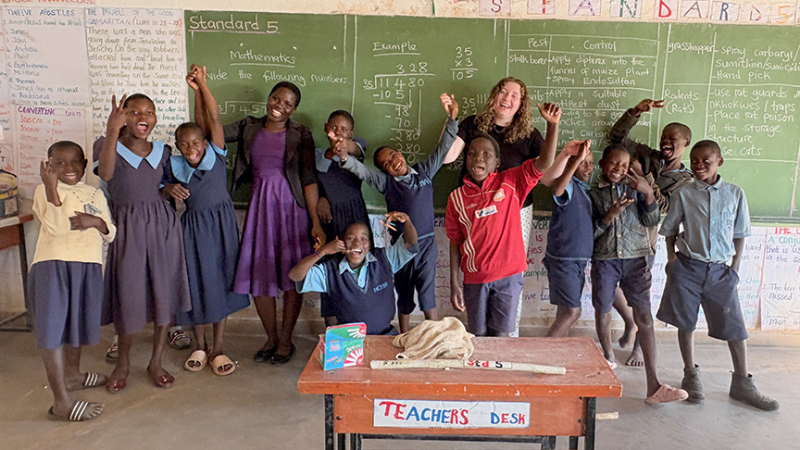
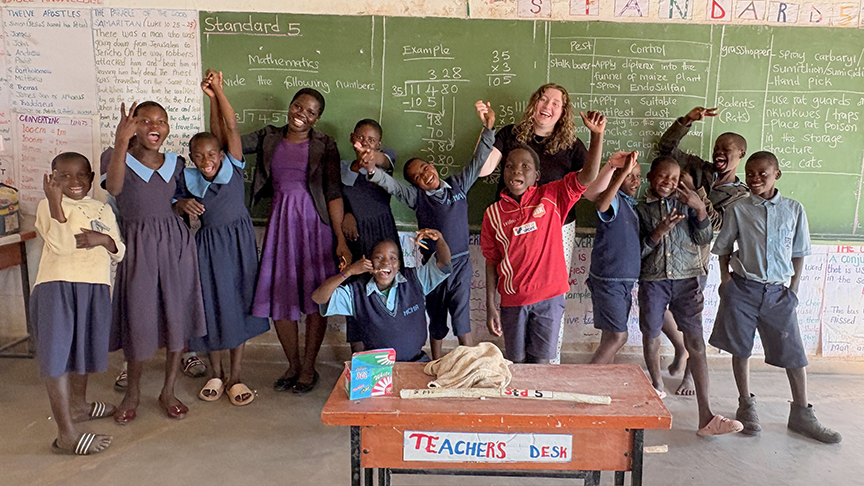
When students from Binghamton University’s College of Community and Public Affairs (CCPA) step into the classrooms of the Malawi Children’s Mission, they aren’t just crossing borders—they’re forging connections that embody the college’s commitment to community-engaged and hands-on learning. The collaboration between CCPA and Malawi Children’s Mission (MCM) is more than a natural fit; it’s a story of shared values and transformative potential for school-based support that engages the whole student.
For Assistant Professor of Social Work Keisha M. Wint, the faculty lead on the trip, the MCM is a perfect partner for CCPA’s Community Schools approach to learning, service, teaching, and community engagement.
“It was very inspiring for all of us to see how MCM has been supporting and sustaining families,“ she said. “Some children who have been with MCM since preschool have progressed through secondary school and are now applying to, and being accepted into, college—a significant achievement given the many challenges and risks of forced early dropout due to constrained resources. It was encouraging to see these successes and to learn about the community initiatives that have developed as a result of MCM.”
Founded in 2007 by Binghamton native Steven Koffman, the Malawi Children’s Mission has grown from a feeding center into a comprehensive organization that supports children and families through services such as health care and education. MCM provides quality instruction to more than 100 students from pre-K through eighth grade and continues to support students in high school and beyond. The Malawi team is led by Malawian native, co-founder, and Executive Director Kenneth Mpemba and his wife, Avisha. Eneless Banda, MSW ’25, a recent Binghamton graduate from Malawi, is also part of the on-site leadership team.
The partnership between MCM and CCPA was sparked by Koffman’s mother, Ruthanne ’82, MA ’84, after her 2014 visit to Malawi. Upon returning, she recounted her experiences to CCPA Dean Laura Bronstein, who offered to become a University partner with the Malawi organization. In January 2015, Steven Koffman invited Bronstein to Blantyre, Malawi, for a two-week visit, helping to launch the partnership.
Associate Professors Lisa Blitz and Denise Yull led the first service-learning mission with a group of seven students in July 2017; 18 students accompanied Blitz and Youjung Lee, an associate professor of social work, in July 2018. However, after the 2019 trip, the COVID pandemic disrupted travel abroad, essentially stalling the program.
When Wint expressed interest in the Malawi mission during her 2022 interview, she was invited to lead the program. Although it took several years to start up again, the 2026 trip marks Wint’s second visit to Malawi. This year, she was joined by seven undergraduate and graduate students: human development major Daniel Mekonen; Master of Social Work students Chrisline Boyer, Sarai Halliday, Olivia Martin, and Taylor Parsons; recent Master of Public Administration graduate Paris DeFreitas; and Mary Jane Brosokas, an undergraduate psychology student from the State University at Oneonta. Wint’s faculty co-lead was Kimberly Harry, assistant professor in Watson College’s School of Systems Science and Industrial Engineering.
“I met Dr. Harry during new faculty orientation,” explained Wint. “We have collaborated on research projects, so when we were exploring options for a second faculty member, I reached out, and she answered the call.”
Student participants are typically recruited at the international education abroad fair. This year, previous participants shared their experiences at various orientations and related events. Wint believes these firsthand accounts inspired even more students to explore the program and submit their applications.
The trip is funded in part by student contributions and scholarship assistance through a CCPA Binghamton University Fund and the University’s Office of International Education Global Initiatives Office (IEGI). One student even raised money through a GoFundMe campaign. The Center for Community Engagement also provides support for this work. Pre-trip planning involves several interviews and orientations as part of the onboarding process to ensure the students are fully prepared.
“IEGI is very helpful with gathering scholarship information, supporting students as they apply,” Wint said. “Callie Frost [senior assistant director] is really hands-on, helping walk applicants through the process, making sure they have their recommendation letters, and meet important deadlines.”
The trip is part of a 4-credit summer course, Asset-based Community Development to Promote Social-Emotional Well-being for Youth in Malawi, so students are not only doing hands-on work with children and families during their time at the MCM but also completing assigned readings, especially on service learning and asset-based community development, and participating in class discussions. Students can tailor the class and trip to focus on issues important to them, whether mental health, parent-child communication, or school and family health education. And, yes, there is a paper to write at the conclusion of the class.
For Sarai Halliday, the trip was an opportunity to learn how to better serve her own rural community using a strengths-based approach.
“Sustainable change begins by listening, valuing local knowledge, and working alongside communities rather than trying to solve problems for them. I know that perspective will shape both my social work education and my future practice,” she said.
Chrisline Boyer described her experience in Malawi as unforgettable and, like Halliday, emphasized that the strengths-based approach significantly changed her perspective on social work and community engagement.
“Learning about Asset-Based Community Development (ABCD) in the classroom while seeing it practiced at the Malawi Children's Mission changed how I think about supporting individuals and communities,” she said. “Rather than approaching a community and thinking you know what it needs, it taught me to first ask community members what strengths, resources, and assets they already have and then build upon those foundations.”
Students participated in many aspects of service at the mission, including preparing and serving lunch, primarily nsima, a staple food of the country made from ground maize and water. They participated in school activities, working directly with the children in both play and classroom settings. They also had opportunities to travel into the community with the school’s nurse, doing home visits and community health clinics.
Wint expresses sincere gratitude to this year’s students, noting their mutual support and the positive impact they had on the group dynamic, even though many began as strangers.
“It was a special group this year,” she said. “I loved talking to the students in our afternoon class sessions, hearing about their experiences engaging with the children and the guardians and the educators with genuine interest and curiosity. They demonstrated a deep respect for the people and culture of Malawi, and I think it was really evident in their interactions and the feedback from the MCM staff.”
In addition to their daily work at the school, the group explored the area by visiting local markets, restaurants, parks, and natural attractions. They also went on safari.
Wint described the trip's conclusion as highly emotional, emphasizing the deep bonds and mutual respect formed between Binghamton students and the MCM community. For her, witnessing these connections was not only moving but also a demonstration of the trip's success and its value to the students involved.
“What moved me most was the incredible warmth of the Malawian people,” Halliday said. “They welcomed our team with open arms and made us feel like part of their community from the very beginning. The relationships we built were genuine and meaningful, and saying goodbye was one of the hardest parts of the experience. I will always be grateful for the kindness, generosity, and joy that the people of Malawi shared with us, and I hope to carry those lessons about community, humility, and human connection into my work for years to come.”