To honor her mother’s memory, PhD student researches autoimmune diseases
Neda Amiri Rad studies how genes interact to cause rheumatoid arthritis and similar conditions
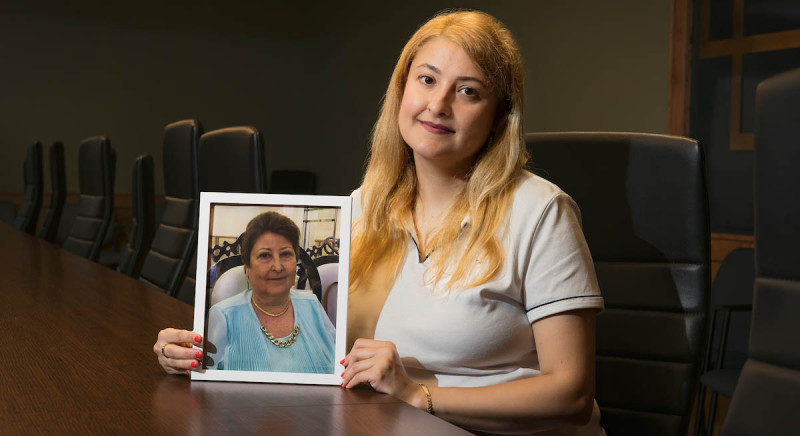
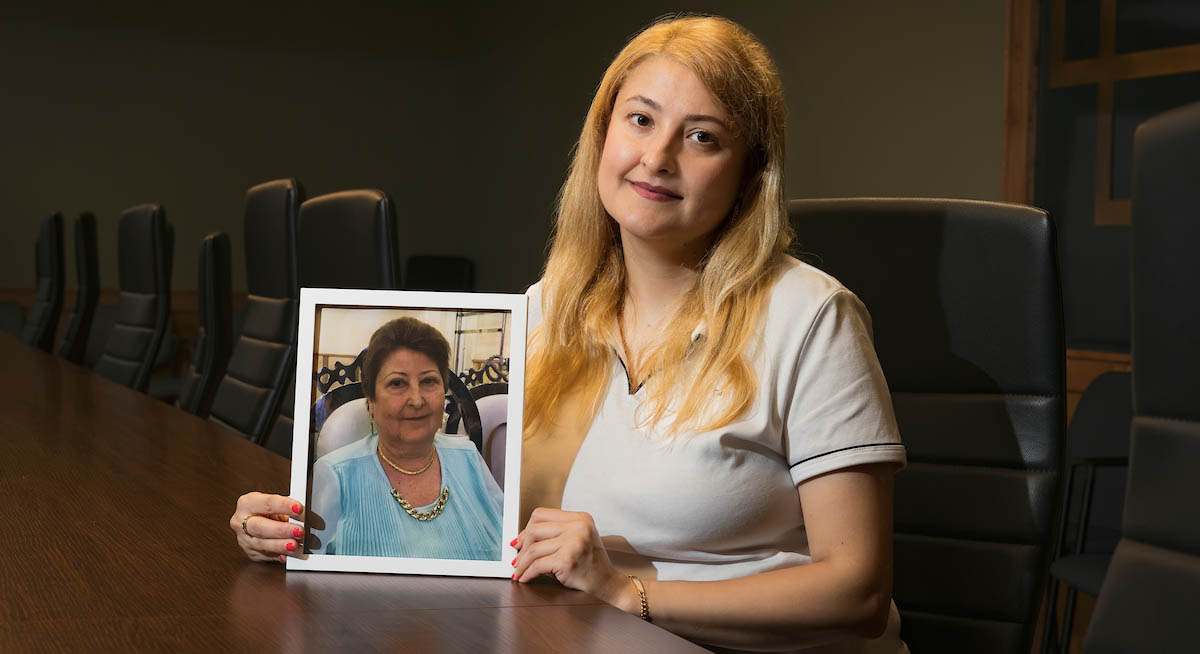
Growing up in Iran, Neda Amiri Rad knew her mother was sick, but no one could figure out why.
As Amiri Rad got older and stronger, she watched her mother grow weaker, suffering through her pain.
After two years, doctors finally offered a diagnosis: an invisible autoimmune condition called rheumatoid arthritis (RA). However, because of the delayed diagnosis, the disease had progressed significantly, and Amiri Rad lost her mother to related medical complications.
Now, as an industrial and systems engineering PhD candidate at Binghamton University, Amiri Rad honors her mother’s memory by working to improve the lives of those suffering from rheumatoid arthritis and other autoimmune diseases.
‘I would hear her crying’
RA causes severe deformation and inflammation of the joints, leading to debilitating pain and mobility difficulties. Worldwide, 17.9 million people were affected in 2021, according to the National Institutes of Health.
After Amiri Rad was born, her mother experienced a flare-up of her then-undiagnosed condition. Eventually, the disease limited her mother's mobility entirely.
“Walking became difficult, and even basic daily activities became challenging for her," Amiri Rad said. "I would hear her crying or moaning from pain, and I would cry, too, because I felt completely helpless."
When her mother experienced muscle loss and became dependent on a wheelchair, her family cared for her as she had always cared for them. In the final months of her life, she developed a lung infection and, because of her body's already-weakened state, that turned into a systemic infection and sepsis. After four months in the ICU, she died in July 2018.
Amiri Rad transformed her grief into motivation to study the genes that contribute to rheumatic diseases. After receiving her bachelor's degree in computer engineering and her master's degree in industrial engineering, both from the Islamic Azad University in Tehran, Iran, she traveled to the U.S. to pursue her doctorate at the Thomas J. Watson College of Engineering and Applied Science's School of Systems Science and Industrial Engineering.
Looking at the whole picture
Amiri Rad's research is computational, focused on identifying patterns previously unrecognized in the genes that contribute to RA.
"One of the main questions I ask is: If we look beyond individual genes and instead study how genes interact as a network, can we identify important biological signals that traditional analysis may miss?" she said.
She studies the structure of the network to find groups of genes that tend to work together, or that appear structurally important in the RA network but have been overlooked. This can help direct future research toward specific biological targets by building a foundation of knowledge about these gene systems. Future researchers can use this information to study the diseases more closely, possibly creating treatments or identification methods based on her mapping of the gene network.
"What I like about this approach is that it treats rheumatoid arthritis as a complex system, rather than as a disease driven by one gene, where many genes and biological processes interact,” Amiri Rad said. “Sometimes the relationships among them can tell us something that looking at each gene separately cannot."
Through research like hers, better treatment and earlier diagnosis are closer than ever. Her work to understand these genes will allow future researchers and medical professionals to intervene sooner and more effectively.
As always, she thinks about what her mother went through: “Rheumatoid arthritis was not as well understood as it is today, and early diagnosis was much more difficult. Unfortunately, that delayed diagnosis gave the disease more time to progress. I grew up seeing what that progression meant in real life.”
Computing the genetic connections
While her research is ongoing, Amiri Rad recently published her first research paper on RA, with a second paper focusing on systemic lupus erythematosus (SLE) still in progress.
Similar to her RA research, she also studies the SLE gene systems, but instead focuses on comparing the genes at different points in time to monitor activity changes. This research looks specifically for biomarkers: identifiable changes in genes that can indicate disease, giving clinicians earlier and more accurate notice of activity and allowing for personalized approaches to treatment.
"My work is still computational,” she added, “so these findings need further biological and clinical validation before they can directly affect patient care, but that is the direction I hope the research can move toward."
This connection between computational and health sciences was largely what drew Amiri Rad to Binghamton University. She admired the strong health-related research within the School of Systems Science and Industrial Engineering, and she valued the opportunity to work with established researchers in the field, such as her doctoral advisor, Hiroki Sayama, a SUNY Distinguished Professor.
“Neda is a super-productive, highly capable researcher, but what distinguishes her the most is her determination, devotion, and persistence,” Sayama said. “Her research is truly driven by her personal life experiences and genuine desire to help people suffering from autoimmune diseases. This gives her the motivation and strength to overcome various difficulties and hardships throughout her research. I deeply respect her and am truly grateful to be her advisor.”
Additionally, she received guidance from George J. Klir Professor of Systems Science Luis Rocha, PhD '97, an expert in systems science with a focus on interdisciplinary studies in several health-related fields.
At Binghamton, Amiri Rad determined that gene networks were the perfect target for her research.
"I realized how naturally my systems background could connect to biology in a complex disease,” she said. “For me, the motivation came first, and the methodology came later. I knew why I wanted to study disease long before I knew that gene networks would become the scientific language I would use to study."
Amiri Rad made many of the connections that have allowed her to continue her research at Binghamton. She has attended and presented at several conventions, including the AI Symposium hosted in Syracuse at the SUNY Upstate Medical University, where she met a contact who later offered her a role as a data science AI&I intern at the famed Mayo Clinic in Rochester, Minnesota.
Earlier this year, she received the Choose Rheumatology Scholarship, awarded by the Rheumatology Research Foundation, and she will represent Binghamton this November at the American College of Rheumatology Convergence in Orlando, Florida.
When asked what advice she had for students just beginning their journey at Binghamton, Amiri Rad said to "stay open to opportunities and do not be afraid if your path changes along the way. Some of the most important opportunities I have had came from reaching out to people and asking questions, attending events, and applying for opportunities even when I was not sure I would be selected.
“I would also tell new students not to measure their progress only by grades, publications, or titles. Finding good mentors, building relationships, networking, learning how to communicate your work, and becoming part of a research community can be just as important."