Binghamton University is first adopter of “Stop the Bleed” campaign in New York
$25,000 grant obtained by NY Sen. Fred Akshar supports public health initiative.
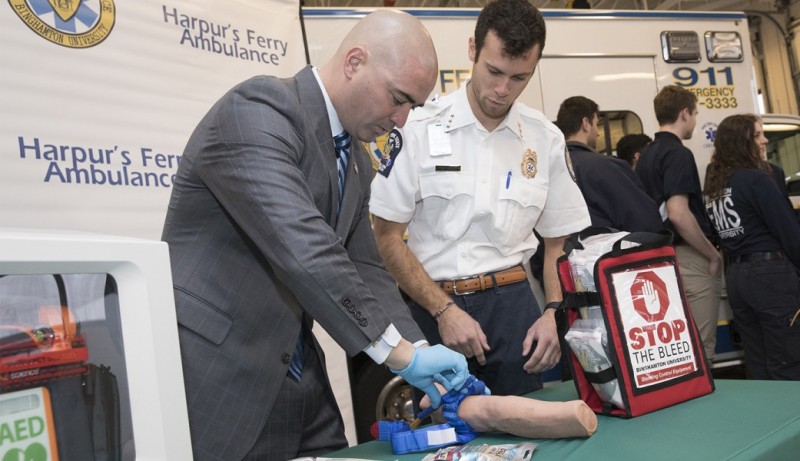
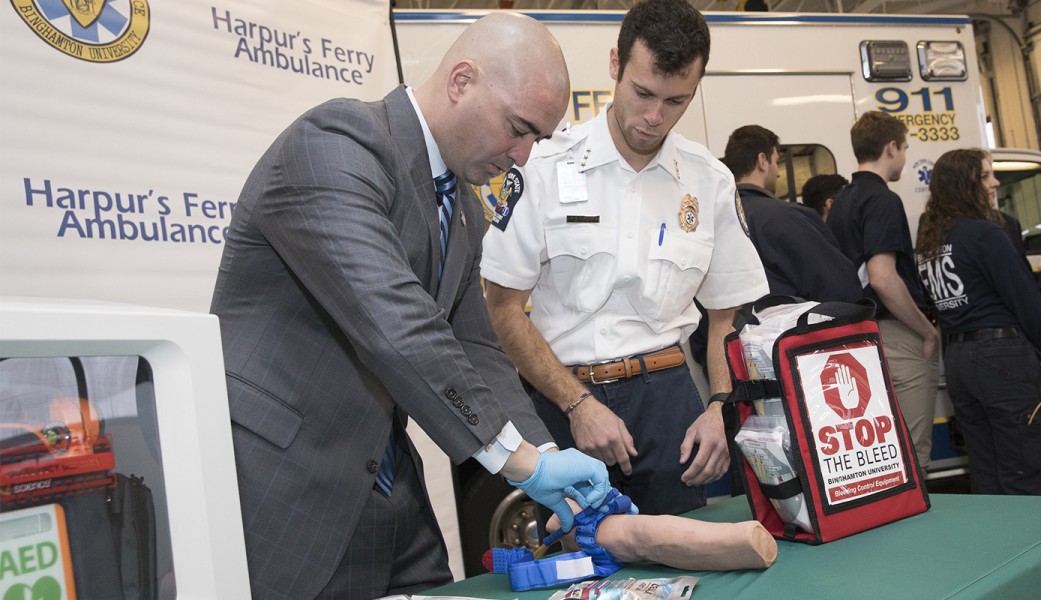
A $25,000 grant obtained by New York Sen. Fred Akshar has enabled Binghamton University to become the first campus in New York state – and one of the first in the country – to launch a “Stop the Bleed” program. Similar to the program that places automated external defibrillators (AEDs) across campus, Stop the Bleed is a national awareness campaign and call to action to provide life-saving equipment that anyone can use to stop massive hemorrhaging until medical help arrives.
Binghamton University’s Emergency Management Program and the Harpur’s Ferry student-run ambulance service officially launched the University’s Stop the Bleed program at a news conference at Harpur’s Ferry Monday, Oct. 30.
When he learned about the program last year, Akshar said he was incredibly inspired. “It was easy for me to say yes to supporting the program,” he said. “The grant to Harpur’s Ferry and the University will help train as many people as possible in this program. I have a background in law enforcement, and clearly every second counts. Having kits like this readily accessible to as many people as possible will certainly save lives.”
The program was brought to the attention of the University by Dr. Adam Fox ’92, MD, assistant professor of surgery and chief of trauma surgery at Rutgers University Hospital and a former Harpur’s Ferry member, said Dave Hubeny, director of emergency management. “With the help of Dr. Fox and Sen. Akshar, we’ve developed a team of dedicated partners and now we’re able to increase the safety of the Binghamton University community.”
“The program was developed a few years ago in response to the increasing number of active-shooter events,” Fox said. “The premise is simple. Educate as many people as possible in techniques to save lives. Equipment in these kits can be used by anyone in any instance of bleeding.
“Today, I’m proud to say there are over 160 bleeding control kits available for any bleeding emergency on the Binghamton campus,” Fox added. “The continued commitment to this public health initiative makes this even more important. Harpur’s Ferry has taken on this project with the commitment of educating as many people as possible in bleeding control techniques to slow or stop bleeding completely until the individual can get to a hospital. Over 800 people have already been trained on campus.”
Calling all of the Harpur’s Ferry volunteers superheroes, Binghamton University President Harvey Stenger said the Stop the Bleed program has just started. “We have the equipment, it’s accessible, but if we don’t learn how to use the equipment, the program won’t work.
“It’s not just putting on the gloves, grabbing some gauze and applying pressure or placing a tourniquet,” Stenger said, “but you’re in the most frightening moment of your life when it happens. In that short period of time before medical help arrives, bystanders have the opportunity to save that person’s life, but it won’t be easy. It’s important to get this message out, just like the AEDs. We hope we never have to use it, but when we do, that we know how to use it.”
Meir Berkman ’16, former executive director of Harpur’s Ferry, explained that training takes about 90 minutes, and the techniques are simple. “We’re at the national forefront of this campaign and one of the first in this country to be implemented at this level,” he said. “Harpur’s Ferry will offer courses every other week beginning in a few weeks, open to the campus and the general community. Participants receive a certificate upon completion.
“We want to train as many people as possible,” Berkman said. “We’ll provide onsite training for student organizations, faculty, staff, unions and other groups, including at the Downtown Center and in Johnson City when they’re ready. We’ve already reached out to local emergency groups as well. If any group in this community or in Sen. Akshar’s district is interested, reach out to us.”
The program stresses the primary steps required in an emergency situation — the ABCs of bleeding control:
A=Alert – Call 911 as soon as possible.
B=Bleeding – Locate the bleeding injury.
C=Compress – Apply pressure to stop the bleeding.
At least one Stop the Bleed kit — containing two pair of blue nitrile gloves, one Celox hemostatic gauze dressing, one Combat Application tourniquet, one SWAT-T tourniquet, one mini black marker and one pair of trauma shears/scissors — has been placed with each of the AED kits on the Binghamton University campus. Fifteen large-venue areas have eight Stop the Bleed kits placed next to AED kits.
For information regarding training schedules or opportunities, contact Harpur’s Ferry at stopthebleed@harpursferry.org.
To learn more about the “Stop the Bleed” campaign, go online.