|
 |
Safety Measures | University Police | University Counseling Center | University Health Service | Harpur's Ferry | Environmental Health and Safety | Alcohol and Other Drug Information | Admissions | Safe Zone Project
Letter from Lois B. DeFleur
Dear Students and Friends,
With over 14,300 students and nearly 3,000 faculty and staff living, working and attending classes on campus, Binghamton University can be likened to a small city, but because we share a commitment to teaching and learning, we also make safety a priority. We care about our students’ safety and have developed comprehensive programs and procedures to help them and our University community remain safe.
From our safety sessions at summer orientation to our educational programs, we work hard to maintain a safe environment for all of us and we continually review all of our emergency and safety procedures.
It is also our responsibility to provide easy access to information about our programs and initiatives, so we have consolidated a number of links to departments, statistics, articles and other safety information will be of interest to you.
Lois B. DeFleur
President
Safety measures at Binghamton University
Safety in residence halls
- All residence hall doors are locked on a 24-hour basis, requiring key-card access.
- Security access telephones are located outside the main entrance of each residence hall for guests, visitors or delivery persons to call students to let them know they are waiting outside. Residents are responsible for meeting callers and escorting them while they are in the building.
- A campus watch program operates in the residence halls, similar to the community “neighborhood watch” programs.
- Resident Assistants (RAs) are trained to identify and seek solutions to safety and security issues between roommates, floor mates, friends, classmates, etc., as well as to properly respond to emergency situations. They work closely with residential directors and our Office of Residential Life, the Counseling Center, University Police, emergency medical services and local first-responders including Harpur’s Ferry, our award-winning student volunteer ambulance service.
Safety on our campus
- From midnight until 5 a.m., all gates except the main entrance to campus are closed to vehicular traffic from midnight until 5 a.m. and vehicles admitted to campus during this time must display a current University parking decal or the occupants of the vehicle must be hosted by a member of the University community.
- More than 60 highly visible, outdoor blue-light phones for emergency use connect directly to University Police when picked up.
- Several areas across campus, including women’s locker rooms, are equipped with panic alarm buttons that permit direct, immediate communication with University Police.
Safety crossing campus
- On-campus escorts are available to all members of the University community each night during the academic year.
- A student escort van provides escort transportation via a predetermined route on campus. Students may utilize the van by waiting for it along the escort van route.
Safety communications in emergency situations
- Binghamton uses an alert system that sends text messages to cell phones. Students can participate in this free program by going to http://telecom.binghamton.edu and clicking on Emergency Notification to register.
- Students using the campus computer network will be redirected to a page that contains emergency information should an emergency arise.
- Key entrances to the campus, as well as dining facilities, are equipped with electronic message boards which can display emergency messages to students.
- Messages will also be sent on the student listserv, B-Line, posted to the University’s home page and sent via voice-mail to campus telephones.
- BU-Alert Line, at 607-777-7700, will be utilized for messages.
- The campus cable channel 42 will be utilized for messages.
- Additionally, in an emergency, toll-free phone lines are dedicated to keeping external audiences updated, and the external media is contacted and kept up to date.
Safety programs for students
- The University offers a three-hour self-defense workshop for women that includes the practice of self-defense techniques.
- Many campus offices offer educational programs on issues including alcohol and other substance abuse, fire safety, other dimensions of personal safety and related topics.
- Personal property can be engraved and registered with University Police through our Operation I.D. program.
Safety support services
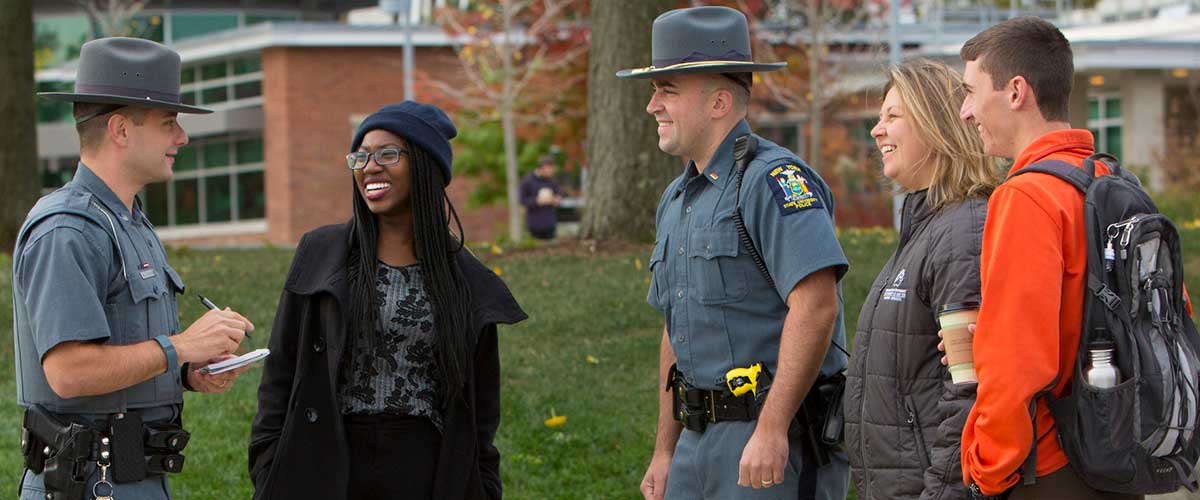
- University Police are fully empowered, state law enforcement officers trained to address the unique needs of the University campus. They work with faculty, staff and students in residential colleges and across campus to promote understanding and to educate about crime prevention.
- Several University offices, including the University Counseling Center, offer student support services to assist students with conflict management, stressors and personal issues with other students.
|
|