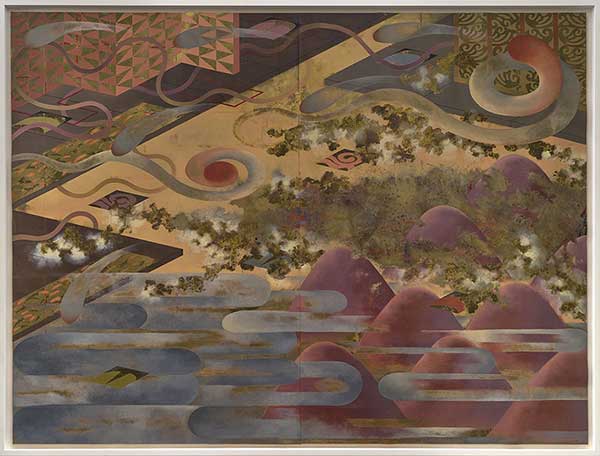
Takako Yamaguchi, (b. 1952)
Untitled, 1984
Bronze leaf, oil, and glitter on paper
On loan from Art Bridges
Standing before Yamaguchi’s massive canvas is an immersive experience that invites the viewer to become lost in the work. There is no interior and exterior, no inside and out. She presents both architecture and landscape, the minute and the vast, in a way that dissolves the boundaries of the frame itself. Lines and forms that extend to the edges of the picture-plane reinforce this sense of totality: a folding screen and the hard edges of a yellow architectural structure cut diagonally across the space, while soft swirls move horizontally across the canvas above an expanse of mauve hillocks and blue clouds.
Yamaguchi’s exploration of decoration, pattern, and beauty is indicative of the Pattern and Decoration Movement of the 1970s–80s and resonates with the sensibilities of the Arts and Crafts Movement explored upstairs in the Main Gallery. In both cases, artists resist the forward-looking momentum of Modernity and instead look back for inspiration. The Pattern and Decoration Movement rejected Modernism’s male-dominated, minimalist aesthetic and the often pejorative connotations of “decorative” art. Like the Arts and Crafts proponents, Yamaguchi revives and celebrates earlier styles, while at the same time, producing work that is distinctly modern.
Threads connect Yamaguchi’s work to the three student-curated Lower Galleries. Like the global spread of blue-and-white ceramics explored nearby in Why So Blue? The Influence of Chinese Blue-and-White Porcelain, Yamaguchi embraced globalism before it became a buzzword. Her works operate at the intersection of the local and global, drawing inspiration from diverse Japanese, French, American, and Mexican sources. Similar to the chinoiserie that emerged from the European desire for Chinese porcelain, Yamaguchi’s work embraces pastiche and plays with the tensions between authenticity and reproduction.
Both Yamaguchi and the exhibition Japanese Card Games and the Significance of Flora celebrate the everyday. A seemingly quotidian object, a deck of playing cards, provides grounds for exploring Japanese history and culture. The Japanese prints of flora accompanying the cards highlight some of the visual strategies Yamaguchi utilizes: elevated perspective, strong diagonals, and patterns of repeating natural elements.
Finally, a similar visual repertoire connects Untitled and Figures and Fragments: Collage and the Human Form. Yamaguchi’s densely patterned and richly layered work evokes collage by combining disparate elements to create new visual forms. These collages built from everyday materials or composed of repeating patterns resonate with the themes explored in the Pattern and Decoration Movement.
Takako Yamaguchi’s Untitled stands at the intersection of several themes explored throughout the current exhibitions at the Binghamton University Art Museum. Her work bridges genres and styles to present a painted surface that is dense, lush, and rich with detail; it celebrates the visual and the experience of looking.