News | Volume 2

Harnessing Collective Wisdom to Foster Development, Advancing Exchange and Cooperation into a New Chapter — 2nd International Theatre Exchange and Collaboration Forum and the “Generation Z” International Theatre Exchange and Collaboration Forum Successfully Held in Beijing

LI Huayi

中文

        From October 24 to 27, the 2nd International Theatre Exchange and Collaboration Forum, also the “Generation Z” International Theatre Exchange and Collaboration Forum, successfully convened in Beijing under the auspices of the National Academy of Chinese Theatre Arts (NACTA). The event brought together over 2,000 participants, including representatives from 45 domestic and international institutions—spanning more than 20 countries and regions—as well as Chinese and international special guests, and teachers and students from primary to tertiary educational institutions across Beijing.

        Building upon the theme “The Art of Theatre within Civilizational Exchange and Mutual Learning,” this year’s forum featured a rich array of activities: Frontier Academic Forum, masterclasses, roundtable dialogues between young artists and scholars of Generation Z, immersive artistic workshops, and live performances. Experts and scholars from China and abroad engaged in in-depth presentations and discussions on the preservation and development of xiqu (traditional Chinese opera), digital and intelligent theatre, theatre education, theatre communication and exchange, and arts management—topics at the forefront of the discipline. Together, they explored paths for preserving and innovating theatrical arts within a globalized context.

        The opening ceremony, titled “The Many Colors of Theatre in Modern Civilization,” featured dazzling East-meets-West performances. Faculty members and students of National Academy of Chinese Theatre Arts collaborated with more than one hundred performers from institutions such as Indiana University Jacobs School of Music, Ulster University’s Faculty of Arts, Humanities and Social Sciences, Singapore Traditional Arts Centre, The Hong Kong Academy for Performing Arts, and various Chinese art institutions and universities. Collaboratively, they presented a visually and aurally captivating spectacle.

Four performers stand on stage against a red backdrop. Two women wear elegant gowns while two men wear formal suits.
Peking Opera song "I am A Peking Opera Performer" at the opening ceremony

A large group of performers in elaborate traditional Chinese opera costumes pose on stage. Behind them, a vivid red backdrop displays large banners with dragons and Chinese calligraphy.
Fusion of four regional operas "Theatrical Dreams in the Lion City" at the opening ceremony

A violinist and a pianist perform on stage in front of a vivid digital backdrop depicting a sunset over dark hills and a glowing shoreline. On the right, a dancer in a flowing blue outfit moves gracefully, holding a white silk scarf that catches the stage light in soft purple tones.
Concerto for violin and piano "Fishing Song" and "Andalusian Romance" at the opening ceremony

Child performers in traditional Chinese opera costumes stand on stage against a vivid red backdrop with large triangular banners. The performer in the central position, dressed in ornate red and gold attire, extends wide flowing sleeves. Some performers wear elaborate facial makeup, while others appear without it, highlighting varied roles in the performance.
Children's opera performance "Fragrant Charm of Traditional Theater" at the opening ceremony

Drama sketch "Suite for Three" staged at the opening ceremony
Drama sketch "Suite for Three" staged at the opening ceremony Image Credit: Three young performers balance together on a small red chair on stage, striking a humorous pose. One wears a white sweater, another is in black pants and a jacket with a hat, and the third peeks from behind. The brightly lit cityscape backdrop adds a lively atmosphere..

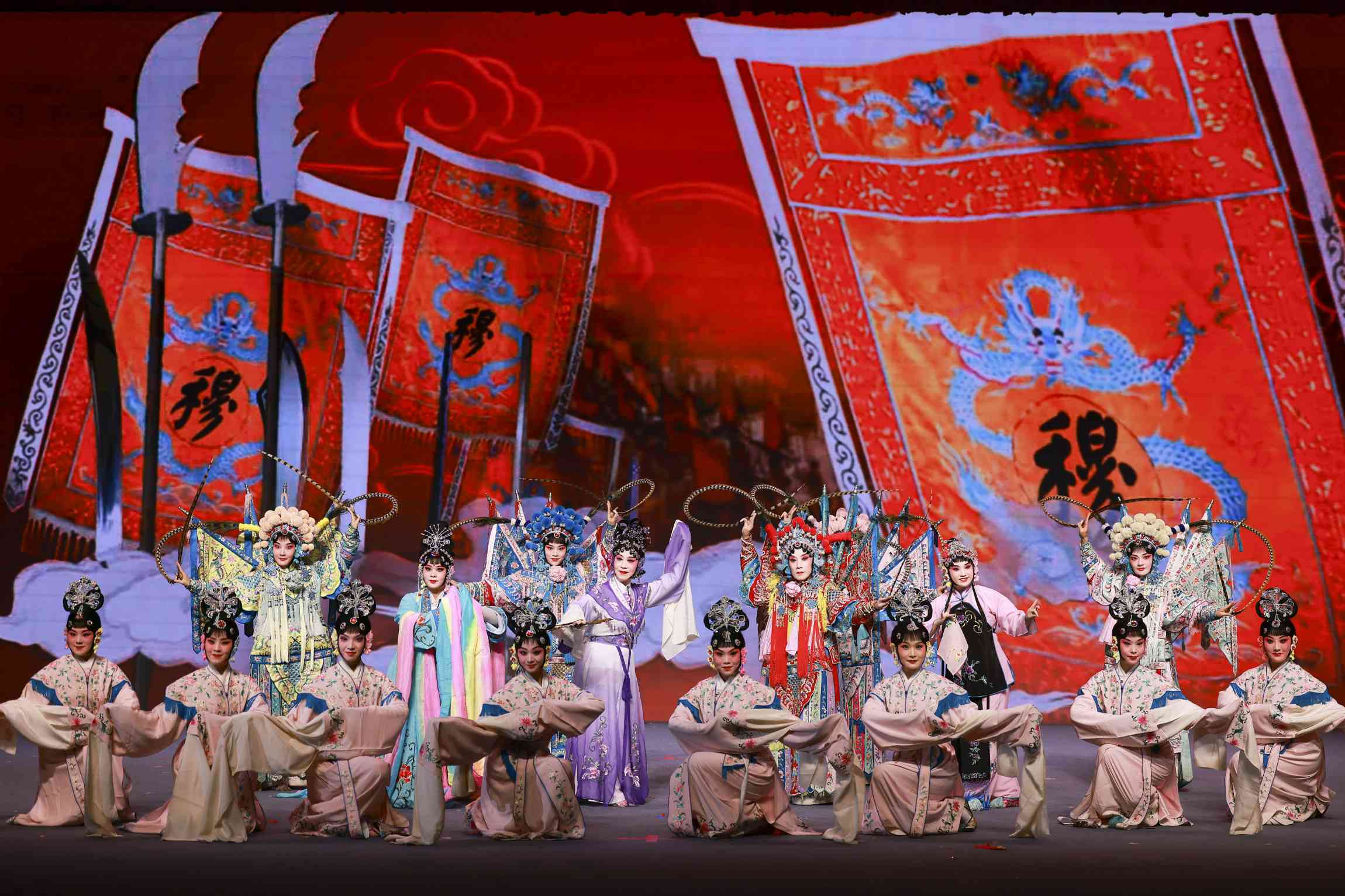
A group of performers in traditional Chinese opera costumes stand on stage, arranged around a central figure dressed in red and seated behind a yellow table. Others wear yellow, black, and pink robes with ornate headpieces. The backdrop features a stylized red dragon and swirling cloud motifs, creating an imperial atmosphere.
Hebei Bangzi Opera Ascending the Throne staged at the opening ceremony

Two performers in traditional Chinese opera costumes engage in a stylized combat scene on stage. One, dressed in ornate armor with feathered headgear, raises long spears, while the other, in a turquoise robe with floral embroidery, strikes a poised stance holding a staff. The background features a misty, painterly mountain scene.
Cantonese Opera segment "Execution of Two Kings: Oath of Brotherhood" staged at the opening ceremony

Pu Opera Oedipus the King staged at the opening ceremony
Pu Opera Oedipus the King staged at the opening ceremony Image Credit: Three performers in traditional Chinese opera costumes enact a dramatic scene on stage. One, dressed in flowing black and gold robes, extends an arm while another in blue appears to plead urgently. The third performer, kneeling with a long gray beard and painted face, strikes a solemn pose against a grid-patterned blue backdrop..

        A key academic pillar of the forum, the "Frontier Academic Forum," served as a high-level platform for scholarly exchange. Renowned artists and academics from the United States, Singapore, Macao, Hong Kong, and other regions gathered to deliberate on cutting-edge topics such as cultural exchange, heritage preservation, arts education, talent cultivation, theatre production, and media dissemination—offering insights and advice for the future generation.

Described in caption
Group photo of all the partcipants at the "Frontier Forum"

        Recognizing youth as the future of theatrical arts, this year's forum placed a strong emphasis on the younger generation. It launched a dedicated roundtable and immersive experiential workshops for Generation Z young artists and scholars. These initiatives employed a dual strategy of "bringing in" and "going out," establishing a broad-based platform for cross-border dialogue and interaction among young scholars and theatre practitioners. Through innovative designs of discussions and courses, these programs ignited deep interest in xiqu and other cultural heritage among the youth, injecting fresh energy into international theatre exchange and cooperation.

A panel of five speakers sits on stage at the 2024 Second International Theatre Exchange and Collaboration Forum. Behind them, a large blue screen displays the forum title in Chinese and English, with photos and names of the panelists. An audience watches attentively.
Roundtable 1 (Host: Wu Xinmiao; Guests: Tan Zhengyan, Hao Hongyan, Yu Sihan, Timothy Pilotti Johansson)

A collage shows three speakers delivering presentations, each holding a microphone and engaging the audience. Below, a large auditorium is filled with attentive students and adults, many in school uniforms. The setting suggests an educational or cultural event focused on Chinese performing arts and theater appreciation.
Activities during the visit to Lize International School

A panel of five speakers sits on stage at the 2024 Second International Theatre Exchange and Collaboration Forum. Behind them, a large blue screen displays the forum title in Chinese and English, with photos and names of the panelists. An audience watches attentively.
Roundtable 2 (Host: Yan Quanyi; Guests: Zhao Yan, Li Guangfu, Meng Li, Zhang Jiafen)

: A collage of classroom scenes shows students and instructors engaging in lectures and performance workshops about Chinese music and theatre arts. One presenter stands at a podium with slides projected behind her, while others demonstrate movements or play traditional instruments. The students watch attentively or participate in interactive activities.
Activities during the visit to Beijing Language and Culture University

A panel of five speakers sits on stage at the 2024 Second International Theatre Exchange and Collaboration Forum. Behind them, a large blue screen displays the forum title in Chinese and English, with photos and names of the panelists. An audience watches attentively.
Roundtable 3 (Host: Yu Jiangang Guests: Zhao Qun, Wang Tairui, Liu Guoying, Li Zhuoqun)

Three speakers stand at podiums giving presentations, each illuminated against a dark background. Below them, students in light blue and white traditional-style robes perform expressive movements on stage, imitating gestures from classical Chinese theatre. A projected image of traditional artwork and performance scenes enhances the visual connection between lecture and demonstration.
Activities during the visit to Tsinghua University

        During the “Masterclasses,” artists and scholars, including Pu Cunxin, Li Hongtu, Catrin S. Rhys, and Lee Li Heng shared their unique perspectives on theatrical arts.

Described in caption
Pu Cunxin giving a speech

Described in caption
Li Hongtu giving a speech

Described in caption
Catrin S. Rhys giving a speech
Described in caption
Lee Li Heng giving a speech

        At the forum's closing concert, “Melodies of East and West,” the National Academy of Chinese Theatre Arts’ Traditional Orchestra performed in collaboration with visiting faculty and students from Ulster University. Their repertoire included a traditional Irish jig and selected Chinese folk songs, showcasing a harmonious blend of musical traditions and exemplifying the aesthetic ideal of “beauty in diversity.”

A mixed ensemble performs on stage, featuring a pianist, two vocalists, and musicians playing traditional string and percussion instruments. The performers, dressed mostly in black with red accents, are illuminated by cool blue stage lighting against a minimalist acoustic panel backdrop.
Delegates from Ulster University, together with faculty and students from our Academy, put on a joint performance of traditional Irish Jig music.

A full orchestra performs on stage under the direction of a conductor standing at the center with raised arms. Musicians play strings, woodwinds, and percussion instruments, all dressed in formal black and white attire. The stage is framed by acoustic panels, and the ensemble is illuminated by soft stage lighting.
Ensemble performance titled "Distant Memories of Pingshan"

A Chinese instrumental ensemble performs on stage, featuring musicians seated in a semicircle playing traditional instruments such as the erhu, pipa, and guzheng, with percussionists in the back. The performers wear coordinated black and white attire, and the minimalist stage backdrop enhances the focus on the music.
Chinese Music Ensemble "Pulling the Rickshaw"

A group of seven percussionists performs on stage, each playing large red Chinese drums decorated with golden dragons. Dressed in black, the musicians are energetically striking their drums in unison under cool blue lighting, creating a dynamic and powerful visual composition.
Percussion Ensemble "Poetry of the Drum"

A group of six performers
Banhu Ensemble "Charm of Liuzi Opera"

pipa performers
Pipa Ensemble "Ambush from Ten Sides"

        At the forum, President Yin Xiaodong of the National Academy of Chinese Theatre Arts officially proposed to establish the Alliance for International Theatre Exchange and Collaboration, an initiative warmly received and widely supported. The alliance aims to build a long-standing platform for international exchange, drawing upon global expertise and resources to create a sustainable framework for theatrical collaboration. It seeks to deepen cooperation in talent cultivation, production and performance, dissemination and promotion, as well as academic exchange—fostering mutual enrichment and growth through international engagement.

        Throughout the forum, Secretary of the Party Committee Li Biyou and President Yin Xiaodong of the National Academy of Chinese Theatre Arts met with key international partners, including Cai Bixia, Founder and Artistic Director of the Singapore Traditional Arts Centre, and an overseas alumni representative of NACTA; Donald E. Hall, Vice President of Binghamton University; Abra Bush, Dean of the Jacobs School of Music at Indiana University; and Sven Schottmann, Deputy Dean of the Faculty of Arts, Humanities and Social Sciences at Ulster University. They explored new pathways for the internationalization of arts education, the strengthening of cooperative ties, and the cultivation of a thriving theatrical ecosystem.

Group photo with Cai Bixia
Meeting with Cai Bixia, Founder and Artistic Director of Singapore Traditional Arts Centre and overseas alumni representative of the National Academy of Chinese Theatre Arts.

Group photo with Yin Xiaodong and Donald E. Hall
President Yin Xiaodong met meets with Donald E. Hall, Vice President of Binghamton University, and his delegation.

Group photo with Yin Xiaodong and Abra Bush
President Yin Xiaodong meets with Abra Bush, Dean of the Jacobs School of Music at Indiana University, and her delegation.

Group photo with Yin Xiaodong and Sven Schottmann
President Yin Xiaodong meets with Sven Schottmann, Associate Dean of the Faculty of Arts, Humanities and Social Sciences, Ulster University, and his delegation.

A photo taken during the meeting with the artists.
Meeting with Chinese Plum Blossom Award-winning artists Shen Xiaomei, Wang Yinghui, Chen Yaping, Liu Wenhui, Wu Suzhen, Chen Liyu.

        The forum attracted widespread attention from both domestic and international media. Major outlets including People’s Daily, China Media Group, China Education Television, and Beijing Radio and Television Station provided on-site coverage, while new media platforms such as Youth.cn, WeChat, Weibo, Douyin, and Bilibili streamed the events live. Some activities of the forum were open to the public, drawing enthusiastic participation from the wider community.

        Culture speaks to souls beyond races; art connects hearts across borders. Looking ahead, the National Academy of Chinese Theatre Arts will remain committed to openness, inclusivity, and tradition-rooted innovation. The Academy will continue to advance the development of the International Theatre Exchange and Collaboration Center, exerting the unique value of xiqu in international cultural exchange. Through deepened artistic and academic collaboration, the Academy aims to foster mutual learning and integration between Chinese and international theatre, in the pursuit of Beauty Shared in Harmony and Diversity. 

(Written by Li Huayi, Deputy Director and Associate Research Fellow at the Office of International Exchange and Collaboration, National Academy of Chinese Theatre Arts.)


← Return to Table of Contents ←

This article was publised in Chinese in Chinese Theatre Arts in 2024. 

Li, Huayi. “Harnessing Collective Wisdom to Foster Development, Advancing Exchange and Cooperation into a New Chapter — 2nd International Theatre Exchange and Collaboration Forum and the ‘Generation Z’ International Theatre Exchange and Collaboration Forum Successfully Held in Beijing.” Chinese Theater Arts, vol. 45, no. 6, 2024, pp. 171–73, https://doi.org/10.15915/j.cnki.cn11-1172/j.2024.06.014.

The English translation of this article was published in the second volume of TheaComm, an E-Journal of Theater Arts Communication in October, 2025. DOI.org (Crossref), http://doi.org/10.22191/theacomm/volume2/article9

Translator: Yichen Zhang

Proofreaders: Chenqing Song, Xi Wang