From Stress to Depression: 9 Ways Binghamton Researchers Are Rethinking Mental Health
Mental health touches nearly every part of our lives, from how we handle stress to how we build relationships, navigate challenges, and connect with the people around us. But there’s still so much to learn about the factors that influence our well-being and how we can better support ourselves and others. Across Binghamton University, researchers from a variety of disciplines are exploring those questions from different angles. Their work is uncovering surprising connections, challenging assumptions, and finding new ways to think about mental health and the systems that support it. As our understanding of mental health grows, so do the possibilities for building healthier, more resilient individuals and communities.
Understanding when and why we become vulnerable to depression
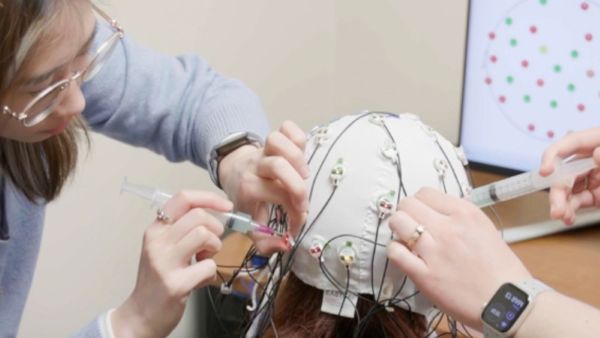
Why do some people develop depression while others remain resilient? At Binghamton University's Mood Disorders Institute, Distinguished Professor of Psychology Brandon Gibb and his team are working to answer that question. Through studies involving local families, researchers at the MDI examine how brain activity, emotional responses, and family interactions influence the risk of depression, particularly during childhood and adolescence. Their research seeks to understand more about how depression develops and help improve interventions for those at risk.
Exploring anxiety as an early symptom of Parkinson’s disease
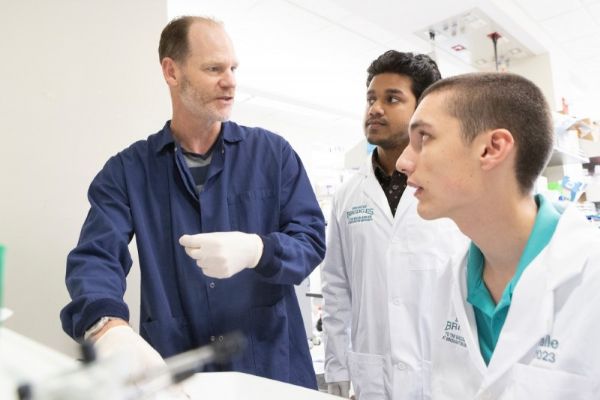
Could anxiety tell us something about Parkinson’s disease before its more recognizable symptoms appear? Binghamton University Professor of Psychology Christopher Bishop is investigating how anxiety develops in people with Parkinson’s disease and the biological changes that may cause it. With support from the Michael J. Fox Foundation, Bishop and his collaborators are studying the amygdala, a region of the brain associated with fear and anxiety, to understand why some patients experience anxiety even before the disease’s characteristic motor symptoms emerge. Their research could help uncover anxiety’s role in the progression of Parkinson’s and potentially identify new opportunities for treatment.
Could your daily habits change how you handle stress?

Skipping breakfast after a late night might seem like a normal part of college life, but could those everyday habits affect how we respond to stressful situations? Binghamton University Associate Professor of Health and Wellness Studies Lina Begdache and her research team explored the connection between lifestyle habits and psychological flexibility, our ability to adapt when faced with challenges. Their findings reveal some interesting connections between what we do every day and how resilient we may be when life gets stressful.
When affection becomes manipulation

A hug, a handhold, or a reassuring touch can communicate love and comfort, but what happens when physical affection is used to cause harm instead? Binghamton University Professor of Psychology Richard Mattson and a team of students explored the darker side of touch in romantic relationships, examining how personality traits and relationship insecurities may influence the ways people give and receive affection. Their research offers a surprising look at how even seemingly caring gestures can be used in ways that aren't so caring after all!
The connection between pain and cannabis use

Young adults are often thought of as healthy and pain-free, but pain may play a bigger role in their lives than we realize. Binghamton University psychology researchers Callon Williams, Emily Zale, Nadine Mastroleo, and Mark Lenzenweger explored how experiencing pain may influence cannabis and alcohol use among young adults ages 18 to 25. Their research challenges some common assumptions about pain at a young age and raises important questions about the ways young adults may turn to substances to cope.
Understanding how couples respond to stress and trauma

When someone experiences intense stress or trauma, its effects may not stop with them; the effects can reach the people closest to them as well. Binghamton University Associate Professor of Psychology Christina Balderrama-Durbin directs the Couple Adjustment to Stress and Trauma (CAST) Lab, where she explores how individuals and couples respond to difficult and traumatic experiences. From military couples and veterans to other communities facing unique stressors, her work asks an important question: What helps some relationships withstand adversity while others struggle?
How can we better support autistic young adults?

College can be an exciting new chapter, but adjusting to a new environment can also bring challenges, and those challenges may look very different for autistic students. Binghamton University researchers Diego Aragon-Guevara and Psychology Professor Jennifer Gillis Mattson examined the experiences of autistic college students and uncovered noticeable differences in rates of anxiety and depression compared with their non-autistic peers. Gillis Mattson’s work also extends beyond the college experience through initiatives like the PANDA Project, which explores new ways to foster community and connection for autistic adults. Together, these efforts raise an important question: What does meaningful support for autistic young adults really look like?
Using data to advance mental health policy research

Getting the right mental health care isn’t always as simple as asking for help. Where you live, which providers are available, and even state policies can shape the care you receive. Binghamton University Assistant Professor of Pharmaceutical Sciences Phillip Hughes is using data to explore the systems behind mental health and substance-use treatment. His work asks a much bigger question: How can we break down barriers and create a system where quality mental health care is accessible to everyone?
What if stress isn’t always the enemy?

We’re often told that stress is something to avoid, but what if changing the way we think about stress could change the way it affects us? Binghamton University Health and Wellness Studies Lecturer Jennifer Wegmann researches stress mindset and resilience, exploring how our personalities and perceptions can shape the way we experience stressful situations. Her work challenges the traditional idea that managing stress simply means reducing it and asks us to reconsider whether stress could actually become a tool for growth
Paula Andrade is a junior from Ecuador. She majors in business administration with concentrations in marketing and business analytics, and minors in global studies. After graduation, she hopes to pursue a marketing career in the nonprofit sector. In her free time, she enjoys reading history, dancing, traveling and watching horror movies.
Have questions, comments or concerns about the blog? Email us at social@binghamton.edu.