Working to keep students healthy
Health and counseling serves as a foundation for student success
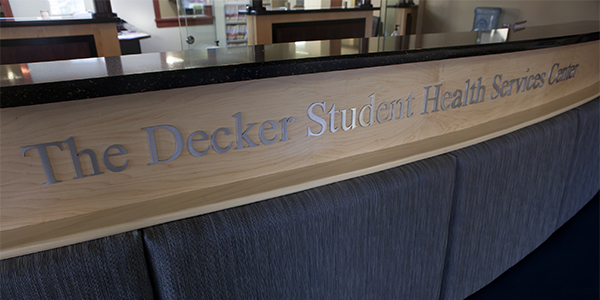
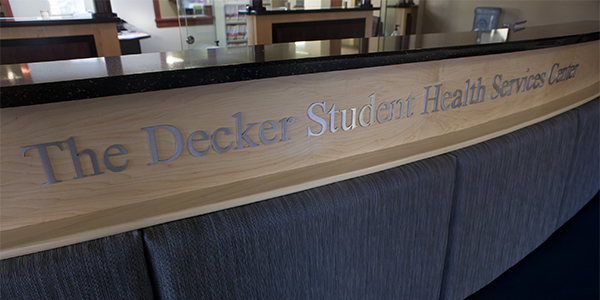
Binghamton University students will notice a number of changes at Decker Student Health Services Center (DSHSC) and the University Counseling Center (UCC) this fall – all made with their health and well-being in mind and a focus on providing services to students right where they are.
“Health and counseling are a foundation of this organization,” said Noel Feik, director of Health and Counseling Services. “If our students are not emotionally and physically well, their academic performance doesn’t matter. They have to be well, and that’s what we’re about.”
With increasing demand for counseling services, the UCC has expanded its staff, hiring three new counselors this fall with expertise working with student-athletes and those in under-represented communities on campus.
“We have a diverse campus so we should have diverse staff,” Feik said. “Our goal is to make sure our students are comfortable seeking services. Students will be more likely to come into a facility when they have someone they can relate to and counseling is such a personal relationship that it just makes sense.”
Feik also reminds students that they can access after-hours phone counselors at any time the UCC is not open. “Simply call the UCC at 607-777-2772 and press 2 on the voicemail menu to be connected with a mental health professional,” she said. “The service is provided through University partner ProtoCall Services, and the counselors who answer the calls are familiar with Binghamton University and local emergency services.”
The University has also introduced a number of changes and new services, including tele-counseling and tele-health, a free service for students enrolled in the University-sponsored domestic student and international student health insurance plans that can be used from a location and time that is convenient for them.
“We find that some students, because of a variety of reasons – stigma, uncertainty and inconvenience – are unwilling to come to us for counseling or health services,” Feik said. “This digital platform allows students who may not take advantage of on-campus counseling and health services to do it via the tele-system. Students are digital users so we’re creating capacity for students to be seen when it’s convenient for them and through a vehicle that they use.”
“One of the things we find is that, as freshman transition to navigating their own health experience, they may be over-utilizers or under-utilizers of health services,” said Feik. “Using tele-health allows students to call in and get screened. Maybe they don’t really need to be seen, but it’s a good way to be able to call home and tell mom or dad, ‘Yes, I have these symptoms, but this is what the doctor said,’ and it’s a covered benefit as part of their domestic or international sponsored insurance plan.” Students can access these services through the Health Services website.
Later this semester, students will also be able to utilize a tele-psychiatry service, connecting students to SUNY Upstate Medical University clinicians using a secure audio/video app.
In addition to the tele-psychiatry program, Dr. Ramona Mazzeo, clinical director of psychiatry at DSHSC, has expanded psychiatric services for students, now offering intakes five days a week to add to the availability for students to be seen for psychiatric consultations.
“Outcomes in psychiatry are enhanced when complemented with psychotherapy. This year we are piloting a colocation of psychiatry and counseling services at the DSHSC. This colocation of services offers a private practice-model that is very exciting,” said Feik.
Two new members of the Health Services staff will increase the number of acute-care and preventive-care appointments available to students this fall. Dr. Richard Moose, MD, the new medical director, who joins us from SUNY Potsdam where he served as a college physician and as the medical and administrative director, and Karen Cerinetti, a new, full-time, 12-month nurse practitioner with years of emergency medical experience. “Both of these individuals are strong believers in patient-centered care,” Feik said.
In addition to the new tele-services options for students, DSHSC is expanding its Mindful Awareness Practice Program this semester. The free, eight-week program includes teaching on: meditation; the interconnection of mind, body and emotions; stress management; emotional flexibility; self-regulation; re-perceiving; neuroplasticity; mindful eating; mindful communication; mindful listening; and intrapersonal and interpersonal attunement.
For student convenience, the program has also been moved out of the DSHSC to two new locations: Mountainview Community and the University Downtown Center. More information can be found on the DSHSC website. https://www.binghamton.edu/health/services/mindfulness/index.html
“You always want to meet the student where they’re at, especially if they are transfer students, international students or freshman, because they don’t know the layout of campus,” Feik said. “Instead of expecting them to navigate campus to find our services, it makes more sense to go to the students. They may be more apt to go to a program or to participate if it’s at their fingertips or within their building or their community.”
Students will also notice redesigned websites for Health Services and the Counseling Center that are easier to navigate, more user-friendly and provide a better experience for students.
In addition, Feik is seeking more student input to ensure the services being provided are the ones that students will take advantage of. Students can always provide feedback through the Student Health Advisory Council (SHAC), which provides students an opportunity to offer health and counseling recommendations. “I am interested in the voice of the customer, our students,” said Feik. In addition to the SHAC, later this fall students will be able to voice their opinion through our online satisfaction survey tool.
“My goal is to get the patient’s experience to match the high quality of care we deliver and that is because we care,” she said.