NSF CAREER awards, research expo among highlights for Biomedical Engineering Department in 2022-23
The fall semester at Binghamton University is in full swing, and the Department of Biomedical Engineering at the Thomas J. Watson College of Engineering is building on a productive 2022-23.
Oral Presentation Awards
First Place for Best Graduate Research Oral Presentation
Joab Dorsainvil, PhD candidate
“Fabricating Stretchable Paper-Based Substrates with a Core-Sheath Structure for Papertronics”
Joab Dorsainvil, Matthew S. Brown, Anwar Elhadad, Zahra Rafiee, Seokheun Choi, Ahyeon Koh
First Place for Best Undergraduate Research Oral Presentation
Fina Lu, Bachelor of Science candidate
“Enhancing Hydrophilicity of the Skin-interface Microfluidic Systems for Sweat Monitoring”
Fina Lu, Ji Hyun Yang, Ahyeon Koh
Poster Presentation Awards
First Place for Best Graduate Research Poster Presentation
Nicole Jeselson, Master of Science candidate
“Development of a Low-Cost Noninvasive Continuous Glucose Monitor”
Nicole Jeselson, Jonathan Tuvy, Winnie Chen, Ahyeon Koh
First Place for Best Undergraduate Research Poster Presentation
Kristen Allen, Bachelor of Science candidate
“Purifying Cardiomyocytes for Application in 3-Dimensional Cardiac Tissues”
Kristen Allen, Natalie Weiss-Pacher, Tracy Hookway
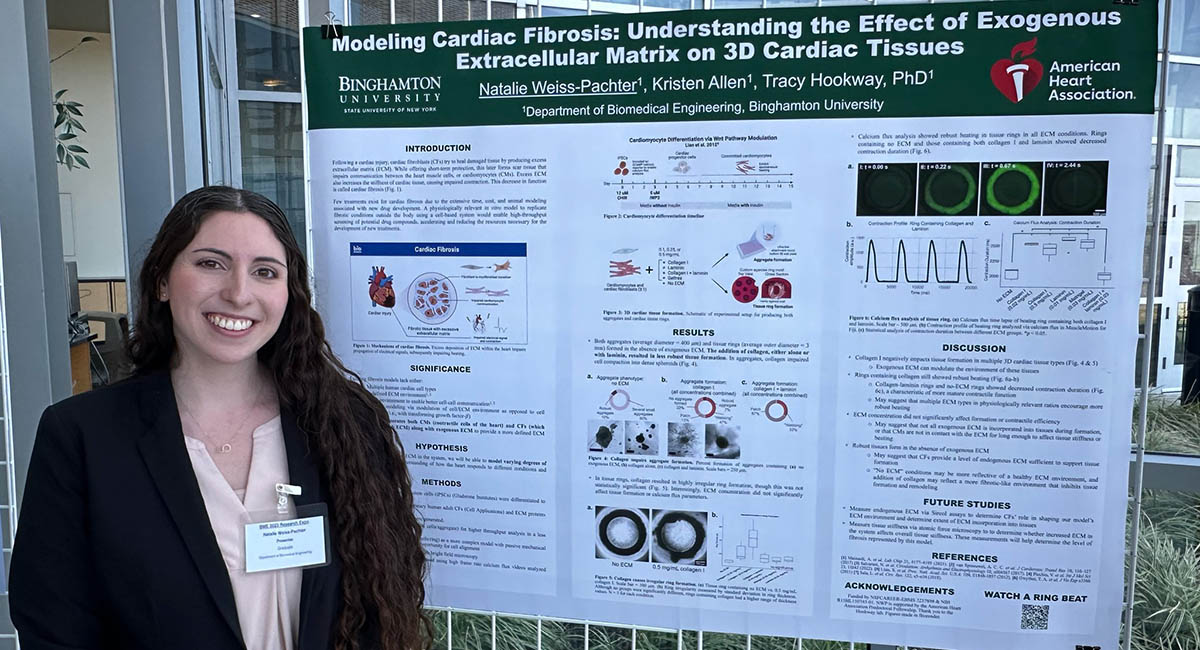
Second Place for Best Graduate Research Poster Presentation
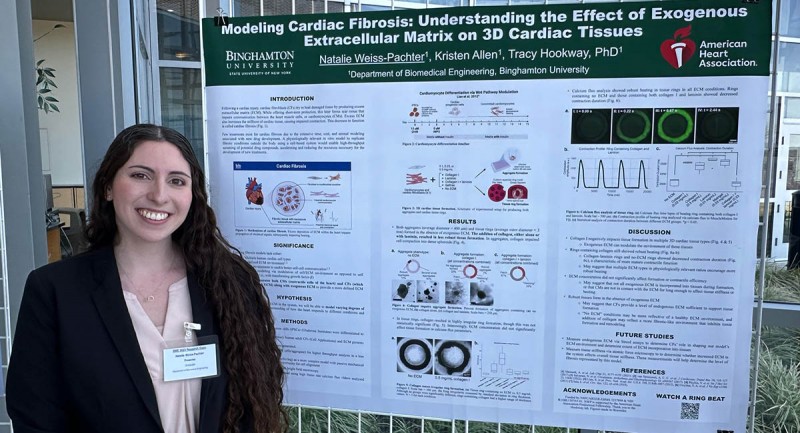
Natalie Weiss-Pacher, PhD candidate
“Modeling cardiac fibrosis: understanding the effect of exogenous extracellular matrix on 3D cardiac tissues”
Natalie Weiss-Pacher, Kristen Allen, Tracy Hookway
Second Place for Best Undergraduate Research Poster Presentation
Joseph Afreh, Bachelor of Science candidate
“Tracking Lipid Transfer from Cancer-Associated Adipocytes to Ovarian Cancer Cells with Stimulated Raman Imaging of Live Cells”
Joseph Afreh, Ryan Pierson, Soumit Saha, Fake “Frank” Lu
Research news
Assistant Professor Tracy Hookway has received a five-year, $500,000 National Science Foundation CAREER Award to continue her research to create 2D and 3D models of human cardiac cells and investigate their functions. She also will explore the role of autonomic neural stimulation on the function of engineered cardiac tissues.
Associate Professor Ahyeon Koh also won a five-year NSF CAREER Award for $500,120 to aid her research into better ways to attach biosensors. Koh has developed a flexible, porous material made from polydimethylsiloxane (PDMS), a nontoxic silicone commonly used for biomedical purposes, which she says is better than the nonporous film that is most common now.
Koh and PhD candidate Ji Hyun Yang have developed a better method for sweat collection at specified time periods that gives a more accurate picture of how a person sweats. Their research, published in the journal Sensors and Actuators, improves on current devices worn on the skin that fill reservoirs one at a time but do not reflect how our rate of sweating changes throughout the day as we perform different activities.
Professor Sha Jin and Distinguished Professor and BME Chair Kaiming Ye are collaborating to develop an innovative technology to reduce environmental pollution by turning food waste into biodegradable plastic. Their research received a $138,000 grant from New York state.
Assistant Professor Yizeng Li co-authored a paper in Nature Communications that looks at cell locomotion, offering a few more steps along the path to future cancer treatment. Collaborators included researchers from Johns Hopkins University, the University of Maryland, the University of Alberta and the Universitat Pompeu Fabra in Spain.
Assistant Professor Fake “Frank” Lu received $300,000 from the NSF’s Early Concept Grants for Exploratory Research (EAGER) program. He hopes to establish near-ultraviolet (NUV) light and coherent anti-Stokes Raman scattering (CARS) microscopy for high-resolution, highly sensitive imaging of native biomolecules and apply this imaging tool to develop label-free digital pathology for brain tumor diagnosis.
Associate Professor Yuan Wan published a study in Nature Communications about his team’s research into the use of cell-derived nanovesicles to deliver therapeutic agents to the interior of cancer cells with better accuracy and efficiency. They experimented with targeting moieties and engineered viral fusogens, which are proteins that facilitate cancer targeting and the fusion of cell membranes.
Student news
A piece in this year’s Watson Review magazine highlighted senior capstone projects from different departments. The BME project team designed a system to produce lactic acid from food waste. The liquid is being used for a capstone project this school year, where it will be purified and used to produce bioplastic.
Alejandro Wiltshire was interviewed about his work in the Biological Soft Matter Mechanics Laboratory (BSMM) with Associate Professor Guy German. Wiltshire joined the lab as a first-year student. With German’s guidance, he has refined his skills in research and laboratory methods.
Faculty/staff news
At Watson College’s spring luncheon, three faculty members and one staff member from the BME Department won Watson College Recognition Awards.
- Distinguished Educator: Assistant Professor Tracy Hookway
- Early Stage Distinguished Research: Associate Professor Ahyeon Koh
- Outstanding Faculty Service: Associate Professor Guy German
- Outstanding Staff Service: Graduate Program Administrative Assistant Kathy Feczko,