Physical therapy students present capstone research
Inaugural DPT cohort showcases work to PT professionals
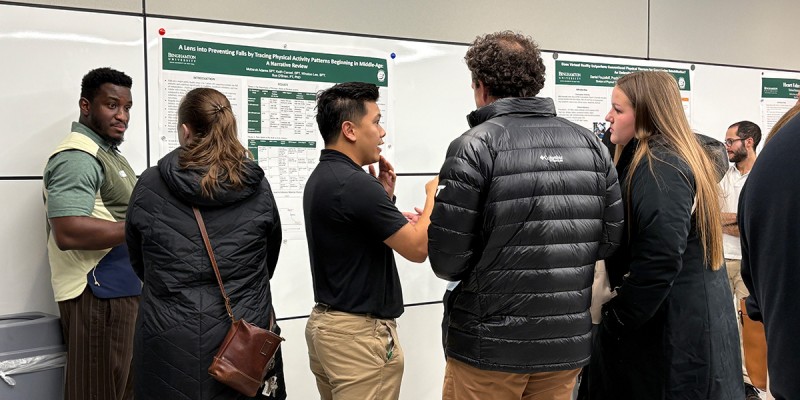
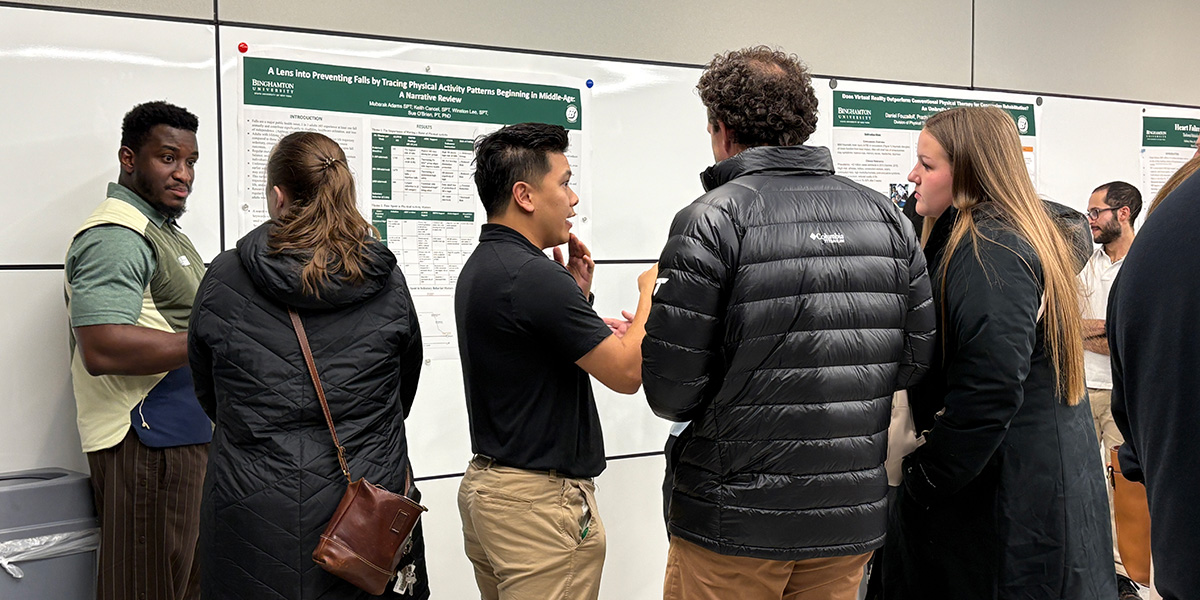
Decker College of Nursing and Health Sciences Doctor of Physical Therapy (DPT) students presented their capstone research projects on Dec. 4, marking the culmination of their studies in a specific area of interest. The students, the first cohort of DPT students at Binghamton University, showcased their work at the University’s Health Sciences Building in Johnson City, New York.
With topics ranging from the use of artificial intelligence in Parkinson’s rehabilitation to how adding variety in anatomy education affects students, the impact hip range of motion has on lower back pain and interventions for fall reduction, the DPT students engaged with faculty, staff, fellow students and physical therapy professionals from the American Physical Therapy Association (APTA).
“This event, organized collaboratively by [Binghamton’s] Division of Physical Therapy and the Southern Tier District of APTA New York, is enriched by the involvement of local clinicians and community partners,” explained Gurpreet Singh, assistant professor and capstone research coordinator for the DPT program. “Their feedback gives students a real sense of how their work connects to everyday patient care, and it helps us keep our curriculum grounded in what’s happening in clinics right now. This partnership ensures we stay aligned with the needs of the community our graduates will soon be serving.”
The presentation of capstone projects marked the final step in on-campus work for the 35 students before they begin their final clinical education experiences. Capstone projects take various forms, including experiments, literature and narrative reviews, patient case studies or evaluations of different treatment options.
“Engaging in research empowers our DPT students to think critically, question assumptions and translate evidence into practice,” Singh added. “Through the research process, they develop the analytical skills, scientific literacy and professional confidence needed to deliver high-quality, evidence-based, patient-centered care. Research prepares them not just to participate in the profession, but to help advance it.”
DPT students were split into workgroups at the end of their second year in the program and began working on their capstone projects earlier this year. Collaborating in groups helps students gain practical experience through teamwork.
The following is a list of the capstone project topics, along with the DPT students who worked on them and their Binghamton faculty mentor.
A Lens into Preventing Falls by Tracing Physical Activity Patterns Beginning in Middle Age: A Narrative Review
- Students: Mubarak Adams, Keith Cancel and Winston Lee
- Mentor: Suzanne O’Brien, associate professor
Behind Closed Doors: Uncovering the Most Prevalent Barriers Limiting Access to Pelvic Floor Physical Therapy
- Students: Jaquelinne Alfaro-Rosales, Melissa Caceres, Melody Carbonell, Sophia Howard and Emily Ramsay
- Mentor: Megan Gottlieb, adjunct clinical instructor
Does Virtual Reality Outperform Conventional Physical Therapy for Concussion Rehabilitation?: An Umbrella Review
- Students: Daniel Fouzailoff, Prachi Udeshi and Matthew Wikstrom
- Mentor: Vipul Lugade, associate professor
The Effects of Simulation-Based Education on Physical Therapy Students Through the Lens of the IPEC Competencies: Teamwork and Communication
- Students: Nicholas Parathyras, Ryan Reyes, Luis Silvestre, Abigail Terrill and Emily Williams
- Mentor: Denise Romano, assistant professor
Hip Range of Motion as a Contributor to Chronic Low Back Pain: A Literature Review
- Students: Jaret Beyer, Dylan Howell, Jasmine Lau and MaKenna Thisse
- Mentor: Matthew Murphy, clinical assistant professor
Rates of Geriatric Depression in Rural United States: A Narrative Review
- Students: Jacob Aurelio, Emma McInernery and Julia Milza
- Mentor: Gauri MacDonald, clinical assistant professor
Spice Up Your Life: How Introducing Variety in Anatomy Education Impacts Student Outcomes and Perceptions
- Students: Samantha Mason and Zachary Timmons
- Mentor: Brian Rooney, clinical assistant professor
Tailored Rehabilitation for Heart Failure and Osteoarthritis: A Narrative Review
- Students: Anthony Manoy, Natalie Novak and Nora Perkinson
- Mentor: Matthew Bowman, clinical assistant professor
Virtual Reality in Parkinson’s Disease: An Umbrella Review
- Students: Iris Costner, Bryce Deering, Gillian Laco and Sydney Verboys
- Mentor: Gurpreet Singh, assistant professor
Voluntary Stepping Interventions in Community-Dwelling Older Adults in the Reduction of Fall Risk: A Narrative Review
- Students: Jacob Freeland, Jonathan LaFortune and Sean Phelan
- Mentor: Woei-Nan Bair, assistant professor
Binghamton University’s Division of Physical Therapy launched the three-year DPT program in June 2023. The first cohort is scheduled to graduate in May 2026.