Phi Beta Kappa Visiting Scholar, Prof. Catherine Ramirez, visit December 3-5, 2025
We are very pleased to announce that Phi Beta Kappa Visiting Scholar, Prof. Catherine S. Ramirez, Professor of Latin American and Latino Studies, University of California Santa Cruz, will be on our campus Dec. 3 - 5, 2025. She will meet with various groups of students and will present a public lecture on Dec. 4 at 5:00 PM in Lecture Hall 10. The title of her talk will be "The Future of Labor and Undocumentedness: Lessons from Latinxfuturism."
Phi Beta Kappa Visiting Scholar, Prof. Ken Ono, virtual visit March 11-12, 2021
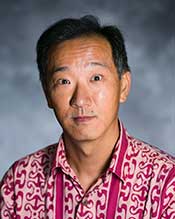
Ken Ono is the Thomas Jefferson Professor of Mathematics at the University of Virginia and the Vice President of the American Mathematical Society. He earned his PhD from UCLA in 1993, and he has published several monographs and over 180 research and popular articles in number theory, combinatorics and algebra. Professor Ono has received many awards for his research, including a Guggenheim Fellowship, a Packard Fellowship and a Sloan Fellowship. He was awarded a Presidential Early Career Award for Science and Engineering (PECASE) by Bill Clinton in 2000 and he was named the National Science Foundation's Distinguished Teaching Scholar in 2005. He was also an associate producer of the 2016 Hollywood film "The Man Who Knew Infinity," which starred Jeremy Irons and Dev Patel.
Thursday, March 11, 2021 at 2:50-3:50 Math Club Talk (for all undergraduates interested in math):
Title: What is the Riemann Hypothesis, and why does it matter?
Abstract. The Riemann hypothesis provides insights into the distribution of prime numbers, stating that the nontrivial zeros of the Riemann zeta function have a “real part†of one-half. A proof of the hypothesis would be world news and fetch a $1 million Millennium Prize. In this lecture, Ken  Ono will discuss the mathematical meaning of the Riemann hypothesis and why it matters. Along the way, he will tell tales of mysteries about prime numbers and highlight new advances.
A link to a Panopto recording of the above Math Club Talk is here:
Panopto recording of the above Math Club Undergrad talk.
Thursday, March 11, 2021 at 4:30-5:30 Colloquium Talk:
Title: Gauss's Class Number Problem
Abstract. In 1798 Gauss wrote Disquisitiones Arithmeticae, the first rigorous text in number theory. This book laid the groundwork for modern algebraic number theory and arithmetic geometry. Perhaps the most important contribution in the work is Gauss's theory of integral quadratic forms, which appears prominently in modern number theory (sums of squares, Galois theory, rational points on elliptic curves,L-functions, the Riemann Hypothesis, to name a few). Despite the plethora of modern developments in the field, Gauss's first problem about quadratic forms has not been optimally resolved. Gauss's class number problem asks for the complete list of quadratic form discriminants with class number h. The difficulty is in effective computation, which arises from the fact that the Riemann Hypothesis remains open. To emphasize the subtlety of this problem, we note that the first case, where h=1, remained open until the 1970s. Its solution required deep work of Heegner and Stark, and the Fields medal theory of Baker on linear forms in logarithms. Unfortunately, these methods do not generalize to the cases where h>1. In the 1980s, Goldfeld, and Gross and Zagier famously obtained the first effective class number bounds by making use of deep results on the Birch and Swinnerton-Dyer Conjecture. This lecture will tell the story of Gauss's class number problem, and will highlight new work by the speaker and Michael Griffin that offers new effective results by different (and also more elementary) means.
Panopto recording of the above Colloquium talk.
Friday, March 12, 2021 at 4:00-5:00, Public Lecture:
Title: Why does Ramanujan, "The Man Who Knew Infinity," matter?
Abstract: This lecture is about Srinivasa Ramanujan, "The Man Who Knew Infinity." Ramanujan was a self-trained two-time college dropout who left behind 3 notebooks filled with equations that mathematicians are still trying to figure out today. He claimed that his ideas came to him as visions from an Indian goddess. This lecture gives many reasons why Ramanujan matters today. The answers extend far beyond his legacy in science and mathematics. The speaker was an Associate Producer of the film "The Man Who Knew Infinity" (starring Dev Patel and Jeremy Irons) about Ramanujan. He will share several clips from the film in the lecture, and will also tell stories about the production and promotion of the film.
Panopto recording of the above public talk.
Phi Beta Kappa Visiting Scholar, Prof. Bart Ehrman, March 23-24, 2017
Prof. Bart D. Ehrman, James A. Gray Distinguished Professor of Religious Studies, University of North Carolina at Chapel Hill, author/editor of thirty books on the New Testament and Early Christianity, delivered a public lecture on March 23, 2017, as Phi Beta Kappa Visiting Scholar. His talk was entitled: "Did the Early Christians Forget Jesus? Eyewitnesses, Oral Traditions, and Distorted Memories."
Abstract: Scholars of memory in such fields as cognitive psychology (personal memories), sociology (collective memory), and anthropology (oral cultures) have shown how people remember, misremember, forget, and invent memories. Such studies can help us better understand the Gospels of the New Testament as guides to the life of the historical Jesus. Do any of the stories about Jesus represent ``false memories"?
On March 24, 2017, a lunch discussion was held on "The Vital Role of the Humanities in a 21st-century Liberal Arts Education" at the President's Reception Room, Anderson Center for the Arts.
Phi Beta Kappa Visiting Scholar, Prof. Ronald Mellor, Nov. 11, 2011
Prof. Ronald Mellor, Phi Beta Kappa Visiting Scholar, presented a public lecture at Binghamton University, Nov. 11, 2011 in the Casadesus Recital Hall (Fine Arts 117) at 4:30 PM. A reception followed.
Title: East Meets West: Encounters Along The Ancient "Silk Road"
Long before the dawn of recorded history, traders and migrants moved across vast distances by land and by sea. They did not just carry products - precious metals, fabrics, or foodstuffs - but they brought their own culture with them: languages, writing systems, new forms of agricultural technology, animals, and even their diseases and systems of belief.
The most famous of these trade routes - the "Silk Road" - stretched from China to the Mediterranean. Though this wonderfully exotic term conjures up a superhighway 5,000 miles long across Eurasia, there was no such thing as a "Silk Road." Rather there were many individual roads, desert tracks, and mountain passes through which traders and nomads, armies and missionaries passed in both directions across the Eurasian steppe. We usually focus on the great civilizations at either end of this long trading network - Rome, Byzantium and the Near East at the western end, and imperial China in the East - but today's lecture will also examine the peoples and activities across the less known expanse of Central Asia.
Background of the speaker: Ronald J. Mellor, Distinguished Professor of History, University of California, Los Angeles.
Ronald Mellor is professor of history at UCLA, where he has been teaching Greek and Roman history since 1976. He served as chair of the department from 1992 to 1997. His research has centered on ancient religion and Roman historiography, and he is the author of Thea Rome: The Goddess Roma in the Greek World; Tacitus; The Roman Historians; Tacitus: The Classical Heritage; Augustus and the Creation of the Roman Empire; and Tacitus' Annals (forthcoming, 2010). In connection with his award-winning work with teachers in the California History-Social Science Project, he served as the coeditor of The World in Ancient Times, a series of nine volumes for young readers (Oxford University Press).
His teaching has included frequent travel study courses in Rome, Florence, and Greece. He has been a fellow or visitor at University College London, the Humanities Research Centre of the Australian National University, the American Academy in Rome, and the Institute for Advanced Study in Princeton. He has held fellowships from the NEH and the ACLS.