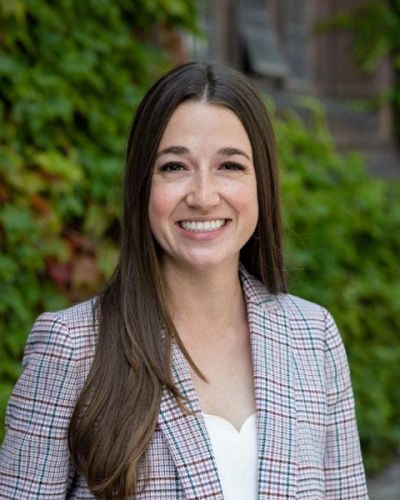
Biography
Bailey Sincox's research spans early modern drama, gender studies, reception and adaptation studies, and the history of the book. At Binghamton, she teaches World Literature I and II as well as courses in medieval and early modern studies.
Her first book project, Getting Even: Gender, Genre, and the Revenge Plot, rethinks early modern stories of justice-seeking beyond Hamlet by centering representations of female characters seeking justice. The book argues that constructions of the revenger’s femininity or masculinity and perceptions of a play’s genre co-constitute one another across plays termed “revenge tragedies” and “domestic tragedies” as well as comedies and romances. Drawing on a parallel archive of recent popular films, Getting Even demonstrates how the female revenge plot, as old as Medea, maintains its perpetual novelty by continually transforming the relationship between sex, gender, and genre.
Her academic writing has appeared in venues including Shakespeare Studies, Shakespeare Survey, Shakespeare, Notes and Queries, The Seventeenth Century Journal, English Literary Renaissance and The Review of English Studies; she has also written academic reviews for Shakespeare Bulletin and Renaissance Quarterly. Beyond the academy, her writing has appeared in The Drift, Harvard Review, The Rambling, The Fence, Public Books and Los Angeles Review of Books. She has recently completed a new introduction to Much Ado About Nothing for the Oxford World's Classics editions of Shakespeare.
Before coming to Binghamton, she was a Perkins-Cotsen Postdoctoral Fellow in the Princeton Society of Fellows. She received her PhD from Harvard University.
Select Publications
- “Much Ado, Anyone But You, and Adapting the ‘Merry War’: An Interview with Ilana Wolpert,” Shakespeare Bulletin 44, no. 2 (forthcoming 2026).
- “Rhodes’s ‘Fair Example:’ Tyranny, Race, and the Orient in The Maid’s Tragedy,” English Literary Renaissance 55, no. 2 (2025), 208-36.
- “Taking Shakespeare in Stride: Lady Macbeth at the American Repertory Theater,” Shakespeare 20, no. 2 special issue “Shakespeare in Action” ed. Eleanor Rycroft and Maria Shmygol (2024), 281-300.
- “The Sexual Politics of Paratexts: John Day’s Gorboduc,” Review of English Studies 74, no. 314 (2023), 222-36.
- “Looking for Perdita in Ali Smith’s Summer,” Shakespeare Survey 75 (2022), 229-39.
- “The Winter’s Tale and Revenge Tragedy,” Shakespeare Studies 47 (2019), 233–60.
Education
- PhD, MA, Harvard University
- MSt, University of Oxford
- BA, Duke University
Research Interests
- 16th- and 17th-century English drama
- Theater studies
- Gender studies
- Reception and adaptation studies
- History of the book
Teaching Interests
- Drama of Shakespeare and his contemporaries
- Classics (in translation)
- Traditions and canons of "world literature"
Honors and Awards
- Folger Shakespeare Library Annual Colloquium Fellowship (2024-25)
- Magic Grant for Innovation, Princeton Humanities Council (2023)
- Shakespeare Association of America Next Generation Plenary (2022)
- Villa I Tatti Graduate Fellowship (2020-21)
- Harvard Horizons Scholar (2020)