Prospective Students

Research for everyone

At Binghamton, we believe scientific research should be for everyone, which is why we developed a program for students who have no experience to those with extensive research backgrounds. From day one, you'll become part of a collaborative community of first-year researchers investigating critical social, environmental, technological, and health challenges to impact people in your community, around the country, and throughout the world.
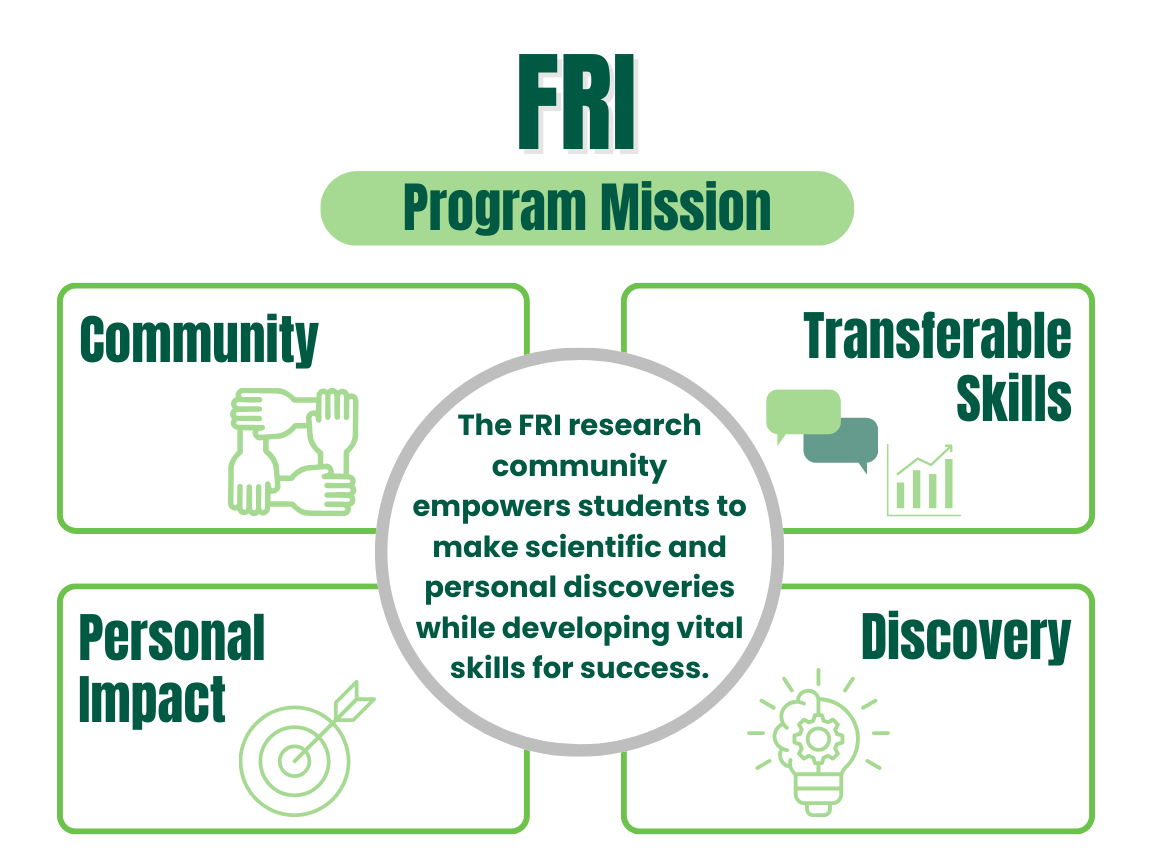
FRI Program Mission infographic with the four quadrants of: Community, Personal Impact, Transferrable Skills, and Discovery. In the middle is the following text: The FRI research community empowers students to make scientific and personal discoveries while developing vital skills for success.

How can FRI impact you?

  • Academic Credit

    In this three-semester program, you will earn 10 credits toward your degree while conducting research. You’ll take a Research Methods seminar (FRI Semester 1) in the fall of the first year, which is followed by two Research Stream courses (FRI Semester 2 & 3) on the concepts and theory related to a discipline. In the Research Stream courses, you will learn research techniques, acquire background on a research question, and follow through on the initial phases of a research problem. Your FRI courses count for multiple general-education, major and minor requirements. 

  • Community

    In a small cohort size, you’ll become part of a close-knit community where friendships forge long-term bonds through shared exploration, making your first year both socially engaging and academically meaningful.

  • Collaboration

    In research teams of 5-7 students, you’ll collaborate with like-minded students who share your interests in a research topic and work with other experts in the field, such as faculty members, international scholars, and community members.

  • Mentorship

    Guided by a strong culture of mentoring, you will experience supportive relationships from prior FRI students and a research educator to guide you in your research. In addition, the FRI team will provide you with personal and professional advice on a range of topics, including course selection, research opportunities, career development, and extracurricular activities.

  • Research Skills

    With research-grade equipment and software, you’ll learn cutting-edge methods and techniques used in numerous disciplines.

  • Career Skills

    With our tailored curriculum to help you achieve your career goals, you'll develop key skills such as critical thinking, oral and written communication, and project management through a research experience.

  • Discovery

    With countless local, national, and global problems to solve, you’ll work on interdisciplinary research teams to tackle social, environmental, technological, and health challenges and then disseminate findings among professionals to fuel innovation.

  • Personal Impact

    With our transformative experiential approach to personalized learning, you’ll take ownership of your research experience and develop growth mindsets that lead to more reflective, resilient, confident, and independent scholarship. Your FRI experience will clarify self-direction and catalyze your future success.

  • Networking

    By building connections with Binghamton University professors, administrators, and staff members, you’ll find new opportunities, other research labs, related student groups, and other resources. Your FRI experience will lay the foundation for requesting valuable letters of recommendation, which are often required for scholarships, internships and graduate school applications.

How does FRI work?

This video gives you an overview of how the FRI program works, highlighting the program's courses, research streams, and enrollment process.

What do FRI students think of FRI? 

In this video, four previous FRI students share their experiences and answer commonly asked questions.

Research Streams

Whether you’re interested in genes, molecules, cells, circuits, physiology, behavior, ecology or technology, we have a research stream for you: biogeochemistry, biomedical chemistry, clean energy, ecological genetics, environmental visualization, image and acoustic signals analysis, microbial films in human health, molecular and biomedical anthropology, and public health.

LEARN ABOUT EACH STREAM

How do you enroll?

The First-year Research Immersion program is by invitation only.

Invited Prospective Students

Interested Incoming Students

  • Step 1: Learn about FRI!
    • Explore our Research Streams
    • Register and attend an FRI Webinar
    • Join us at Fall Open House
    • Attend Spring Admitted Students Day
    • Schedule a tour with Admissions
    • Schedule a 1-on-1 tour: This is an opportunity to talk with current FRI students and faculty, tour FRI labs to see students conduct novel research in real-time, and discover why FRI is the right fit for you!
    • Follow us on social media:

Frequently Asked Questions

Program Basics

  • Who can participate in the program?

    New first-year students can participate in FRI. Students are invited via e-mail to the program through the Office of Undergraduate Admissions.

    If you missed this first-year experience, consider applying for the FRI summer programs.

  • Who is chosen for the program?

    Admissions will invite a diverse population of incoming Harpur and Watson students who indicated interest in the STEM fields, and those students who are undecided. Students are chosen for having high academic merit and a possible interest in research.

  • Are all parts of the program mandatory?

    If you accept your offer, you agree to commit to all parts of the program and to complete the three-semester sequence.

  • I really want to participate in the program but I was notified that the slots are full. Is there any chance I can still be a part of the program?

    A waiting list will be kept according to research stream interest. If spots become available, interested students will be notified. There are other research opportunities available to students on campus. The Undergraduate Research Center is a great resource for students who want to get involved in research. In addition, the FRI summer programs are 5- and 10-week parallel programs available in the summer. Each summer 2-3 of the FRI research streams are available.

  • I have no previous experience with research. Will I be at a disadvantage in comparison to the other students?

    FRI has been designed for students with little to no research experience. It is a step-by-step program that allows students to progress at a rate that makes sense given different backgrounds and experience. Students will be provided with constant feedback and guidance to help them develop their research skills. Thus, previous research experience is not necessary or expected. 

  • If I am interested in pre-health, which research stream should I choose?

    Currently, we have seven research streams that would align well with pre-health:

    • Biomedical chemistry 
    • Drug Discovery (pharmaceutical sciences, biochemistry)
    • Ecological Genetics
    • Microbial biofilms in human health (microbiology)
    • Molecular & biomedical anthropology
    • Neuroscience 
    • Public Health
    • Also, some of the research in Image-&-Acoustic-Signals-Analysis addresses health issues, such as better ways of monitoring pain, via pain recognition in people's faces.

Structure of FRI Courses

  • Does the program follow a regular grading system?

    Yes, students are taking courses for the FRI program, and they receive letter grades for those courses. The course grades are based on engagement in the research process, scientific communication, contribution to team research projects, and other assignments.

  • How are the FRI courses structured? 

    In the research methods seminar, there will be two hours of class weekly. In addition, students will participate in team meetings with their instructor and/or peer mentor. The laboratory portion of the program (second and third semesters) is run as an authentic research lab. You will mentored by faculty and peer mentors throughout. If a student wants additional help, the student can and should ask the professor or a peer mentor for assistance. In addition, the FRI program monitors the progress of all students, leading to check-ins with individual students about their progress.

Research Streams

  • Do the students in each stream work individually or in teams?

    For the research conducted, students will work in teams. We have students work interdependently because developing teamwork and collaborative skills are so important in all career pathways. Each student team will work on a research question that is related to the overall objective of the research stream for that year.

  • Is it possible to switch my Research Stream?

    If slots become available in the stream you are interested in during your first semester, you may be able to switch streams. You should not count on this option as research streams are usually full. FRI is more about the research experience than the research topic. Once you complete the program, you can pursue research opportunities outside of that field.

  • When do I find out which Research Stream I am accepted into?

    Students are assigned to a Research Stream after the Binghamton University deposit deadline (May 1st). Students should expect to receive a stream assignment email in June.

Research Outside the Program

Open House and Registration

  • How do I register for FRI courses?

    You will be automatically pre-registered for your FRI Semester 1 course (HARP 170, Research Methods) before summer orientation. During orientation, confirm that you are enrolled in the appropriate section for the particular research stream to which you have been assigned.

    For the second and third semester FRI courses, you will be informed about what to register for and when.

  • What information can I get about FRI at Binghamton's Open House?

    FRI students and faculty should be available to answer any questions you may have. At each Open House the FRI program hosts an information session and provides tours of research labs.  Visit our sessions to get a closer look at the science buildings, hear personal stories and inquire about what research at Binghamton entails.

Scholarships/Fees

  • Do I get scholarship money for participating?

    No. There is no monetary award for the program. 

  • Are there any fees associated with this program?

    Yes. You will be charged an additional $38.50 in course fees for the FRI Semester 1 research methods course. You will also be charged an additional $150 in lab fees for both the FRI Semester 2 and 3 courses, totaling $300 during the FRI experience. Research-grade equipment and supplies are expensive. The laboratory fee subsidizes the cost of the research-grade supplies and the need for students to be able to repeat procedures as they learn protocols and design and run experiments.