The human toll: Binghamton to host Hostile Terrain 94 Exhibit
More than 3,200 people have met their end in Arizona deserts since 1994, their bodies scattered in the arid borderlands, their final destinations never reached.
Causes of death vary — exposure, dehydration, hypothermia, violence — but they share one factor in common: The United States’ policy of Prevention Through Deterrence (PTD, which channels undocumented border-crossers away from populated areas into hostile terrain.
This fall, Binghamton University will host Hostile Terrain 94 (HT94), a participatory art project that raises awareness of this humanitarian crisis. HT94 was developed by the Undocumented Migration Project (UMP), a non-profit research-art-education-media collective directed by UCLA anthropologist Jason De León.
Distinguished Professor of Anthropology Randall McGuire hopes that the exhibit gives the campus community insight into the real human cost of U.S. border policy.
“These barriers force migrants out into the desert where they are in peril of death. They also increase the chance of injury and death as migrants attempt to climb over them or tunnel under them,” he said.
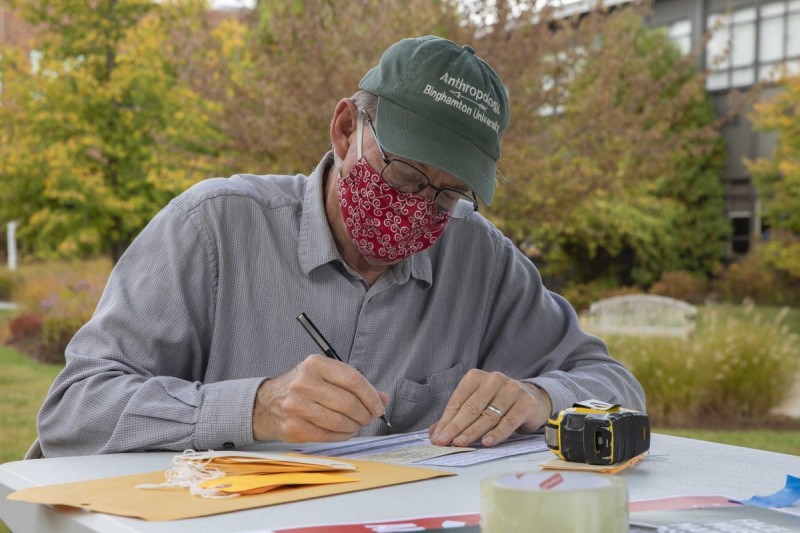
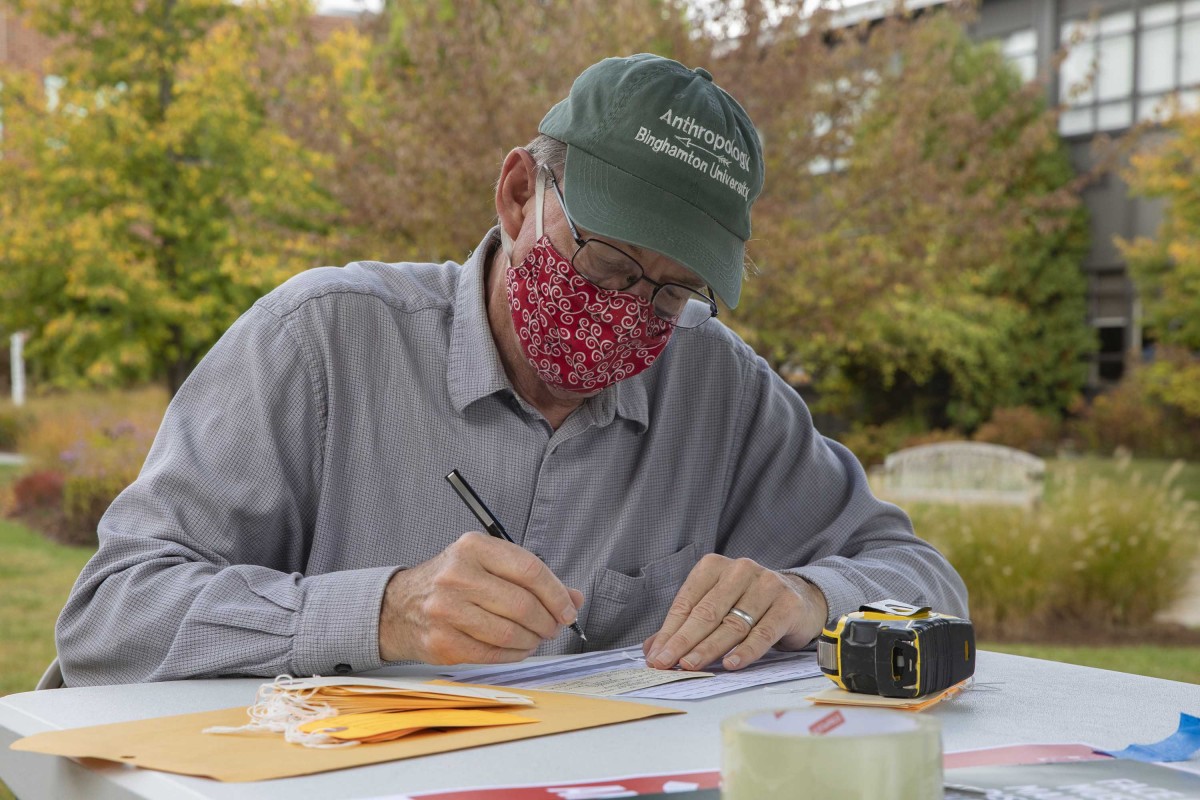
Mounted simultaneously at more than 150 national and global institutions, the HT94 interactive exhibit invites volunteers to write the names of deceased migrants, along with their age, sex, cause of death, condition of their body and location of their recovery, on color-coded toe tags. Yellow tags represent people whose remains have been identified, while orange tags symbolize nearly 1,000 unidentified individuals. These tags are then geo-located and pinned to a wall map of the desert showing the exact locations where remains were found. On the completed map, the mass of 3,200 colored tags illustrates the severity of the crisis.
Students can fill out the toe tags between 10 a.m. and 6 p.m. Sept. 28, 29, and 30 in the Fine Arts Memorial Courtyard. For assistance with filling out the tags, contact Cinthia Campos at campos5@binghamton.edu.
The exhibit will open in the Grand Corridor of the Fine Arts building Oct. 1, and will run through Oct. 17. An online panel discussion will be held on Zoom from 5 to 7 p.m. Oct. 1. The exhibit will move to the University Downtown Center Oct. 19, where it will be on display through the end of the semester.
The exhibit is made possible with funding from the Material and Visual Worlds Transdisciplinary Area of Excellence.
Additional sponsors include the Anthropology Graduate Student Organization, the Binghamton University Art Museum, Binghamton University Libraries, the Center for Civic Engagement, the Department of Art & Design, the Department of Anthropology, the Department of Classical and Near Eastern Studies, the Department of History, the Department of Romance Languages, the Human Rights Institute, the Institute for Advanced Studies in the Humanities, the Institute for Genocide and Mass Atrocity Prevention, the Latin American and Caribbean Studies Program, and the Latin American Student Union. HT94 Downtown will be sponsored by the Binghamton University Libraries, the Broome County Council of Churches, Broome County Peace Action, Veterans for Peace, Citizen Action of New York and the Binghamton-El Charcón Sister City Project.
‘The wall’ and COVID
While border walls have received renewed attention from the Trump administration, the United States began constructing the walls in 1994 as part of the PTD policy. President Donald Trump’s border wall is a piecemeal addition to the existing 650 miles of vertical barriers along the border, which include 299 miles of vehicle barriers and 350 miles of pedestrian walls and fencing; the U.S. border is just under 2,000 miles, McGuire explained.
Academic researchers studying the walls — including McGuire and Anthropology Professor Ruth Van Dyke — have shown that they are ineffective in reducing the number of crossings or the movement of contraband. Most undocumented migrants in the United States don’t cross the desert, but overstay visas.
The only clear and proven impact of the walls is to increase deaths and injuries,” McGuire said.
The exhibit’s 3,200 figure comes from the known deaths in southern Arizona between 1994 and 2019, while U.S. border patrol reports more than 7,000 on the entire border during that same time span. But the true cost in lives is difficult to know because some bodies are never found or recovered, McGuire pointed out. Conservative estimates by the group Border Angels number the total dead around 10,000 during that 21-year span, but that’s likely a low estimate.
Crossing the U.S. border outside of a designated port of entry is a civil misdemeanor, with penalties ranging from fines to a maximum of six months in prison; repeated convictions rise to felony level.
Walls, fences and border security cannot unravel the complex knot of problems related to migration, and all too often become a device to advance political careers and demonize desperate people, McGuire said. Migrants are prompted to make a dangerous trek due to factors such as violence, the impact of climate change, economic deprivation and gangs.
Fewer people have been crossing the desert in recent years, instead turning themselves into border agents and claiming asylum. The coronavirus may change that trend.
Asylum-seekers are now sent back to Mexico to await hearings, where many live in crowded camps afflicted by the virus. Recently, the United States has deported more detainees over virus concerns as well.
“A consequence of these actions has been a dramatic increase in the numbers of people crossing the desert both to escape COVID in the migrant camps and because they lose hope that their asylum cases will be heard,” McGuire said.