Stanley Whittingham: Pioneer of Lithium-Ion Battery Technology
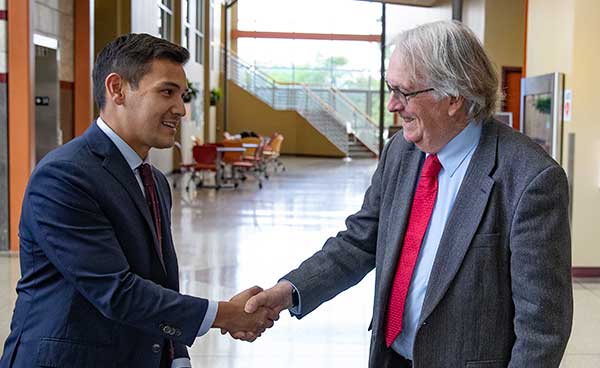
M. Stanley Whittingham, SUNY distinguished professor at Binghamton University, pioneered the development of lithium-ion batteries, which power many of the devices we rely on every day, from cell phones to cars.
Whittingham, who shared the 2019 Nobel Prize in Chemistry with John B. Goodenough and Akira Yoshino, holds the original patent on the use of intercalation chemistry in high-power density, highly reversible lithium batteries.
Whittingham’s work has inspired major initiatives led by Binghamton University that aim to establish upstate New York as a national hub for battery technology innovation. The campus is home to the National Science Foundation Energy Storage Engine in Upstate New York as well as New Energy New York, which earned the U.S. Economic Development Administration Build Back Better Regional Challenge award and designation as a federal Battery Tech Hub.
Stanley Whittingham's Legacy in Materials Science and Engineering
Whittingham was instrumental in establishing Binghamton’s Materials Science and Engineering Program, an interdisciplinary effort that brings together chemistry, physics, and engineering. An annual Stanford University study that looks at the impact of scientists worldwide regularly counts him among the top 2% of all researchers.
A Fellow of the American Association for the Advancement of Science, Whittingham is also a member of the National Academy of Engineering and a Fellow of the Royal Society, the oldest scientific academy in continuous existence.
Whittingham, who grew up in Britain, was named a Knight Bachelor for his services to research in chemistry in 2024. The recognition, announced as part of King Charles III’s birthday honors list, entitles him to be known as Sir Stanley, or Sir Stanley Whittingham.
Latest Headlines
- Q&A with Binghamton’s Nobel Laureate professor May 13, 2026
- Nobel laureate elected AAAS Fellow March 26, 2026
- Binghamton researchers among top 2% of scientists Oct. 9, 2025
- Nobel Prize winner knighted by King Charles June 20, 2024
- Whittingham wins VinFuture Grand Prize Jan. 2, 2024
- Whittingham attends State of the Union address Feb. 7, 2023
- Nobel Prize winner named Fellow of the Royal Society May 19, 2021
- Binghamton professor elected to National Academy of Engineering Feb. 8, 2018
- Whittingham named to “Great Immigrants, Great Americans” list July 1, 2020
Nobel Prize Coverage
- Binghamton University professor wins Nobel Prize in Chemistry Oct. 9, 2019 Campus congratulates Nobel Prize winner Oct. 10, 2019
- Campus and community fete Nobel laureate Oct. 19, 2019
- Binghamton University celebrates Nobel Prize winner Dec. 10, 2019
- The Nobel journey of M. Stanley Whittingham May 6, 2020
- Text of Whittingham's speech at the Nobel Banquet in Stockholm May 6, 2020
- Binghamton University celebrates fifth anniversary of Nobel Laureate Dec. 10, 2024
Battery Ecosystem Headlines
- NSF Energy Storage Engine enters second phase with ambitious plans, March 23, 2026:
- Binghamton marks official launch of federally funded battery initiative, June 27, 2024
- Binghamton battery project named one of 10 NSF Innovation Engines, Jan. 29, 2024
- Battery initiative wins $113M to bolster domestic battery manufacturing, reinvigorate region, Sept. 2, 2022
- Binghamton battery project wins $500,000; will compete for $100M, Dec. 16, 2021